

ObjectiveBody dysmorphic disorder (BDD) is a prevalent concern among young adults. However, the underlying mechanisms of BDD development remain elusive. This study aims to investigate the intricate relationship between attachment styles and BDD symptoms, with appearance-based rejection sensitivity (ARS) as a mediating factor and gender as a moderator.MethodsA total of 815 young adults participated, completing a battery of questionnaires including the Revised Adult Attachment Scale (RAAS), Appearance-Based Rejection Sensitivity Scale (ARSS), and Scale of Body Image (SBI).ResultsData indicated a positive association between attachment anxiety and BDD symptoms, with ARS found to mediate this link. Furthermore, gender differences were observed to moderate the relationship between ARS and BDD symptoms.ConclusionThis study sheds light on the foundational mechanisms of BDD, tracing its origins to early caregiver-infant bonds and highlighting the enduring impact of ambivalent care on body image perceptions. Additionally, the identification of ARS as a specific contributing factor to BDD onset underscores its significance in understanding and addressing this disorder. By considering the influence of social norms and cultural context, gender differences in the association between ARS and BDD symptoms are elucidated.
Developing forensic patient-oriented research guidelines: a rapid review using an integrated knowledge translation approach
This paper reports findings from a rapid literature review that informed new guidelines for conducting patient-oriented research in forensic mental health settings. The project adopted an integrated knowledge translation approach at a mental health hospital in Ontario, Canada, engaging a project team that included current forensic patients, hospital staff, and members of an international community of practice. Sources were identified through nine academic databases and targeted grey literature searches, screened independently by two reviewers and extracted using a structured template guided by an a priori framework developed with patients and staff at a knowledge exchange event. Findings were iteratively refined through a patient advisory group, an implementation study, ethnographic observations, and related integrated knowledge translation activities conducted alongside the review. Together, 31 academic and grey literature sources informed a framework organized around five core dimensions: 1) Resourcing, orientation, and training; 2) Confidentiality, consent, and compensation; 3) Relationships, shared understanding, and support; 4) Levels of engagement; and 5) Evaluation and sustainability. Guided by cross-cutting principles common among participatory mental health research, such as dignity, trust, respect, and a commitment to redressing power and attending to forms of epistemic injustice, the guidelines respond to distinctive constraints of forensic environments while highlighting opportunities to promote authentic co-production and sustain patient involvement in research. Recommendations include dedicated resources and capacity-building for patients; relational, ongoing consent practices co-developed with patients; flexible patient researcher roles with fair, paid compensation; and sustained institutional support for participatory practices. We call on forensic hospitals and secure settings to adapt and evaluate these guidelines and to invest in expanding patient leadership to advance the field.
High Intensity Training for Adults With ADHD in Specialised Mental Health Care
Conditions: Attention Deficit Disorder With Hyperactivity (ADHD)
Interventions: Behavioral: High intensity training
Sponsors: Solli Distriktspsykiatriske Senter; Helse Bergen Hospital Trust
Enrolling by invitation
Interventions: Behavioral: High intensity training
Sponsors: Solli Distriktspsykiatriske Senter; Helse Bergen Hospital Trust
Enrolling by invitation
When OCD Is Loud, Trust Your Higher Power
by Annabella Hagen, LCSW
When I met Marie, she shared how faith and her connection with a Higher Power had always been important in her life. Her parents taught her that faith could be an anchor during hard times.
But Marie also had a genetic predisposition to obsessive compulsive disorder (OCD). When doubts and fears began to take over, she slowly lost confidence that she could ever feel peace again. Without knowing it, the more she tried to reason with the thoughts, fight them, or seek reassurance, the stronger they became.
Her OCD changed themes as she grew up. The voice within whispered different fears at different times:
“You may hurt the kids you’re babysitting.”
“You caused your granny’s pneumonia because you didn’t wash your hands well enough.”
“Am I going blind?”
“Why do these ugly images come into my head in sacred places? I must stop them.”
She tried to “fix” her doubts. But the more she focused on them, the more they grew. They distracted her from what mattered most — including her relationship with her Higher Power. She blamed herself for not feeling close to God. She felt ashamed and spiritually broken.
Many people with OCD blame themselves for their unwanted thoughts. They panic.
“Why would I think this?”
“What does this say about me?”
“Am I a terrible person?”
No matter what Marie did, she could not find certainty. She could not get enough reassurance. She wished she could control her thoughts and feelings. Because she couldn’t, she became very hard on herself. Her self-compassion slowly disappeared.
But here is something important: every human being — whether they have OCD or not — experiences disturbing thoughts, images, or impulses at times. Research going back decades, including studies like Rachman and de Silva (1978), shows that intrusive thoughts are common in the general population.
The difference is not the content of the thoughts. The difference is how often they come, how intense they feel, and how much distress they cause.
When someone without OCD has a strange thought, they may feel uncomfortable and say, “That was weird,” and move on.
But someone with OCD feels a strong need to solve the doubt. They may analyze it, argue with it, pray repeatedly, seek reassurance, or try to push it away. Without realizing it, these efforts make the thoughts louder and more frequent. This is how the OCD cycle grows.
Understanding this can bring hope. It means the problem is not your faith. It is the pattern.
And the good news is that OCD is not only genetic or neurological. It is also behavioral. That means you can learn to respond differently!
Thoughts and feelings are like the weather. They come and go. When we fight them or try to control them, they often stay longer.
You can learn to let them be.
Through Exposure and Response Prevention (ERP), you can practice moving toward what matters most — your faith, your family, your values — even when doubt is present. Instead of trying to silence the thoughts, you can choose not to follow the urge to fix them.
The first step is awareness.
You may already notice the unwanted thoughts. But can you notice how you respond?
Ask yourself gently:
- Do I try to get rid of emotional pain right away?
- Do I avoid situations because they trigger anxiety and doubts?
- When I feel an urge, do I automatically act on it?
- Can I see that thoughts are just thoughts, not facts?
These small moments of awareness begin to weaken the cycle.
As you practice new responses, you can begin shaping new pathways in your brain. Slowly, you can move closer to the connection with your Higher Power that you have been longing for.
Thoughts come and go. What matters most is what you choose to do.
You can act in faith and trust your Higher Power, even when the OCD voice is loud. That voice feels powerful, but it is not your identity. It does not define your relationship with God.
Change takes time. It takes practice. But it is possible. And it is worth it!
And you can find your way back!
Remember, OCD may try to use your faith as a weapon, your faith is not the problem—the disorder is. OCD is a health condition that seeks certainty where faith invites trust.
If you find yourself in a cycle of “loud” thoughts and repetitive compulsions—like over-praying, seeking constant reassurance, or fearing you’ve lost your connection to the divine—know that healing is possible.
To help more individuals like Marie navigate these challenges, the International OCD Foundation has released a comprehensive new brochure specifically for people of faith.
Download the “OCD is Not What You Think It Is” Brochure here or visit the Faith & OCD Resource Page to find more specialized support and information.
The post When OCD Is Loud, Trust Your Higher Power appeared first on International OCD Foundation.
Effects of Transcranial Magnetic Stimulation on Social Cognition, Cognitive Processing, and Functional Brain Architecture
Conditions: Psychopathy
Interventions: Device: continuous theta burst stimulation (cTBS); Device: Intermittent theta burst stimulation (iTBS); Device: Sham
Sponsors: University of Colorado, Denver; National Institute of Mental Health (NIMH)
Not yet recruiting
Interventions: Device: continuous theta burst stimulation (cTBS); Device: Intermittent theta burst stimulation (iTBS); Device: Sham
Sponsors: University of Colorado, Denver; National Institute of Mental Health (NIMH)
Not yet recruiting
Detection of Self-Harm in Electronic Mental Health Records Using Privacy-Preserving Local Language Models: Methodological Study
Background: Self-harm is the strongest risk factor for suicide and an important outcome for mental health care. Although prevalent in clinical populations, it is often imprecisely captured in routinely collected clinical data, where it is often recorded and stored as unstructured free text. Contemporary language models, such as GPT (OpenAI) and Gemini (Google), can analyze free-text clinical notes, but such models may violate data governance of processing sensitive patient data. Objective: This study aimed to evaluate whether a privacy-preserving language model running entirely within an institution’s secure computing infrastructure (here, the UK National Health Service [NHS]) could accurately identify the presence and timing of self-harm using electronic health records from secondary mental health care. Methods: Clinical notes were drawn from Oxford Health NHS Foundation Trust using a multistage workflow: (1) a random sample of 1000 patients with a psychiatric diagnosis, defined according to the (; codes F00–F99); (2) candidate-note identification using a Gemma3-4b language model to flag notes containing self-harm content; and (3) from those candidates, 1352 randomly sampled notes were selected for expert annotation, resulting in gold-standard corpus enriched for self-harm content. Clinical notes were annotated for the presence of self-harm and its timing (≤90 days, >90 days, or unknown). A privacy-preserving locally served 27-billion-parameter Gemma 3 language model (“Gemma3-27b”) was used as the core model. Prompts were systematically developed and refined using a labeled development set to identify self-harm and generate a structured output per clinical record. Gemma3-27b performance was compared against a strong baseline multilabel text classification model based on robustly optimized BERT pretraining approach (RoBERTa), a transformer-based language model architecture. Model performance was evaluated using precision, recall, and the -score (harmonic mean of precision and recall), with 95% CIs estimated from 1000 bootstrap samples with replacement. Results: Gemma3-27b outperformed the RoBERTa classifier across all categories, achieving Precision=0.92, Recall=0.92 (sensitivity), and -score=0.92 for notes containing self-harm, and Precision=0.97, Recall=0.97 (specificity), and -score=0.97 for notes without self-harm. For the 51 notes labeled as recent self-harm in the held-out test set, Gemma3-27b achieved Precision=0.84, Recall=0.75, and -score=0.79. The global weighted -score of Gemma3-27b across all categories was 0.88, compared to 0.85 for RoBERTa. Conclusions: With systematic prompt development on a labeled development set, but no gradient-based fine-tuning, the current Gemma3-27b language model matched or exceeded a fine-tuned RoBERTa classifier for ascertaining self-harm events and their timing. Aggregate gains were modest, while improvements were largest in the most challenging, lower-frequency timing categories. On a simplified binary recent-versus-other task, RoBERTa performed marginally better, indicating that supervised classifiers remain highly effective when the task is simplified and sufficient labeled data exist. This work demonstrates the technical feasibility of privacy-preserving self-harm detection within a secure NHS research environment.

Factors Influencing the Initiation and Continued Engagement of Digital Mental Health Tools Among Adults: Theory of Planned Behavior–Informed Systematic Review
Background: Digital mental health tools (DMHTs) offer scalable support, but engagement varies. Understanding the shapes of initiation and ongoing use is essential for effective design and implementation. Objective: This study aims to synthesize determinants of adults’ initiation and engagement with DMHTs, organized through two lenses: (1) psychological factors aligned with the theory of planned behavior (TPB) and (2) design and access features. Methods: A systematic search of 9 databases (June 2025) identified qualitative and mixed methods primary studies reporting end-users’ experiences with DMHTs. Studies were screened and reported in accordance with the PRISMA (Preferred Reporting Items for Systematic Reviews and Meta-Analyses) guidelines. Quality appraisal used quality assessment with diverse studies (QuADS). Data were synthesized using a framework-guided thematic approach, mapping findings to TPB constructs and complementary design and access domains. Results: A total of 22 studies met inclusion criteria. Findings clustered into 2 interdependent domains. TPB constructs explained how beliefs, social expectations, and perceived control shaped decisions to start and persist with DMHTs. Design and access features frequently acted through these same pathways, especially by altering perceived behavioral control (PBC), with cost, connectivity, device constraints, and time flexibility affecting feasibility, with content design and privacy shaping perceived value and trust. Perceived fit (goals, cultural or linguistic relevance, and routine alignment) consistently influenced both initiation and continuation. Several features operated bidirectionally; depending on context, the same feature could facilitate or hinder engagement. Conclusions: Engagement with DMHTs is jointly determined by users’ beliefs and the design and access conditions within which tools are offered. Implementation should pursue a dual strategy, strengthening willingness to seek support (addressing attitudes, norms, and perceived control) while engineering low-effort, trustworthy, and context-appropriate experiences. Priorities include equity-focused policies (data costs, devices, and connectivity), transparent data practices, co-design with diverse communities, and consistent, theory-informed outcome measures.
<img src="https://jmir-production.s3.us-east-2.amazonaws.com/thumbs/87f0720b5833047d5135a207e6576970" />
Context-dependent interaction between oxytocin gene polymorphisms and alcohol dependence in modulating negative emotions during acute alcohol withdrawal in adult males
ObjectiveThe importance of multiple gene-environment interaction (G × E) has been highlighted in understanding the etiology of negative emotions. This study examines the impact of oxytocin (OXT) polymorphisms (rs2740210, rs6133010, and rs2740209) in combination with alcohol dependence on anxiety and depression symptoms during acute alcohol withdrawal under different social and environmental contexts.MethodA total of 414 Chinese Han male adults undergoing acute alcohol withdrawal were recruited. Participants provided blood samples for genotyping, self-reported measures of depression and anxiety, assessments of alcohol dependence severity, and demographic information regarding social and environmental contexts.ResultsResults revealed a positive correlation between severity of alcohol dependence and symptoms of depression and anxiety, while oxytocin polymorphism did not have a direct effect on depressive and anxiety symptoms. A significant interaction between OXT polymorphism (rs2740210 and rs2740209) and alcohol dependence in relation to anxiety symptoms solely among adults living with family and/or those who were married was observed. Further analyses indicate that the GG and CC genotypes are risk genotypes, while the T allele (rs2740210) and G allele (rs2740209) are non-risk alleles in the interaction between OXT genotypes (rs2740210, rs2740209) and alcohol dependence on anxiety among the aforementioned participants.ConclusionsThese findings provide evidence for distinct G × E interaction effects on anxiety and depression symptoms during acute alcohol withdrawal, supporting the weak diathesis-stress model. Furthermore, the study highlights the importance of considering environmental factors when investigating the role of oxytocin as a biological substrate underlying social bonding and the regulation of negative emotions.
AI in Healthcare: Symposium Insights
For years, artificial intelligence (AI) has been growing behind the scenes of our lives. Starting off as modifications of not‑so‑simple algorithms, early large language models could barely string a few words together, much like early vision systems that struggled to distinguish a lamppost from a cat in digital images. More recently AI has not just grown but proliferated—like Darwin’s finches in the Galapagos—into nearly every niche available in the digital world.
AI has infiltrated into daily life personally and professionally for many, and while modern healthcare has historically been hesitant to adapt to new technologies, Raghav Mani, director of Digital Health at Nvidia, pointed out that healthcare is adopting AI at three times the rate of other industries. Clearly, there is a lot to discuss, which is why The New York Academy of Sciences and the Windreich Department of Artificial Intelligence and Human Health at the Icahn School of Medicine at Mount Sinai co-hosted the 3rd annual “New Wave of AI in Healthcare,” a two-day symposium on May 12 and 13 with the goal of opening discourse between researchers, clinicians, industry leaders and other interested parties on all topics related to AI and healthcare.
Day one
The first day opened with a lightning round of welcome remarks from organizers expressing their personal experience with AI in healthcare research and practice. While some, like Nicholas Dirks, PhD, president and CEO of The New York Academy of Sciences shared concerns about how to maintain human involvement in AI use, he also expressed awe stating that “The pace of progress is breathtaking.”
Others were more practical in their assessments. Lisa Stump, chief digital information officer at Mount Sinai Health System asserted, “The future is not something we enter, it’s something we create.” Similarly, Brendan G. Carr, MD, CEO, Mount Sinai Health System, described AI as a “new partner” to aid clinicians in synthesizing the vast and growing clinical data. Girish N. Nadkarni, MD, a nephrologist and practicing clinician at Icahn School of Medicine at Mount Sinai summarized the whole event before the first talk even began: “The real question is not IF AI will transform healthcare, but HOW.”
The keynote presentation leading day one’s discussions endeavored to answer that very question. With his talk entitled, “Harnessing the power of Platform Thinking to Transform Healthcare,” John Halamka, MD, president of the Mayo Clinic Platform, spent 30 minutes exploring the power of data while questioning how AI is and should be used to analyze the varied data currently available, but cautioned that this is no simple task when considering the sources of data and potential restrictions on data use. He spoke about practical applications of AI data analysis that have and can be done, including in drug discovery. He also pointed out that AI can fill gaps in the healthcare workforce.
The day continued with four talks exploring different aspects of AI model use in healthcare. Marina Sirota, PhD, professor at the University of California, San Francisco spoke about how clinical data can be used for predictive medicine. Others, including Mani and Jonathan Carlson, PhD, vice president and managing director of Microsoft Heath Futures, discussed how AI agents and models can be used as part of hospital and clinician toolkits at multiple levels—not just as data analysis engines, but also to aid in synthesizing patient data and diagnostic support. Rounding out the discussion, Azra Bihorac, MD, senior associate dean for research at the University of Florida described how AI models need to be validated just like any other tool. She also pointed out that while AI is continuously improving in its ability to assess problems and suggest the next best course of action, human input is vital for collaborative success.

The final talks for day one focused on how AI can be used directly with patient care situations. Following their individual talks on how AI can be integrated into electronic health records (EHR), combining models to develop new insights, or reimagining diagnosis ability to improve diagnostic equity, the final three speakers engaged in a dynamic, and sometimes heated panel discussion. Karen Wong, MD, a physician at Epic, Alexander Fedotov, PhD, director of AI digital precision health at AstraZeneca and Pierre Elias, MD, assistant professor at Columbia University Irving Medical Center each shared their thoughts on how AI will be used in the near future. While they were all in agreement that AI cannot replace clinicians, they also recognized that AI will be a disruptive force, but it’s up to clinicians to take responsibility to use the technology as appropriate but to rely on their intuition and judgement as trained professionals. When opining on the future of AI use in healthcare five years from now, Fedotov stated, “I would still want to see humans at the helm of all the decision maker processes.”
Day two
While the first day laid the foundations for AI use in healthcare spanning bench to bedside, the second day of the symposium included more discussion and criticism of AI on the logistic level.

The day began with a keynote fireside chat between Nadkarni and Dave A. Chokshi, MD, a physician and professor at City University of New York, and former NYC health commissioner. He spoke about his leadership experiences, sharing many anecdotes of his time as a public health advocate and communicator during the COVID-19 pandemic. When questioned on the importance of communication considering the state of healthcare and declining trust of the public—especially with the increased use of AI, which has the potential of adding layers of feelings of abandonment, surveillance, and impersonalization—Chokshi pointed out that “It makes relationships even more important that we know then are.” He stressed that a his job, as a clinician, is to build trust with patients, and make sure that they return for care. While he envisions AI being transformative to healthcare in the next few years, he cautioned that listening and integrating feedback from front line users, clinical staff and patients, will be vital.
The morning continued with talks exploring AI’s use in research and learning in healthcare. Joshua C. Denny, MD, CEO of NIH All of Us Research, delivered a detailed summary of the progress and of the All of Us project. Despite recent funding concerns and cuts, the project scope remains on track, and researchers world-wide are utilizing the data derived from this project and how the project leads are working to establish parameters and modules for researchers to more easily implement AI in their data analysis. Andrew Gruen, PhD, standards lead at MLCommons, then spoke animatedly about the importance of establishing standards and benchmarks for AI use in researcher and healthcare settings. He spoke candidly on the need to not just train AI but to have external evaluation and validation of AI models.
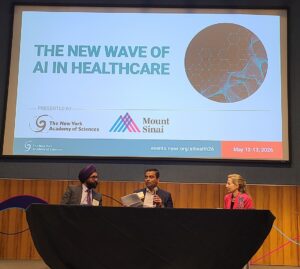
The symposium concluded with multiple discussions on the interactions between AI and humans—not just as a tool, but by viewing the use of AI in the broader scale. Karandeep Singh, MD, executive director for health innovation at the University of California, San Diego explored various opinions of clincians and patients on the use of AI, while pointing out that the use of AI in healthcare settings should be thoughtfully considered before implantation. Meanwhile, Vardit Ravitsky, PhD, president and CEO of The Hastings Center for Bioethics, discussed the ethics behind AI use as a direct to patient setting, specifically as a patient-used chatbot. In a debate following their respective talks, the two delved deeply into the risks associated with AI use, both on the patient side with chatbots and with scribe technologies used by clinicians and patients. They often agreed on the need for transparency in AI usage, but specific AI applications, like uses of AI robots in the home to combat loneliness in the elderly resulted in disagreements.
The final talk presented by Tanzeem Choudhury, PhD, chief of health innovation at Cornell Tech, brought many previously discussed topics together. Her research explores how AI can be used in treatment of mental health, describing how AI can be used in multiple aspects of mental health therapy from recording physiological symptoms with wearables to using chatbots for various functions. She cautioned that while these tools may eventually be transformative, the current state of AI use in mental health is still growing.
The closing remarks by Alexander Charney, MD, PhD, professor at Icahn School of Medicine at Mount Sinai summarized the event well. He shared that throughout the symposium he imagined what clinicians and researchers from 100 years ago and from 100 years in the future would think about the current state of healthcare and about the challenges being faced now with how to incorporate AI. He said, “We aren’t the first group of human beings to deal with powerful technology and figuring out how we’re going to use it to change society.” He hopes that the people from the past would see that we understand and respect the past and learn from it being rigorous in our research and testing, while the people from the future will look on us with pride at our fearless and tenacity in the face of new technology. He hopes that both groups would see that we “tried to do the right thing.” He ended saying that he does see all of that here along with passion and coming together of everyone at the meeting.
The post AI in Healthcare: Symposium Insights appeared first on Inside Precision Medicine.
I’m scared of everything — what does it mean and how do I get over it?
What you’re describing sounds really overwhelming. I’m glad you reached out. The fears you mention — being scared of doing something against your will, worrying you might not have control, and feeling intensely concerned about being judged — are patterns I often see in people with anxiety and, sometimes, people with obsessive-compulsive disorder (OCD). A hallmark of OCD is a deep doubt about control: the fear that you might act in a way that goes against your values, even though you don’t want to. These kinds of fears are called intrusive thoughts. While intrusive thoughts can feel very real and frightening, they are not things you actually intend to do or predictions of things that you will do — they’re unwanted experiences that don’t define you.
Avoiding sports and other things for fear of being judged is also a symptom of anxiety. I can understand how hard it is to tell your family what you’re going through, especially if you have felt ignored in the past. At the same time, your pain deserves to be heard and taken seriously. I encourage you to try talking to your parents again, but if you truly feel like you can’t, consider telling one safe person — whether that’s another family member, a school counselor, or even a teacher you trust. You can write how you’re feeling in a note if speaking feels too hard.
The physical symptoms you mentioned — neck and shoulder pain, fidgeting — are also common in anxiety because our bodies can hold tension when our brains are on high alert. What this likely means is that your brain is caught in a fear loop, constantly scanning for danger around control and judgment.
The good news is that this is very treatable. A mental health professional may recommend a type of cognitive behavioral therapy called exposure and response prevention (ERP). ERP helps you gradually face the situations or thoughts you fear instead of looking for reassurance from someone else or avoiding those situations or thoughts altogether. Over time, ERP teaches your brain that thoughts are just thoughts, not actions, and that you can tolerate uncertainty without something bad happening.
For now, you might try gently labeling upsetting thoughts as anxiety, not facts, and practicing not accepting them as true when they show up. Taking small steps toward what you’ve been avoiding can help you rebuild your confidence, even if it feels uncomfortable at first.
While you can practice managing anxiety or intrusive thoughts on your own, it’s better to have help. Once you talk to someone you know and trust, have them help you reach out to a mental health professional who can provide a more thorough assessment and the appropriate treatment for you. You don’t have to go through this alone, and with the right support, this can get much better.
The post I’m scared of everything — what does it mean and how do I get over it? appeared first on Child Mind Institute.