Nature Biotechnology, Published online: 08 July 2026; doi:10.1038/s41587-026-03185-2
Viral vectors delivered through the brain glymphatics achieve widespread targeting of glial cells.


Radically different
Nature Biotechnology, Published online: 08 July 2026; doi:10.1038/s41587-026-03185-2
Viral vectors delivered through the brain glymphatics achieve widespread targeting of glial cells.
Nature Biotechnology, Published online: 08 July 2026; doi:10.1038/s41587-026-03193-2
Delivery of an in vivo–selected AAV into the glymphatics achieves broad transduction of human glial cells in chimeric mice.
Novartis has agreed to acquire Myricx Bio, a London-based developer of next-generation antibody-drug conjugates (ADCs), for up to $1.5 billion in a deal designed to bolster the buyer’s oncology pipeline with a next-generation ADC payload platform designed to fight cancer.
Privately-held Myricx specializes in developing ADCs that use N-myristoyltransferase inhibitor (NMTi) payloads, an approach designed to deliver a differentiated cancer-killing payload directly to tumor cells. Myricx says its ADC approach holds the potential to address limitations of TOPO-1 inhibitors, tubulin inhibitors, and other commonly used ADC payload classes—ranging from toxicity to healthy cells, to tumor resistance, to dose-limiting adverse events.
The acquisition deal is designed to combine Myricx’s two lead ADC assets and next-generation first-in-class NMTi payload platform with Novartis’ expertise in developing cancer therapies.
According to Myricx Bio, preclinical data suggests that its NMTi payload may have broad activity across multiple solid tumors, including TOPO-1-resistant models, and may enable more effective use of ADCs in settings where existing payload classes have limitations. NMT is an enzyme responsible for the addition of myristic acid, a 14-carbon fatty acid, to the N-terminus of multiple proteins that are crucial for cancer cell survival.
“ADCs have become an important part of cancer treatment, but there remains a clear need for new payload mechanisms to overcome resistance and expand their impact for patients,” Fiona Marshall, PhD, Novartis’ president of biomedical research, said in a statement. “Myricx Bio has developed a promising NMTi payload platform with a differentiated mechanism that could broaden the use of ADCs across multiple tumor settings.”
Marshall added that the Myricx Bio acquisition “reflects our strategy to scale innovative platforms, as we have with radioligand therapies, to deliver more durable, transformative treatments for patients.” In February, Novartis announced plans to build a 46,000-square-foot radioligand therapy (RLT) manufacturing site in the Dallas-Fort Worth suburb of Denton, TX.
Novartis investors reacted by sending its shares traded on the SIX Swiss exchange down 2% Monday, from CHF 127.92 ($157.69) to CHF 125.10 ($154.22). Novartis’ American Depositary Shares (ADSs) traded on the New York Stock Exchange dipped 3%, from $159.90 to $155.08 as of 10:13 a.m. ET

Until now, Myricx has said little about its two lead NMTi-ADC candidates, except to disclose on its website that it is prioritizing one that targets B7-H3 and the other, HER2, “based on compelling preclinical efficacy and safety data across multiple solid tumor-associated antigens and cancer cell types.”
Novartis agreed to shell out $1.1 billion cash upfront plus up to $400 million tied to achieving milestones. The transaction is expected to close in the second half of this year, subject to satisfaction or waiver of customary closing conditions, including regulatory approvals.
“We are delighted that Novartis recognizes the transformative promise of our NMTi-ADC platform to deliver this next-generation of potential first-in-class, highly differentiated ADC therapeutics,” stated Mohit Rawat, Myricx Bio’s CEO. “Together with Novartis, we look forward to building upon our work to transform the landscape of cancer treatment.”
Rawat joined Myricx last year with the goal of steering the company through preclinical development and its next stage of growth.
Founded in 2019, Myricx Bio was spun out from Imperial College London and the Francis Crick Institute by Ed Tate, PhD; Roberto Solari, PhD; and Andrew Bell, PhD, with support from Cancer Research UK, as well as seed investment from Brandon Capital and Sofinnova Partners.
Myricx’s co-founders and their collaborative teams discovered that NMT played a vital role in maintaining multiple critical, diverse cellular processes in cancer cells, including vesicle trafficking, growth factor signaling, cancer cell survival, mitochondrial biogenesis, and cancer cell metabolism.
Under CTO Robin Carr, PhD, Myricx Bio raised £90 million ($114 million) in a Series A financing in mid-2024 led by Novo Holdings and Abingworth, joined by British Business Bank, Cancer Research Horizons, Eli Lilly, and existing investors. This enabled the company to scale its operations and expand the team to rapidly advance its pipeline.
The planned acquisition of Myrocx Bio is Novartis’ third major deal this year focused on boosting its cancer pipeline.
On June 24, Antares Therapeutics announced it would receive $105 million upfront from Novartis through a strategic collaboration to discover, develop, and commercialize small molecule therapies against promising but historically undruggable oncology targets. Novartis also committed to paying Antares up to $1.8 billion tied to achieving additional option exercise, development, regulatory, and commercial milestones, as well as tiered royalties on global net sales.
And in March, Novartis committed up to $2 billion upfront toward acquiring Pikavation Therapeutics, a subsidiary of Synnovation Therapeutics that specializes in developing PI3Kα inhibitor programs designed to treat forms of cancer. Novartis also agreed to pay up to $1 billion in payments tied to achieving development, regulatory, and commercial milestones.
The post Novartis to Acquire Myricx Bio for Up to $1.5B, Adding Cancer-Fighting ADC Payload Platform appeared first on GEN – Genetic Engineering and Biotechnology News.
For years, HIV has resisted traditional vaccine strategies. The virus’s staggering antigenic diversity, rapid mutation rate, and glycan‑shielded envelope have made it extraordinarily difficult for the immune system to generate antibodies capable of recognizing HIV’s vulnerable sites. Yet a small number of people living with HIV do develop broadly neutralizing antibodies (bnAbs)—rare antibodies that can target conserved regions of the virus despite its shape‑shifting defenses. These bnAbs have long been viewed as templates for next‑generation vaccine design, but reliably eliciting them through vaccination has remained out of reach.
A team led by scientists at La Jolla Institute for Immunology (LJI) and Scripps Research now reports a potential breakthrough. In a study published in Nature, the researchers demonstrated that a germline‑targeting HIV vaccine can elicit bnAbs in outbred nonhuman primates. The study is titled, “Vaccination elicits HIV broadly neutralizing antibodies in primates.”
Germline targeting represents a fundamentally different vaccine design philosophy. As the authors wrote, it is “a conceptually radical vaccine design approach to elicit bnAbs, aiming to prime rare bnAb‑precursor B cells possessing pre‑determined human genetic and structural features shared with template bnAbs, and then guide B cell affinity maturation to potent bnAb evolution with heterologous boosters.”
To test this strategy, the team engineered protein immunogens that mimic key HIV envelope structures known to initiate bnAb development. Rhesus macaques received a priming immunogen designed to activate naive B cells, followed by a sequence of booster shots that guided those cells through the necessary maturation steps. “This series of vaccinations will guide, or ‘walk,’ a B cell from its naive state to its broadly neutralizing state,” explained co-first author and LJI instructor Patrick Madden, PhD.
The researchers reported that bnAb‑class memory B cells emerged in at least half of the animals, and “serum bnAb activity developed in 44% of animals.” In the strongest responder, bnAb titers reached titers “expected to confer protection against diverse HIV isolates,” according to the authors.
Human translation is already underway. The priming immunogen used in this study has been evaluated in the HVTN 144 trial and is currently being tested in the Phase I IAVI G004 trial. Shane Crotty, PhD, LJI professor and CSO, noted that the approach may perform even better in humans due to immunogenetic factors.
The next challenge is optimization—refining booster sequences, improving response rates, and ultimately demonstrating protection. But this study provides long‑sought proof of principle, according to the authors: “Germline-targeting vaccines can reproducibly elicit prespecified classes of bnAbs to prespecified epitopes under endogenous conditions, supporting further optimization of this approach for HIV vaccine development.”
The post Germline‑Targeting HIV Vaccine Generates Broadly Neutralizing Antibodies in Primates appeared first on GEN – Genetic Engineering and Biotechnology News.
Biomedical engineering graduate and certificate programs are coming to Auburn University. Led by the department of chemical engineering and the Biomedical Engineering Advisory Committee, the state‑approved programs will serve the entire college of engineering and the broader Auburn University community, according to university officials.
These offerings include a doctoral degree, thesis and non‑thesis master’s degrees, and two graduate certificates, all drawing on the university’s expertise in advanced biomedical technologies and biotechnology.
“The biotechnology and biomanufacturing sectors within the state of Alabama are growing quickly, and they need engineers who are prepared to contribute on day one,” said Mario Eden, PhD, dean of engineering. “These offerings position Auburn as a conduit for that workforce, producing graduates with the technical depth and hands‑on experience industry partners are asking for and enhancing the college’s capacity to support the state’s growing innovation economy.”
Biomedical engineering blends principles of engineering, biology, physics, and medicine to advance human health. It focuses on developing technologies and systems that improve how diseases and injuries are understood, diagnosed, monitored, and treated. This interdisciplinary field includes:
Auburn’s biomedical engineering lineup will involve more than 20 faculty members across the college.
“This effort gives us a clear framework for graduate study in a field where our faculty have already built real momentum,” said Selen Cremaschi, PhD, chair of the department of chemical engineering. “It brings that activity into a coordinated structure that supports rigorous graduate experiences and reflects our identity as a research driven college.
The biomedical engineering certificate program is expected to launch in Fall 2026 with a full program launch scheduled for Fall 2027.
The post Biotech and Biomed Engineering Grad and Certificate Programs to Debut at Auburn appeared first on GEN – Genetic Engineering and Biotechnology News.
It has long been known that brain gray matter plays a key role in multiple sclerosis (MS) disease progression and cognitive impairment, but because magnetic resonance imaging (MRI) has only been able to detect lesions in white matter, neither clinicians nor researchers have had a way to detect or monitor gray matter (cortical) lesions. And while many new drugs developed in the past decade can slow disease progression significantly, they primarily work on reducing white matter lesions.
A University at Buffalo (UB)-led team now reports that it has found a way to use artificial intelligence to reveal these otherwise invisible cortical lesions by reviewing existing MRI scans. The researchers say the significance of finally being able to see what has been known as one of the most important indicators in MS disease progression cannot be overstated.
“Detecting previously invisible cortical lesions on conventional legacy MRI scans has major implications for MS research and clinical care,” commented Robert Zivadinov, MD, PhD, SUNY distinguished professor in the Department of Neurology and director of the Buffalo Neuroimaging Analysis Center (BNAC) in the Jacobs School of Medicine and Biomedical Sciences at UB. “The ability to see for the first time these previously hidden indicators of MS disease progression, including cognitive impairment and disability, is an important advance.”
Added Michael G. Dwyer, PhD, associate professor of neurology and biomedical informatics in the Jacobs School and a researcher with BNAC, “What this collaboration has been able to accomplish is a real success story for applying AI in the medical arena. We now have access to these incredibly useful data on MRI scans that were there but you couldn’t see them without using AI to pull them out. The computational methods are finally at the point where we can do this.”
Zivadinov is senior author, Dwyer first and corresponding author of the team’s published paper in Communications Medicine, titled “Quantifying cortical lesions in multiple sclerosis MRI datasets using multi-contrast post- processing and deep learning.”
“Multiple sclerosis (MS) affects both the inner, connectivity-oriented portions of the brain (white matter) and the outer layer of the brain (the cortex),” the authors explained. While the involvement of cortical lesions in MS has been known almost since the identification of MS in the late 19th century, they weren’t included on diagnostic criteria until the 21st century. And even when they were included, it was noted that their use would be greatly limited due to the current capabilities of clinical MRI.
“Historically, research and clinical care in MS have focused on white matter, where focal demyelinating lesions are a hallmark of the disease,” they continued. And although there are now many therapies that can almost completely halt the incidence of new white-matter lesions in individuals with MS, they haven’t had the same impact on clinical progression, the team continued.
Over more recent decades it’s been found that gray matter is affected from the earliest MS disease stages, and it’s become evident that gray matter pathology is more than secondary to white matter damage. “From a clinical perspective, cortical lesions are strongly associated with clinical disability and cognitive impairment,” the authors stated. “They may also have more prognostic value than white matter lesions for disability and disease course.”
There’s an urgent need for in vivo imaging methods that can show gray matter lesions, they stressed. Dwyer added, “We have all been very frustrated, knowing that these cortical lesions were there but not being able to see them. There’s a lot of ongoing damage that continues to happen in MS that you won’t see with conventional MRI, but that histopathologists have been clearly demonstrating for decades on postmortem tissue.”
For their newly reported study the team applied advanced image processing techniques, including artificial intelligence, to standard MRI scans from a large MS clinical trial. “Recently, several post-processing methods, including synthetic contrasts and artificial intelligence (AI)-based approaches, have shown potential for enhancing cortical lesion detection on conventional MRI data,” they noted. “These methods have the potential to reanalyze existing clinical-trial data to answer key mechanistic questions about both MS development and about treatment effects.”
The AI approaches the researchers used, building on work from co-authors from the Netherlands, were designed to extrapolate vital information from the relationships between multiple images that can’t be seen on a single image.
The researchers combined multiple image-processing techniques, including a new one they developed called MMCLE, or multimodal cortical lesion enhancement. They then applied these techniques to MRI scans from the large, phase III FDA regulatory ORATORIO clinical trial, a study of the MS drug Ocrelizumab that included more than 700 participants.
They found that while individual images of a patient’s brain revealed mostly white matter lesions, once they applied the AI-based image processing methods to multiple different contrast images, they were able to see anywhere from 15 to 20 cortical lesions for each patient, more than 11,000 for the whole dataset. “We confirmed that cortical lesions can be clearly visualized and quantified with these methods,” they stated. “Using deep learning, we also confirmed that the simultaneous use of multiple contrasts improves quantification.”
Dwyer explained further, “If you look on the original scans, you generally can’t see the cortical lesions, but generative AI is very powerful because it can look between the scans and detect tiny differences between them. Because it sees those minor discrepancies, AI can reveal that there’s something going wrong there, that the tissue is not behaving like healthy tissue. The trained models can view multiple MRI images together and synthesize them and synthesize what had been missing.”
Zivadinov added “This work, which has revealed that there is so much invisible pathology in the brain, will have tremendous impact for reviewing data from past clinical trials and also for those going forward,” he says.
The post AI Reveals Hidden Brain Lesions in Multiple Sclerosis MRI appeared first on GEN – Genetic Engineering and Biotechnology News.
Although genome editing was not a new concept, as zinc finger and TALEN platforms were already in use, the discovery of CRISPR-Cas9 shifted genome-editing research and clinical translation into high gear. But just like other platforms, this new kid on the block was not applicable to every editing situation for every genetic disease.
A longstanding desire in the field is a one-and-done, mutation-agnostic cure for genetic diseases that result from numerous mutations in a gene or from large-scale chromosomal structural variations, including deletions, duplications, inversions, and translocations. Gene therapies for these genetic indications require large-scale DNA manipulation, presenting different technical and regulatory challenges than correcting single-nucleotide point mutations.
Scientists donned their Indiana Jones hats to search for this holy grail of genome editing. Promising approaches under exploration included bridge recombinases, large serine recombinases, and CRISPR-associated transposases (CASTs), as well as immune-evasive DNA cargoes like circular single-stranded DNA (cssDNA), which may address the innate toxicity of double-stranded DNA (dsDNA) payloads.
Still, delivery can remain a conundrum for large payloads. For the most part, current delivery mechanisms are size-limited in terms of payloads, as are the workarounds using mRNA formats and leveraging reverse transcriptase.
The thirst is there, and the quest will continue. New genome-editing tools applicable to large DNA cargoes and delivery mechanisms will be refined, putting potential cures in sight for some deplorable diseases.
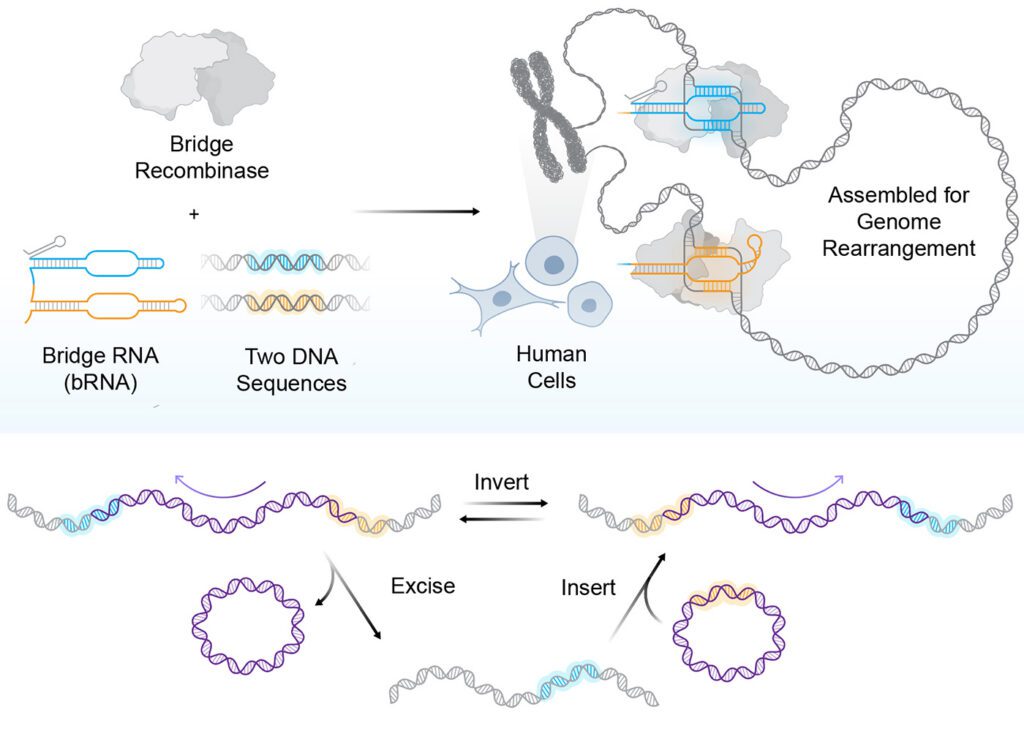
A new class of programmable genome-editing tools, bridge recombinases are the first RNA-guided DNA recombinases providing a distinct mechanism for manipulating DNA.1,2
The system has two key components: the recombinase enzyme, which catalyzes the DNA rearrangement, and a bridge RNA guide with two independently programmable loops. The target-binding loop controls genomic locus targeting, and the donor-binding loop specifies the donor payload.
Reprogramming the bridge RNA to change the configuration and orientation of the target and donor sites allows the system to be redirected to perform excision of a desired sequence from the genome or inversion of a DNA segment in place. The modularity means a single two-component system can perform all three fundamental DNA rearrangements—insertion, excision, and inversion—through a single unified mechanism.
“The most immediate advantage is the scale of DNA that bridge recombinases can manipulate,” said Patrick Hsu, PhD, co-founder and core investigator of the Arc Institute and assistant professor of pathology at Stanford University. “A technology that can operate at the scale of whole-gene replacement or correct structural variants opens up a new class of genetic interventions.” Multi-kilobase insertions, inversions up to 0.93 Mb, and excisions up to 0.13 Mb have all been demonstrated in human cells.3
Bridge recombination also does not rely on dsDNA breaks. The recombinase catalyzes strand exchange directly through a covalent intermediate, making the outcome deterministic in a way that nuclease-dependent approaches are not. This indicates that the system may have advantages in post-mitotic cells for therapeutic applications. About a quarter of the size of Cas9, the system can be encoded in delivery vectors with limited capacity.
“The technology is still in development. While our current efficiency and specificity numbers (20% insertion efficiency with 82% on-target) represent a meaningful proof-of-concept in human cells, improving both metrics will be necessary for safe and effective therapeutic applications,” said Hsu. The diversity of bridge-recombinase systems found in nature continues to be explored.
“For simpler cases where we want to insert a DNA payload into a fixed safe harbor site, we are working on large serine recombinases (LSRs),” said Hsu. While these enzymes lack the RNA programmability of bridge recombinases, they offer very high efficiency and specificity of insertion and are effectively unidirectional, leading to very stable insertions of large DNA cargoes into the human genome.
A 2025 Nature Biotechnology paper described an LSR enzyme engineered to enable site-specific insertions of multi-kilobase DNA payloads with 53% efficiency and 97% genome-wide specificity. Importantly, it was demonstrated that LSRs work well in non-dividing cells, including primary human T cells.4
Stylus Medicine, a company Hsu co-founded, intends to advance LSRs for in vivo genetic therapies. “I am excited to see the new therapies that will emerge from combining recombinase technology with machine learning-assisted protein engineering and advances in DNA and effector delivery for challenging disease contexts,” said Hsu.
CASTs are naturally occurring bacterial systems that utilize nuclease-deficient CRISPR machinery to integrate DNA at genomic locations specified by guide RNAs (gRNA). “While CRISPR is often used to cut DNA, CASTs instead use CRISPR systems to guide site-specific DNA transposition,” said Isaac Witte, PhD, department of chemistry and chemical biology at Harvard University.
In 2019, two research groups—one at Columbia University led by Sam Sternberg, PhD, and the other at the Broad Institute of MIT and Harvard, headed by Feng Zhang, PhD—found that CASTs use CRISPR systems to target DNA transposition by a transposase complex. Further work demonstrated that CASTs were very efficient bacterial genome editors.
CASTs can mobilize multi-kilobase-scale DNA cargoes, and their naturally evolved transposition mechanism avoids forming dsDNA breaks in the genome. The problem was that the wild-type systems exhibited extremely low (often ≤0.1% of treated cells) or undetected integration activity in human cells.
Collaborating with the Sternberg lab, the lab of David Liu, PhD, from the Broad Institute of MIT and Harvard, used PACE (phage-assisted continuous evolution), a directed evolution platform developed by the Liu lab, to enhance the efficiency of CAST transposition.
In PACE, bacteriophages, which infect host bacteria, encode evolving genes in place of an essential gene for phage replication. This essential gene is instead encoded by host bacteria. “In PACE, you link the desired activity of the evolving biomolecule to the expression of this essential gene. In this case, we linked targeted DNA integration to the replication of phages encoding evolving CAST protein components,” said Witte.
A series of modifications ensured efficient enhancement of activity, resulting in the generation of an evolved variant of the CAST transposase protein TnsB that mediated over 200-fold improved integration activity in human cells. The TnsB protein contained ten individual mutations scattered throughout the predicted structure, which contributed to improved activity.
The evolved TnsB was combined with other PACE-evolved and rationally engineered CAST components to yield evoCAST, a system optimized for human-cell integration activity, published in Science.5
The evoCAST DNA integration does not require formation of dsDNA breaks in the genome, resulting in undetected levels of insertion and deletion mutations (indels) commonly found in traditional methods of gene insertion like nuclease-stimulated, homology-directed repair (HDR). In addition, evoCAST can be easily reprogrammed to genomic sites of interest by changing the gRNA sequence, and it supports a variety of DNA payload sizes, ranging from less than 1 kb to at least 15 kb.
A potential limitation, however, is that evoCAST is molecularly complex, containing seven distinct protein subunits, making the total coding size (~8.5kb) relatively large compared to around 5 kb for Cas9.
Big-picture limitations center on delivery, according to Witte, such as mitigating the cytotoxicity of foreign dsDNA in most therapeutically relevant cell types. Additionally, reducing the size and the number of distinct components required for integration activity may facilitate evoCAST applications in vivo. Next steps include harnessing the naturally existing diversity of CAST systems to develop a more diverse repertoire of CASTs for genome editing in human cells.
Full Circle Therapeutics’ genome writing technology centers on an immune evasive DNA modality, a mini-cssDNA, called C4DNA—circular, clean, concealed, and customizable up to 20 kb.
“The holy grail of gene editing is kilobase DNA integration. While most studies focus on new editing enzyme discovery, we address the challenge from the donor side. To integrate gene-size DNA in a specific locus, the choices of donor cargo templates are ds, ss, circular, or linear DNA. Workarounds using RNA formats and leveraging reverse transcriptase are still size-limited,” said Howard Wu, PhD, co-founder and CSO at Full Circles Therapeutics.
The company has commercialized over 350 research-grade cssDNA for primary sequences and is developing processes for GMP-grade products for clinical applications. According to Wu, initially, the company’s founder, Richard Shan, intended to supply linear cssDNA as a DNA commodity for researchers in the gene-integration field. The starting material was cssDNA that was cleaved into linear strands. A serendipitous benchmark experiment using cssDNA as a control demonstrated surprisingly better integration performance than its linear counterpart.6 The unexpected results led to a foundational patent describing the use of cssDNA for targeted genomic integration.
After benchmarking the different DNA formats, cssDNA appeared superior and compatible with various CRISPR-Cas systems, along with other meganuclease editing systems such as TALEN. Next, they evaluated the hypothesis that immunogenicity due to dsDNA could be eliminated if mobile genetic elements like transposase systems and LSRs could use cssDNA.
Collaborating with a team at Harvard Medical School led by Benjamin Kleinstiver, PhD, they demonstrated that naked unmodified cssDNA, combined with piggyback transposases or LSRs, enables kilobase writing, albeit inefficiently. One way to improve integration efficiency was to design an oligo that could fuse to the cssDNA with hydrogen bonding to form a partial duplex. A 30- to 60-mer partial duplex showed good integration efficiency when compared to dsDNA, while remaining immune silent.
In another approach, the team modified the nuclear editor and installed a peptide sequence identified from a bacterial genome with a strong binding affinity with cssDNA. In this case, the modified Cas9 became an engineered molecular chaperone to recruit the DNA molecule and form a complex, effectively loading and delivering the genome engineering complex into the nucleus and direct to the targeted genome.7
Continued collaboration with Kleinstiver’s lab aimed to improve integration efficiency. The approach, in this case, used a partial duplex cssDNA that reconstituted a recombinase recognition sequence. The scientists termed this integration through nucleus-synthesized template addition of large lengths (INSTALL). INSTALL is compatible with diverse genome engineering nucleases and RNA-guided recombinases for high-fidelity kilobase-scale human genome writing.8
“We welcome partners,” said Wu. “It is prime time to talk about DNA medicines.”
References
The post The Quest for Large-Scale DNA appeared first on GEN – Genetic Engineering and Biotechnology News.
The Food and Drug Administration on Tuesday approved a new medicine from the biotech company Vera Therapeutics for patients with a type of chronic autoimmune kidney disease.
The drug, called Trutakna, was cleared to treat IgA nephropathy, or IgAN, a disease caused by the buildup of immune antibodies in the kidneys. The condition leads to progressive loss of kidney function and potentially organ failure requiring dialysis.
“We’re extremely excited to bring Trutakna to patients,” Vera CEO Marshall Fordyce told STAT, in an interview conducted ahead of the FDA approval.
In biomanufacturing, scale has long been synonymous with success. Bigger bioreactors, larger facilities, and expanded footprints traditionally defined the path to higher output. But that paradigm is shifting with intensified bioprocessing. Today, the industry is embracing a more nuanced, efficient approach—one that prioritizes productivity over size, agility over rigidity, and integration over segmentation. Intensified bioprocessing is not just an incremental improvement; it is a fundamental rethinking of how biologics are made.
“Intensified bioprocessing aims to improve the productivity and efficiency of biomanufacturing,” explains Julie Kozaili, PhD, principal scientist at Asahi Kasei Bioprocess. “This is often achieved by designing new processes or modifying existing ones to increase output per unit time or equipment volume.”
That deceptively simple definition captures a sweeping transformation. Instead of relying on traditional batch processes, intensification often involves running at higher cell densities, integrating multiple process steps, and transitioning toward continuous or semi-continuous operations.
The implications are significant. Intensified processes can reduce facility size, minimize resource consumption, and shorten development timelines—all while maintaining or even improving product quality. For an industry under constant pressure to deliver therapies faster, these advantages are hard to ignore.
The urgency behind intensification is driven by both scientific and economic realities. Many modern therapeutics—particularly viral vectors and gene therapies—face inherent production challenges. Low yields, complex manufacturing requirements, and stringent quality standards make scaling difficult and expensive.
In viral-vector development, one of the central bottlenecks is simply producing enough material. Clinical applications often require a minimum effective dose volume, yet production systems struggle to generate sufficient yield, forcing manufacturers to concentrate limited output into small delivery formats. Legacy adherent cell culture technologies compound the problem by relying on scale-out strategies—adding more units rather than increasing efficiency—making cost reductions difficult as production expands.
Intensified bioprocessing offers a different path. It “is important because it allows manufacturers to increase capacity without new facilities, reduce equipment footprint, reduce media, buffer, and utility usage per gram of product, and shorten scale-up, tech transfer, and time-to-clinic timelines,” Kozaili says.
For companies working with unstable or complex molecules, speed can be just as important as scale. Faster processing reduces the risk of degradation and accelerates the path from development to commercialization.
Although cost savings are often cited as a benefit of intensification, industry leaders emphasize that its true value lies beyond the cost of goods. “Intensified bioprocessing is less about driving down cost and more about enabling speed, flexibility, and fit,” says Mark Schofield, PhD, director of science at Cytiva. “For monoclonal antibodies in particular, the industry’s priorities are getting to launch faster, making better use of existing facilities, and being able to respond to uncertain or fluctuating demand.”
This shift in perspective reflects broader changes in the biopharmaceutical landscape. Pipelines are increasingly diverse, with smaller patient populations and more specialized therapies. Manufacturing systems must be adaptable, capable of switching between products or scaling production up and down as needed. “Intensification helps companies do all three by rethinking how processes are designed and scaled,” Schofield adds.
Companies such as Repligen are advancing upstream intensification through perfusion-based systems designed to sustain high cell densities and continuous productivity. Perfusion cell culture, a cornerstone of many intensified strategies, continuously feeds fresh media while removing waste and product, allowing cells to remain in an optimal growth state over extended periods. This approach not only improves yield but also creates a more stable and controlled production environment compared to traditional fed-batch methods. Repligen’s filtration and analytical technologies further support this shift by enabling continuous clarification and real-time monitoring, helping bridge the gap between process development and scalable manufacturing.
Beyond large platform providers, a growing number of specialized innovators are helping push intensified bioprocessing forward, particularly in high-demand areas like viral-vector manufacturing and upstream control.
Meanwhile, Batavia Biosciences is tackling one of the most persistent challenges in gene therapy: low viral-vector yields. Traditional adherent cell culture systems often require scaling out—adding more equipment rather than increasing efficiency—which drives up costs without significantly improving productivity. Batavia’s intensified approach centers on integrated solutions that combine optimized cell lines, streamlined purification processes, and novel bioreactor designs to dramatically increase output. By enabling higher yields within a smaller footprint, these strategies effectively miniaturize manufacturing, making it possible to produce clinical and commercial quantities without the need for large-scale facilities.
Together, these efforts underscore a key theme in intensified bioprocessing: innovation is not confined to a single step or technology. Instead, it is emerging across the entire workflow, from upstream cell culture to downstream purification and process analytics.

The promise of intensified bioprocessing is being realized through a growing ecosystem of technologies. Asahi Kasei Bioprocess, for example, has developed solutions that support intensification at multiple stages. “We support intensified bioprocessing across upstream and downstream operations,” Kozaili explains, pointing to innovations such as hollow-fiber microfilters for high-intensity cell culture clarification and advanced virus filtration systems designed for continuous processing.
These technologies are engineered to handle the increased throughput associated with intensified upstream processes. High-density cultures generate larger volumes of product, which must be efficiently clarified, purified, and stabilized without compromising quality.
Downstream, continuous virus filtration systems can operate at low flux over extended periods while maintaining robust viral clearance. Inline buffer formulation systems further streamline workflows by eliminating the need for large storage tanks and ensuring consistent buffer quality in real time.
Automation and integration are also key components. New ultrafiltration and diafiltration systems are being designed for flexibility, allowing them to be deployed upstream or downstream and enabling seamless process integration.
Though technology is a crucial enabler, successful intensification requires more than just new equipment. It demands a holistic approach to process and facility design. “At CRB, our role is to help clients translate emerging process concepts into facilities that are safe, operable, and scalable,” says John Rubero, senior fellow in purification bioprocessing.
One of the defining characteristics of today’s intensification efforts is that they are often partial or hybrid implementations. Fully continuous, end-to-end processes remain relatively rare. Instead, manufacturers are adopting elements of intensification—such as integrating continuous perfusion with multi-column capture chromatography—within otherwise traditional workflows. This incremental approach allows companies to realize benefits without fully overhauling their operations. It also provides a pathway for future evolution as technologies mature.
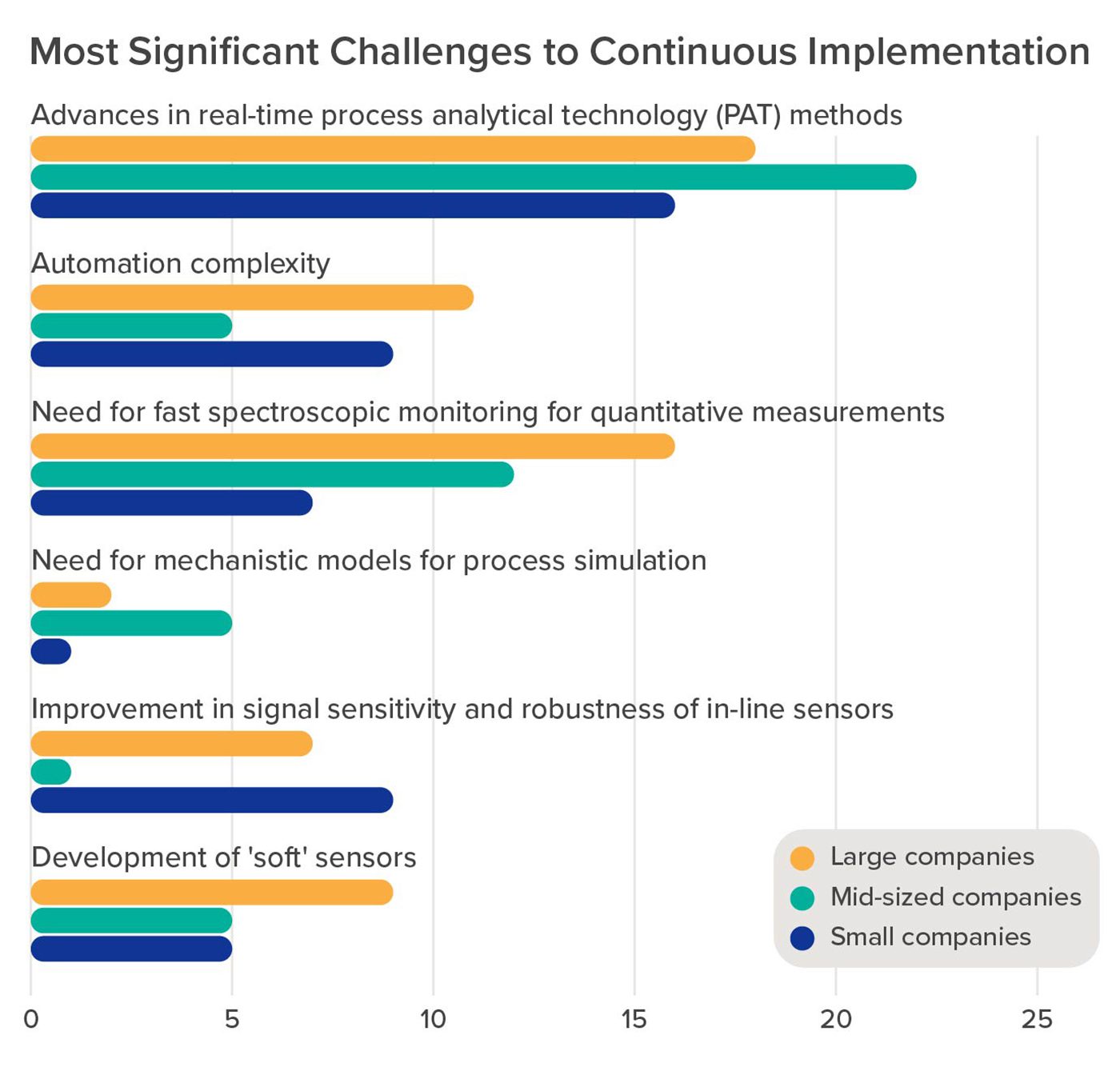
Despite its advantages, intensified bioprocessing is not without challenges. One of the most significant is bridging the gap between process development and commercial-scale implementation. “While the practice of linking unit operations together is largely accepted, real-time control of an end-to-end continuous process remains challenging,” Rubero explains.
In traditional batch processes, control strategies are relatively straightforward because lot traceability is easy to maintain. But intensified systems—especially continuous ones—require real-time monitoring and advanced control strategies to ensure process stability and product quality.
“It is not realistic or necessary to find and assign a sensor to monitor each critical process parameter or critical quality attribute,” Rubero says. “Instead, a combination of direct measurements, soft sensors, multivariate models, and process understanding is required for effective process control.”
So, the industry is moving toward integrated approaches that combine process analytical technology (PAT) with mechanistic and data-driven models. These systems enable more sophisticated monitoring and control but are still evolving in terms of reliability and adoption.
Technical challenges are only part of the equation. Intensification also requires a shift in mindset—one that can be difficult for organizations accustomed to established manufacturing paradigms. “In many cases, the technologies are either new or have novel applications, creating a learning curve,” Kozaili acknowledges.
Training gaps, operational changes, and resistance to new approaches can slow adoption. Teams must adjust not only their processes but also their thinking, moving away from long-standing practices toward more dynamic, integrated systems.
As Schofield notes, “adopting new approaches inevitably comes with skepticism.” Externally, there can be hesitation to move away from established technologies. Internally, organizations might question how intensified solutions might impact existing product lines. Those discussions, however, are part of the transition.
Despite these challenges, momentum is building. As intensified technologies demonstrate their value in real-world applications, resistance is gradually diminishing. “Over time, evidence and adoption speak for themselves,” Schofield says.
Kozaili emphasizes the importance of organizational alignment. “We had to change the company’s established mindset by securing support to develop these technologies and clearly show the value of these approaches,” she explains.
Collaboration also plays a key role. For technology providers, working closely with customers to test and refine solutions helps build confidence and accelerate adoption. “For our customers, it’s about finding the right partners to test the technologies, while providing appropriate feedback for improvement,” Kozaili adds.
Looking ahead, the trajectory of intensified bioprocessing is clear. Purpose-built facilities designed specifically for intensified operations will become more common, replacing retrofitted batch plants that struggle to accommodate new workflows, because intensified bioprocessing is no longer a niche concept reserved for early adopters. It is rapidly becoming a central pillar of modern biomanufacturing strategy.
The post Bioprocessing at Full Throttle appeared first on GEN – Genetic Engineering and Biotechnology News.
Want to stay on top of the science and politics driving biotech today? Sign up to get our biotech newsletter in your inbox.
Good morning. Plenty of news today, and also a deal that is running out soon: Buy one year of STAT+, get one year free.
Vertex said yesterday it will spend $10 billion to acquire Crinetics Pharmaceuticals, a biotech developing drugs for rare endocrine disorders.