WASHINGTON — The Trump administration is negotiating new drug-pricing deals, now with smaller companies, according to three people with knowledge of the meetings, including a White House official.
The new talks offer a pathway for smaller pharmaceutical companies — those not included in the first round of deals — to pledge lower prices and potentially avoid tariffs or new pricing policies through Medicare.
The new negotiations suggest the administration is looking to replicate the strategy it used with larger drugmakers: extract voluntary, confidential agreements in pursuit of lower prices and more domestic manufacturing. They also offer smaller players in the sector, which have faced substantial uncertainty about how federal policies would affect them, the chance to cut a deal and gain more certainty about how they might be affected by federal policies.
WASHINGTON — The Trump administration announced Thursday 100% tariffs on imported brand-name drugs — but with significant caveats.
Many large drugmakers won’t have to pay the tax because they’ve struck deals with the U.S. to build manufacturing facilities here and lower the prices of their medications. Drugmakers that haven’t struck those deals but pledge to bring production to the U.S. can have their tariffs reduced to 20% for the remainder of Trump’s term.
The tariffs open a new front in the Trump administration’s efforts to rein in the pharmaceutical industry and in its push to bring manufacturing back to the U.S. The announcement comes as Trump has looked to emphasize his administration’s work to make prices — especially medicines — more affordable ahead of the midterms.
How has the Food and Drug Administration’s recent decisions on rare disease drugs affected investment trends? Why is Eli Lilly getting into sleep medicine? And where did Allison go on her vacation?
We discuss all that and more on this week’s episode of “The Readout LOUD,” STAT’s weekly biotech podcast. Biotech investor Rod Wong joins us to talk about why an industry-patient coalition he’s part of sent a letter to President Trump asking for more regulatory flexibility at the FDA.
Background: Large language models (LLMs) now enable chatbots to engage in sensitive mental health conversations, including depression self-management. Yet their rapid deployment often overlooks how well these tools align with the priorities of people with lived experiences, which can introduce harms such as inaccurate information, lack of empathy, or inadequate crisis support. Objective: This study explores how people with lived experience of depression experience an LLM-based mental health chatbot in self-management contexts, and what perceived benefits, limitations, and concerns inform harm-mitigating design implications. Methods: We developed a technology probe (a GPT-4o–based chatbot named Zenny) designed to simulate depression self-management scenarios grounded in prior research. We conducted interviews with 17 individuals with lived experiences of depression, who interacted with Zenny during the session. We applied qualitative content analysis to interview transcripts, notes, and chat logs using sensitizing concepts related to values and harms. Results: We identified 3 themes shaping participants’ evaluations: (1) informational accuracy and applicability, including concerns about incorrect or misleading information, vagueness, and fit with personal constraints; (2) emotional support vs need for human connection, including validation and a judgment-free space alongside perceived limits of machine empathy; and (3) a personalization-privacy dilemma, where participants wanted more tailored guidance while withholding sensitive information and using privacy-preserving tactics. Conclusions: People with lived experience of depression evaluated LLM-based mental health chatbots through intertwined priorities of actionable information, emotional validation with clear limits, and personalization that does not require unsafe data disclosure. These findings suggest concrete design strategies to mitigate harms and support LLM-based tools as complements to, rather than replacements for, human support and recovery.
<img src="https://jmir-production.s3.us-east-2.amazonaws.com/thumbs/78ae955c189d2dea8e926c80ddf7b242" />
Posted on
<![CDATA[Lipocine’s oral brexanolone (LPCN 1154) for the treatment of postpartum depression failed to meet the primary endpoint in a phase 3 placebo-controlled trial.]]>
This is today’s edition of The Download, our weekday newsletter that provides a daily dose of what’s going on in the world of technology.
Fuel prices are soaring. Plastic could be next.
As the war in Iran continues, one of the most visible global economic ripple effects has been fossil-fuel prices. But looking ahead, further consequences could be looming for plastics.
Plastics are made from petrochemicals, and the supply chain impacts from the conflict are starting to build up. Americans will likely feel the ripples.
This story is from The Spark, our weekly climate newsletter. Sign up to get it in your inbox every Wednesday.
The must-reads
I’ve combed the internet to find you today’s most fun/important/scary/fascinating stories about technology.
1 SpaceX has filed for an IPO It’s set to be the largest ever, targeting a $1.75 trillion valuation. (NYT $) + Which would make Elon Musk the world’s first trillionaire. (Al Jazeera) + But the IPO could hinge on the success of Moon missions. (LA Times $) + And the conflicts of interest are staggering. (The Next Web) + Meanwhile, rivals are rising to challenge SpaceX. (MIT Technology Review)
2 Artemis II is on its way to the Moon NASA successfully launched the four astronauts on its rocket yesterday. (Axios) + The lunar plans could violate international law. (The Verge) + But the potential scientific advances are tremendous. (Nature) + Check out our roundtable on the next era of space exploration. (MIT Technology Review)
3 Iran has struck Amazon’s cloud business in Bahrain again It promised to hit US companies only yesterday. (FT $) + Other targets include Google, Microsoft, Apple, and Nvidia. (CNBC) + AWS data centers in Bahrain were also hit last month. (Reuters $)
4 OpenAI was secretly behind a child safety campaign group It pushed for age verification requirements for AI. (The San Francisco Standard $) + OpenAI had backed the legislation as a compromise measure. (WSJ $) + Coincidentally, Sam Altman heads a company providing age verification. (Engadget)
5 Anthropic is scrambling to limit the Claude Code leak It’s trying to remove 8,000 copies of the exposed code from GitHub. (Gizmodo) + An executive blamed the leak on “process errors.” (Bloomberg $) + Here’s what it reveals about Anthropic’s plans. (Ars Technica) + AI is making online crimes easier—and it could get much worse. (MIT Technology Review)
6 A new Russian “super-app” aims to emulate China’s WeChat And give the Kremlin new surveillance powers. (WSJ $)
7 America’s AI boom is leaving the rest of the world behind And it’s concentrating power and wealth in a handful of companies. (Rest of World)
8 Chinese chipmakers have claimed nearly half the country’s market Nvidia’s lead is shrinking rapidly. (Reuters $)
9 The first quantum computer to break encryption is imminent New research reveals how it could happen. (New Scientist)
10 The world’s oldest tortoise has been embroiled in a crypto scam Reports that Jonathan died at just 194 years old are thankfully false. (Guardian)
Quote of the day
“Starlink is the only reason this valuation is defensible.”
—Shay Boloor, chief market strategist at Futurum Equities, tells Reuters why SpaceX has such high hopes for its IPO.
One More Thing
These companies are creating food out of thin air
Dried cells—it’s what’s for dinner. At least that’s what a new crop of biotech startups, armed with carbon-guzzling bacteria and plenty of capital, are hoping to convince us.
Their claims sound too good to be true: they say they can make food out of thin air. But that’s exactly how certain soil-dwelling bacteria work.
Startups are replicating the process to turn abundant carbon dioxide into nutritious “air protein.” They believe it could dramatically lower farming emissions—and even disrupt agriculture altogether. Read the full story.
—Claire L. Evans
We can still have nice things
A place for comfort, fun and distraction to brighten up your day. (Got any ideas? Drop me a line.)
+ Need more Artemis II in your life? This site takes you inside the flight. + Here’s a fascinating look at the recording errors that improved songs. + Good news: the elusive Nightjar bird is making a comeback. + Finally, a master chef has baked clam chowder donuts.
ObjectiveThis study aimed to identify risk factors for splenomegaly in chronic schizophrenia patients and clarify associations among metabolic−immunoinflammatory pathways, psychiatric symptoms and splenomegaly. The findings will help optimize somatic monitoring and intervention strategies.MethodsA case−control design was used. A total of 426 patients were assigned to splenomegaly (n= 165) and non−splenomegaly (n= 261) groups according to abdominal ultrasound. Demographic data, clinical information, and antipsychotic use were collected. Mental symptoms were assessed by the Positive and Negative Syndrome Scale. Hematological indicators were detected, and abdominal ultrasound was performed to evaluate spleen morphology and fatty liver occurrence. SPSS 24.0 was used for statistical analysis, including univariate analysis and binary logistic regression to screen influencing factors of splenomegaly.ResultsThe splenomegaly group had significantly higher levels of lipoprotein(a), cholesterol, triglycerides, HbA1c, CRP, IL-6 and β2-microglobulin than the non-splenomegaly group (all p < 0.05). The incidence of fatty liver and PANSS negative symptom score were significantly higher in the splenomegaly group, while the usage rate of aripiprazole was lower (p< 0.05). Binary logistic regression showed that HbA1c (OR = 1.797, p = 0.046) and PANSS negative symptom score (OR = 2.258, p = 0.003) were independently associated with splenomegaly. Aripiprazole use was associated with lower odds of splenomegaly (OR = 0.656, p = 0.041).ConclusionSplenomegaly in chronic schizophrenia patients is closely linked to metabolic abnormalities and immunoinflammatory activation. Prominent negative symptoms are independently associated with splenomegaly and may serve as an early warning signal. Aripiprazole use is independently associated with reduced odds of splenomegaly.
The approval of the first non–dopamine-blocking therapy for schizophrenia marks a defining moment in psychiatry. Muscarinic M1/M4 modulation, alongside emerging TAAR1 and glutamatergic pathways, signals a shift beyond dopamine dominance toward circuit-level integration. These advances embody mechanistic humility: the scientific courage to prioritize clinical signal over mechanistic certainty. It is the scientific curiosity to revisit older hypotheses, question single-pathway models, and integrate multiple mechanisms. Building on the recognition of dopamine blockade’s experiential burdens, this new era guides psychiatry toward a pluralistic framework. The challenge for 2026 is not to replace dopamine, but to rebalance it, moving from receptor blockade dominance to circuit modulation informed pluralistic treatment. This evolution aims to restore harmony not just among neural circuits, but within the lived experience of patients.
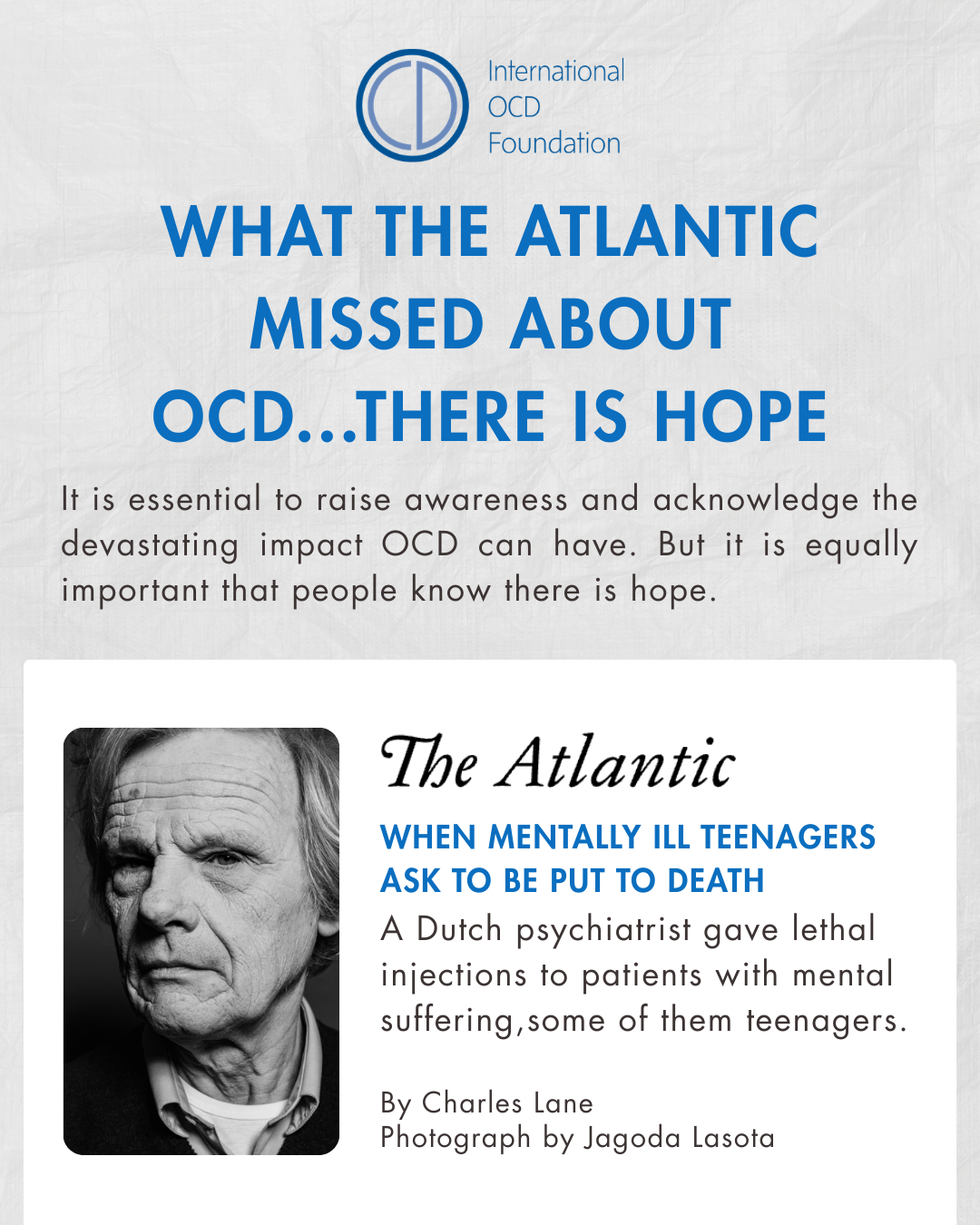
The Atlantic’s recent article, “When Mentally Ill Teenagers Ask to Be Put to Death,” brings needed attention to the profound and often misunderstood suffering caused by obsessive compulsive disorder (OCD). As the story illustrates, OCD can be severe, chronic, and life-threatening — so much so that individuals with OCD are at significantly elevated risk of suicide.
However, what is missing from this important conversation is an equally critical truth: effective, evidence-based treatments for OCD exist. Unfortunately, even after years in care, up to 98% of people never receive the many first, second, and third-line approaches that are available due to systemic breakdowns in proper screening, diagnosis, referral, and access to specialized care.
With appropriate care, many individuals who once felt trapped by their symptoms are able to reclaim their lives, pursue their goals, and thrive. At the International OCD Foundation, we regularly hear from people affected by OCD who have gone from a place of despair to one of hope because they were able to access evidence-based treatment, specifically Exposure and Response Prevention therapy (ERP).
It is essential to raise awareness and acknowledge the devastating impact OCD can have. But it is equally important that people know there is hope. The tragic outcomes outlined in “When Mentally Ill Teenagers Ask to be Put To Death” are not inevitable. With continued efforts on raising accurate awareness of OCD and strengthening our systems of care around the globe, more people with OCD can access the effective, life-saving treatment they deserve.
For those seeking help, resources and treatment guidance are available at iocdf.org.