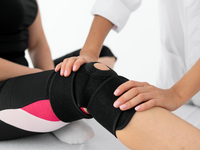
Background: Knee braces may improve symptoms and physical function following anterior cruciate ligament reconstruction (ACLR). However, their effectiveness depends on adherence, which typically relies on self-reported wear time, prone to recall and response bias. Objective measures (eg, temperature sensors), validated in footwear and orthotics research, offer a potentially more accurate alternative to self-reporting. Despite this, there is no research comparing self-reported and sensor-measured wear times in a knee brace. Objective: This study aimed to determine how well self-reported wear times reflect sensor-measured data in a slim-fit knee brace. Methods: Young adults (aged 18-45 years), 1-8 years post-ACLR, with a symptomatic knee (the 4 Knee injury and Osteoarthritis Outcome Score subscales [KOOS] score <80/100) wore a slim-fit brace during a 6-week feasibility trial. This study reports a secondary analysis of participants allocated to the brace group. Self-reported wear times were recorded in daily logs. An undisclosed, embedded temperature sensor recorded temperature every 10 minutes. A wear detection algorithm identified brace donning and doffing. These data were used to calculate aggregated measures (ie, summary measures across the entire 6-week intervention period, including cumulative wear time, average daily wear time, and total number of days worn) and repeated measures (daily wear duration, 3- and 7-day rolling averages, where wear time is averaged over consecutive days). Agreement between self-reported and sensor-based measures was assessed using concordance correlation coefficients (CCCs) and limits of agreement (LoA). Results: Of the 14 randomized participants, 10 (30% male [n=3]; mean age: 33, SD 6 years; time post-ACLR: 4, SD 1 years) had both temperature sensor and self-reported wear data. Six participants (60%) underreported average daily wear time (mean 29, SD 24 minutes across all 10 participants), while nine (90%) overreported the number of days worn (mean 9, SD 6 days across all 10 participants). Daily wear time showed moderate agreement between the sensor and self-reporting (CCC 0.70, 95% CI 0.58-0.79), but wide LoA (−223 to 217 minutes). Using 3- or 7-day rolling averages narrowed LoA (−47 to 36 minutes per day and −14 to 10 minutes per day, respectively) and slightly improved CCCs (0.74, 95% CI 0.58-0.85, and 0.73, 95% CI 0.51-0.86, respectively). Greater agreement was observed with more aggregated outcomes; for total 6-week wear time, the CCC was 0.84 (95%CI 0.50-0.95). When expressed as daily average wear time, the CCC was excellent (0.92, 95% CI 0.73-0.98), although daily LoA remained wide (−68 to 32 minutes), indicating substantial individual variability between self-reported and sensor-based measures. For the total number of days worn, the CCC was moderate (0.64, 95% CI 0.15-0.88) and LoA was wide (−10 to 22 days). Conclusions: Self-reported daily brace wear time is inaccurate compared to wear time measured by the temperature sensor. Aggregated data and rolling averages showed better agreement. Future intervention studies should consider objective adherence measures. Failing this, averaging self-reported wear time across the intervention period could improve accuracy. Trial Registration: Australian New Zealand Clinical Trials Registry ACTRN12623001027606; https://tinyurl.com/2spr7bnu