For years, artificial intelligence (AI) has been growing behind the scenes of our lives. Starting off as modifications of not‑so‑simple algorithms, early large language models could barely string a few words together, much like early vision systems that struggled to distinguish a lamppost from a cat in digital images. More recently AI has not just grown but proliferated—like Darwin’s finches in the Galapagos—into nearly every niche available in the digital world.
AI has infiltrated into daily life personally and professionally for many, and while modern healthcare has historically been hesitant to adapt to new technologies, Raghav Mani, director of Digital Health at Nvidia, pointed out that healthcare is adopting AI at three times the rate of other industries. Clearly, there is a lot to discuss, which is why The New York Academy of Sciences and the Windreich Department of Artificial Intelligence and Human Health at the Icahn School of Medicine at Mount Sinai co-hosted the 3rd annual “New Wave of AI in Healthcare,” a two-day symposium on May 12 and 13 with the goal of opening discourse between researchers, clinicians, industry leaders and other interested parties on all topics related to AI and healthcare.
Day one
The first day opened with a lightning round of welcome remarks from organizers expressing their personal experience with AI in healthcare research and practice. While some, like Nicholas Dirks, PhD, president and CEO of The New York Academy of Sciences shared concerns about how to maintain human involvement in AI use, he also expressed awe stating that “The pace of progress is breathtaking.”
Others were more practical in their assessments. Lisa Stump, chief digital information officer at Mount Sinai Health System asserted, “The future is not something we enter, it’s something we create.” Similarly, Brendan G. Carr, MD, CEO, Mount Sinai Health System, described AI as a “new partner” to aid clinicians in synthesizing the vast and growing clinical data. Girish N. Nadkarni, MD, a nephrologist and practicing clinician at Icahn School of Medicine at Mount Sinai summarized the whole event before the first talk even began: “The real question is not IF AI will transform healthcare, but HOW.”
The keynote presentation leading day one’s discussions endeavored to answer that very question. With his talk entitled, “Harnessing the power of Platform Thinking to Transform Healthcare,” John Halamka, MD, president of the Mayo Clinic Platform, spent 30 minutes exploring the power of data while questioning how AI is and should be used to analyze the varied data currently available, but cautioned that this is no simple task when considering the sources of data and potential restrictions on data use. He spoke about practical applications of AI data analysis that have and can be done, including in drug discovery. He also pointed out that AI can fill gaps in the healthcare workforce.
The day continued with four talks exploring different aspects of AI model use in healthcare. Marina Sirota, PhD, professor at the University of California, San Francisco spoke about how clinical data can be used for predictive medicine. Others, including Mani and Jonathan Carlson, PhD, vice president and managing director of Microsoft Heath Futures, discussed how AI agents and models can be used as part of hospital and clinician toolkits at multiple levels—not just as data analysis engines, but also to aid in synthesizing patient data and diagnostic support. Rounding out the discussion, Azra Bihorac, MD, senior associate dean for research at the University of Florida described how AI models need to be validated just like any other tool. She also pointed out that while AI is continuously improving in its ability to assess problems and suggest the next best course of action, human input is vital for collaborative success.
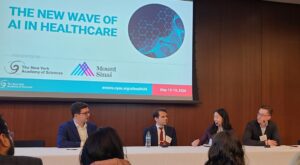
The final talks for day one focused on how AI can be used directly with patient care situations. Following their individual talks on how AI can be integrated into electronic health records (EHR), combining models to develop new insights, or reimagining diagnosis ability to improve diagnostic equity, the final three speakers engaged in a dynamic, and sometimes heated panel discussion. Karen Wong, MD, a physician at Epic, Alexander Fedotov, PhD, director of AI digital precision health at AstraZeneca and Pierre Elias, MD, assistant professor at Columbia University Irving Medical Center each shared their thoughts on how AI will be used in the near future. While they were all in agreement that AI cannot replace clinicians, they also recognized that AI will be a disruptive force, but it’s up to clinicians to take responsibility to use the technology as appropriate but to rely on their intuition and judgement as trained professionals. When opining on the future of AI use in healthcare five years from now, Fedotov stated, “I would still want to see humans at the helm of all the decision maker processes.”
Day two
While the first day laid the foundations for AI use in healthcare spanning bench to bedside, the second day of the symposium included more discussion and criticism of AI on the logistic level.
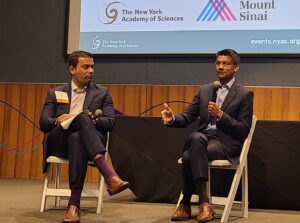
The day began with a keynote fireside chat between Nadkarni and Dave A. Chokshi, MD, a physician and professor at City University of New York, and former NYC health commissioner. He spoke about his leadership experiences, sharing many anecdotes of his time as a public health advocate and communicator during the COVID-19 pandemic. When questioned on the importance of communication considering the state of healthcare and declining trust of the public—especially with the increased use of AI, which has the potential of adding layers of feelings of abandonment, surveillance, and impersonalization—Chokshi pointed out that “It makes relationships even more important that we know then are.” He stressed that a his job, as a clinician, is to build trust with patients, and make sure that they return for care. While he envisions AI being transformative to healthcare in the next few years, he cautioned that listening and integrating feedback from front line users, clinical staff and patients, will be vital.
The morning continued with talks exploring AI’s use in research and learning in healthcare. Joshua C. Denny, MD, CEO of NIH All of Us Research, delivered a detailed summary of the progress and of the All of Us project. Despite recent funding concerns and cuts, the project scope remains on track, and researchers world-wide are utilizing the data derived from this project and how the project leads are working to establish parameters and modules for researchers to more easily implement AI in their data analysis. Andrew Gruen, PhD, standards lead at MLCommons, then spoke animatedly about the importance of establishing standards and benchmarks for AI use in researcher and healthcare settings. He spoke candidly on the need to not just train AI but to have external evaluation and validation of AI models.
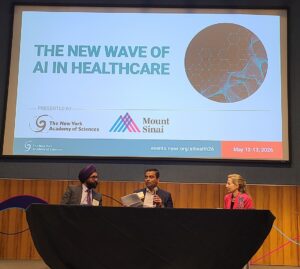
The symposium concluded with multiple discussions on the interactions between AI and humans—not just as a tool, but by viewing the use of AI in the broader scale. Karandeep Singh, MD, executive director for health innovation at the University of California, San Diego explored various opinions of clincians and patients on the use of AI, while pointing out that the use of AI in healthcare settings should be thoughtfully considered before implantation. Meanwhile, Vardit Ravitsky, PhD, president and CEO of The Hastings Center for Bioethics, discussed the ethics behind AI use as a direct to patient setting, specifically as a patient-used chatbot. In a debate following their respective talks, the two delved deeply into the risks associated with AI use, both on the patient side with chatbots and with scribe technologies used by clinicians and patients. They often agreed on the need for transparency in AI usage, but specific AI applications, like uses of AI robots in the home to combat loneliness in the elderly resulted in disagreements.
The final talk presented by Tanzeem Choudhury, PhD, chief of health innovation at Cornell Tech, brought many previously discussed topics together. Her research explores how AI can be used in treatment of mental health, describing how AI can be used in multiple aspects of mental health therapy from recording physiological symptoms with wearables to using chatbots for various functions. She cautioned that while these tools may eventually be transformative, the current state of AI use in mental health is still growing.
The closing remarks by Alexander Charney, MD, PhD, professor at Icahn School of Medicine at Mount Sinai summarized the event well. He shared that throughout the symposium he imagined what clinicians and researchers from 100 years ago and from 100 years in the future would think about the current state of healthcare and about the challenges being faced now with how to incorporate AI. He said, “We aren’t the first group of human beings to deal with powerful technology and figuring out how we’re going to use it to change society.” He hopes that the people from the past would see that we understand and respect the past and learn from it being rigorous in our research and testing, while the people from the future will look on us with pride at our fearless and tenacity in the face of new technology. He hopes that both groups would see that we “tried to do the right thing.” He ended saying that he does see all of that here along with passion and coming together of everyone at the meeting.
The post AI in Healthcare: Symposium Insights appeared first on Inside Precision Medicine.