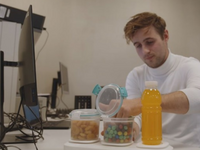
<strong>Background:</strong> Snacks contribute 19% to 34% of daily energy intake, yet studying snacking behaviors faces challenges due to self-report biases. The SnackBox, an automated dietary assessment tool, enables structured measurement of snacking in seminaturalistic settings. <strong>Objective:</strong> This study explored the relationships between snacking and perceived stress (case study 1) and physical activity (case study 2) using the SnackBox technology. <strong>Methods:</strong> Forty-seven office workers (n=29, 61.7% female; mean age 28.8, SD 4.1 years) used the SnackBox at work and home for 2 weeks. The device recorded snack consumption (grams and time). Participants reported perceived stress via ecological momentary assessments and wore a Chill+ band and a Garmin wearable to track physical activity. <strong>Results:</strong> Across the study period, 1455 ecological momentary assessments, 2933 hours of wearable data, and 2199 snacking events were recorded. Participants consumed a daily average of 769 (SD 772) kcal from snacks. Stress did not significantly impact snacking likelihood (<i>χ</i><sup>2</sup><sub>1</sub>=0.2; <i>P</i>=.69). Snacking was more likely before vigorous physical activity (odds ratio 2.00; SE 0.39; <i>P</i><.001). <strong>Conclusions:</strong> The SnackBox demonstrated utility as a technology probe for exploring relationships between snacking and physiological and contextual factors. This approach enhances our understanding of snacking and supports personalized interventions and predictive models. <strong>Trial Registration:</strong> ISRCTN Registry ISRCTN45046481; https://www.isrctn.com/ISRCTN45046481