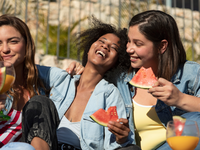
Background: Youth should be partners in the development and dissemination of health information created for their demographic. The Manaora Rangatahi (youth) Guidelines comprise 10 eating and 10 wellbeing messages that were cocreated with rangatahi Māori (Māori youth) in Hawke’s Bay, New Zealand, and then disseminated through a digital media campaign. Objective: This study aimed to present the process evaluation of the co-design and implementation of the pilot digital media dissemination campaign of the Manaora Rangatahi Guidelines. Methods: The 17 rangatahi who were involved in the cocreation of the guidelines codeveloped a dissemination plan, filmed video clips for each of the 20 messages, and supported the 20-week digital media campaign. The codevelopment process over 4 wānanga (workshops) is described and critiqued, and the implementation was assessed using the data analytics from Instagram and TikTok, the main social media platforms for dissemination. The rangatahi participated in a short postcampaign review survey. Results: The dissemination plan included a website for the messages, a campaign name and logo, apparel with messaging and QR codes, and the design of a digital media campaign featuring the participating rangatahi. Video clips of each of the guideline messages featuring the rangatahi were professionally developed with support from 3 Māori influencers and a video production company. The 10 phases of the campaign involved the release of 2 messages (one eating and one wellbeing) every fortnight over 20 weeks. Instagram and TikTok analytics showed that the campaign achieved >1.48 million impressions and >19,000 engagement actions (eg, likes, comments, and sharing). The mean engagement rate (Instagram 6.2%, TikTok 1.2%) was greater than or similar to the platforms’ medians across all industries (0.36% and 1.73%, respectively). Various paid promotion strategies boosted the number of impressions, and paying one of the influencers to promote the messages in phase 8 created a more than 10-fold increase in impressions on Instagram. The estimated cost of the overall campaign was NZ $125,000 (US $72,500). The majority (about 60%) of rangatahi felt the campaign was successful and engaging. Conclusions: Rangatahi have expert knowledge in how to disseminate messages to their peers. They successfully co-designed and pilot-tested the implementation of a low-cost digital media campaign using peer-to-peer messaging and videos, which achieved substantial reach. The dissemination reach was good, but was significantly influenced by paid promotions. The cost per thousand impressions was equivalent to or better than much larger government-funded health promotion social media campaigns targeting youth. The development and dissemination of eating and well-being messages aimed at youth should ideally involve partnering with the target audience to enhance the relevance and reach of the messages. A well-funded dissemination campaign with paid promotions through influencers and digital platforms could expect to achieve substantial awareness of the messages.