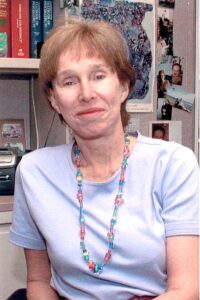
Dr. Edna Foa served for decades as a professor of clinical psychology in psychiatry at the University of Pennsylvania, where she also directed the Center for the Treatment and Study of Anxiety (CTSA), the internationally renowned program she founded in 1979. Through the CTSA, Edna created not only a hub for groundbreaking research, but also a training ground that would shape the future of evidence-based treatment for anxiety, obsessive compulsive disorder (OCD), and post-traumatic stress disorder (PTSD).

At a time when OCD was poorly understood and often ineffectively treated, Edna helped establish and rigorously validate exposure and response prevention (ERP) as a gold-standard intervention. Building on the early behavioral work of pioneers before her, she brought a level of empirical precision, clinical sophistication, and dissemination that transformed ERP from a promising approach into a cornerstone of modern treatment. In doing so, she fundamentally changed what recovery could look like for millions of people living with OCD.
Her influence extended well beyond OCD. Dr. Foa was also a central figure in the development of cognitive-behavioral models and treatments for PTSD, including prolonged exposure therapy, which has become one of the most widely used and effective interventions for trauma-related disorders. Across both domains, her work exemplified a rare integration of theory, research, and clinical application—always grounded in a singular goal: to reduce suffering and restore lives.
Her connection to the International OCD Foundation (IOCDF) was a natural extension of her commitment to bridging science and real-world impact. Edna was deeply engaged with the IOCDF community over many years, contributing to its mission of improving access to effective treatment and advancing understanding of OCD. The Foundation awarded her with the Outstanding Career Achievement Award in 2011. She was a frequent presence at conferences, where she not only shared her research but also helped elevate the standards of clinical care through teaching, mentorship, and collaboration.
The IOCDF’s growth into a global leader in OCD advocacy, education, and training reflects, in many ways, the scientific foundation that Edna helped build. Her work made it possible for organizations like the IOCDF to promote treatments that are not only evidence-based, but truly life-changing. And through her direct involvement, she helped ensure that the connection between research and practice remained strong, dynamic, and accessible.
Edna Foa showed us what it means to dedicate a life to advancing knowledge in the service of humanity. She illuminated a path forward for so many, and her influence will continue to guide the field for generations to come.
Below are several tributes to Dr. Foa from IOCDF community members.
From Jonathan Grayson, PhD
My mentor, Tom Borkovec, used to talk about our psychological lineage; that in 1979, you only had to go back a few generations of your “forefathers” to reach the founders of American psychology. In this respect, Tom is my psychology father – he taught me to discipline my thinking – he encouraged wild flights of speculation, but to always temper it in print with what could be researched and proved. With this in mind, Edna is my psychology mother. As I noted elsewhere, for all of us who work with OCD, we are her children, grandchildren and so on.
I first met Edna in 1979 at Joseph Wolpe’s Behavior Therapy Unit at Temple University. She hired me as an adjunct research assistant professor. This was in the ancient days at the height of the first wave. There was no cognitive behavioral therapy. ABCT was AABT, American Association of Behavior Therapy. The disorder we were studying was OC, the DSM labeling it obsessive compulsive disorder doesn’t yet exist. Edna was on the first of her landmark OC grants.
She was the flashpoint for all that we do with OCD. Don’t get me wrong, she didn’t invent ERP, but her work was/is the basis of all OCD treatment today. In the same way that cognitive therapy techniques existed before Aaron Beck, but his work was the flashpoint of that second wave; and the techniques of ACT pre-exist Stephen Hayes, but his work and thinking were the flashpoint of the third wave. There was no OC Foundation.
I joined Edna and Gail Steketee and to work with Edna was always a collaboration. So many hours of discussing, designing and analyzing research. Writing papers together often until midnight and beyond. You may have heard that Edna was demanding. She was, but that had nothing to do with the hours we worked. The same clinical skills she used with patients, she used in choosing those who worked with her. We were all driven. There are those who found her direct delivery difficult, but it wasn’t anger or belittling, it wasn’t intimidating (okay, maybe a little), she was simply direct without sugar coating. The truth about Edna was that she was caring and very generous.
As I said, our research was a collaboration and the order of authors on publications reflected our contributions. If you had a research idea that was tangential to her main projects, she would support you. When I told her I thought we should have support groups to help sufferers maintain their gains, I was given a free hand to develop and run GOAL as I saw fit. When my son was nine months old and I told Edna that I was going to change my work hours to: one and a half daytime hours and the rest of my hours after 4 pm, she accepted this. She didn’t have to admonish me or warn me to do my job, Edna knew the kind of people she had chosen. She wanted the people who worked with her to grow. When it came time for me to move on, she was like any parent, sorry for me to go, but happy for me to pursue my life. She was like that with all of us. So many of those who have shaped the OCD world worked with Edna. While I was there, Michael Kozak joined the team and later Edna and Michael published their ground breaking paper on emotional processing. Alec Pollard, Charly Mansueto and Rich McNally also passed through our center. Marty Franklin and Jon Abramowitz came after me making up the many generations of her “children.”
For those whom I’ve neglected to mention, forgive me, but the list is too long. My OCD career began in 1979. Her loss is a hole in the fabric of reality, but her legacy and wisdom lives on through all of us whose OCD psychological lineage can be traced back to Edna Foa.
From Marty Franklin, PhD
I am writing this tribute while waiting at an airport gate for a flight to a national conference. Over the course of the next few days I will have the opportunity to present applied research data, participate in a clinical roundtable about OCD and its treatment, & engage with colleagues as we toss around ideas for how best to move the field forward. Edna’s profound influence on my career, my life, and even my thinking is most often accessible during relatively quiet moments like this, where opportunities for reflection make their way forward amidst the work I have committed to myself to doing. Indeed, I learned of Edna’s passing a few weeks ago while right in the middle of presenting a clinical training about exposure-based treatments for OCD. I paused for a moment to take it all in, but before I could decide how best to proceed under the circumstances, I heard Edna’s voice, in her characteristic and unmistakable Israeli accent, telling me that these clinicians took time out of their busy schedules to receive this training, and therefore I must continue straight through to the end. My feelings? You can process those later. Classic Edna.
My very first day of internship in 1991 at the Medical College of Pennsylvania was spent in Edna’s presence at her Center for the Treatment and Study of Anxiety, the unit she established in 1979 to develop, test, and disseminate cognitive-behavioral interventions for anxiety and related conditions. Edna’s work even by then was highly influential, and her legend was already well in the making. At that initial meeting, Edna slid a formidable stack of old-school medical charts across the table to me and said, “Marty, is it? These are your OCD cases for this rotation.” I thanked her, then asked the first of myriad naïve questions in the legendary Tuesday Meetings: “When will I receive the training to treat these cases?” She pivoted back to look at Michael Kozak, her Clinical Director, as if to wax nostalgic about the process of indoctrinating yet another green intern. Edna then gestured at the pile, and said, “The training is in there.” Edna was a fine clinician too, and thus read well my horrified expression, then offered, “But don’t worry: we’ll help you.” True to her word, she did exactly that.
Edna’s influence on the field broadly speaking, on the development and expansion of cognitive-behavioral theory, on using clinical science to alleviate human suffering, and in pushing the proverbial envelope, has been chronicled elsewhere and cannot ever be overstated. Edna was one of the true pillars of clinical psychology, and the effects of her work will live on in perpetuity, of that I have little doubt. What was less well known except for those of us fortunate enough to have been mentored by Edna was the incredible amount of time and emotional investment she made in seeding the field with the next generation of theorists, scholars, and clinicians who would carry that work forward in the years to come. I count myself in that incredibly lucky group, all of whom were blessed by her personal investment in our training and careers. Edna had exacting standards for herself and for us, and fully expected that same level of investment and intensity on our part. Vigorous debate was just part of the process, where occasionally the fur would fly. But Edna also knew us well enough to understand what each of us needed in order to help us make the commitment needed to join her in the vanguard. In one of our many career development conversations back in the mid 1990s, likely in her East Falls office well after 8 pm, I was fretting about the “soft money” environment of academic psychiatry, and openly wondering if it was time to pivot to hard-line academic psychology or even to private practice. Edna stopped my rumination dead in its tracks, looked into the depths of my soul (which she did regularly), and said, “It’s only soft money if you can’t get it…and I know you can get it. Plus, academia is a really fun way to make a living, and a life.” Edna Foa believed in me: it was about damn time to believe in myself as well, and to make the commitment required to honor that belief. And to always keep pushing to get better at the work, which is truly a never-ending process.
Sitting in this airport now, on my way to give another set of talks on topics I have come to know very well and continue to pursue with the passion that comes from also believing that this work is vital, I concur with Edna’s assessment of academia, and am truly grateful that I listened. Thank you, Edna, for illuminating a path forward for me, as I know you did for countless others. You were unforgettable, and your work will continue on in the hands of those you mentored and trained to carry on the legacy.
From Gail Steketee, PhD, MSW
I had the pleasure and helpful educational challenge of training under Dr. Edna Foa beginning in 1976 and continuing for a decade during which I worked closely with her studying OCD and co-authoring manuscripts and federal grant applications. Edna generously provided me with excellent clinical supervision during my training at the Behavior Therapy Unit at Temple University where I learned how to treat phobias, agoraphobia and panic, and especially OCD. Edna’s encouragement and specific feedback guided my understanding of patients and how to provide effective treatment. Her supervision coincided with the end of her important early study of the impact of exposure and response prevention, following in the steps of Victor Meyer, Isaac Marks, and Jack Rachman. I treated the last few patients with OCD in her study and co-authored a case report stemming from that work – my first published paper in the field in 1977.
Edna opened many doors for me to join colleagues around the world who were studying OCD and behavioral treatment methods. Together we wrote and published 26 papers and 14 book chapters. And I mean “together”. We would schedule writing times during which Edna generated ideas and spoke aloud in her heavily accented Israeli English while I contributed my thoughts and sharpened the language as we went along. Grant applications were a special challenge as NIMH became strict about page limits. More than once we stayed up all night writing grants to meet the deadline – we were both younger then – and once we actually drove to Bethesda to deliver a grant application just in time for the deadline. I joined Edna at many conferences in the U.S. (especially AABT [now ABCT] and OCF [now IOCDF]) and in Europe at EABCT and WCBCT (the World Congress of CBT). We met many delightful OCD researchers and clinicians – it was an exhilarating time. I traveled with Edna and friends to her home country of Israel where she treated us to delightful sights and experiences including the Dead Sea.
The 10 year period with Edna was a heady time as my career unfolded. She supported my decision to get a PhD in social work at Bryn Mawr while working full time with her on our research. Eventually, I left Temple to take a full-time faculty position at Boston University, arriving with a strong publication record already in hand thanks to Edna’s masterful training and modeling of how to design and conduct research, how to write papers that accurately reflected the study and its findings, how to write strong grant applications, and how to connect with energizing colleagues around the world. I am grateful for her mentoring that enabled me to establish my own career and become a mentor to others. She was a brilliant theoretician who spawned impressive thinking and research on OCD, PTSD, behavior therapy, and related topics. Hers was a long and full life. She will be sorely missed.
The post In Memoriam: Edna B. Foa, PhD appeared first on International OCD Foundation.