

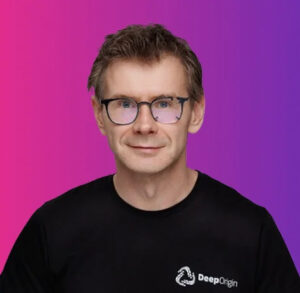
AI is often portrayed as either a technology that will revolutionize healthcare and cure disease or an overhyped force that could stifle science—but the reality is far more nuanced. While AI is already transforming biomedical research, meaningful advances in medicine require much more than powerful algorithms. That complexity is the focus of this conversation with Michael Antonov, co-founder of Oculus, who turned to biology and drug discovery after pioneering virtual reality.
To do so, he co-founded the computational drug discovery company Deep Origin. Rather than relying on AI alone, Antonov believes progress depends on integrating machine learning with physics-based molecular simulations, mechanistic models, and rigorous experimental validation. This philosophy has been fundamental for shaping Deep Origin’s AI-native platform to improve virtual drug screening, predict toxicity, and help researchers develop safer, more effective therapies.
In this episode of Behind the Breakthroughs, Anotonov examines how AI is changing drug discovery and the pharmaceutical industry’s opportunities and limitations, taking a pragmatic approach to claims that AI alone can improve human health from larger models and more computing power. This conversation offers a glimpse into biomedical innovation’s future for those interested in where AI is truly changing medicine and where human expertise and experimental science remain vital.
This interview has been edited for length and clarity.
IPM: Does virtual reality (VR) have a role in medicine and healthcare?
Antonov: VR is predominantly a visualization device, so it’s good for training and various other areas in terms of actual treatments. When VR has been used and is actually FDA approved, as far as I know, it presents modified images to each eye and kind of trains your brain to treat them both simultaneously. Similarly, it’s been used for PTSD treatments and some of the areas where you can maybe handle fears. I haven’t personally experimented with that.
On the visualization side, for displayed molecules, there’s a company that has done a great job of allowing you to look at the molecules, and this could be useful for research. That said, it just gives you more spatial perception. It doesn’t actually solve the problem for you.
On the training side, there are potentially huge benefits, even though you would then have to require investing a lot in software to make it actually perform well. Now, one good example is, I have invested in this company called Osso VR, which does training for knee replacement surgery, and they actually practiced it, and they did a study where their surgeons trained with their knee replacement and got 230% more proficiency.
Given the time and the accuracy of a procedure and the speed of how they learn. But to me, that felt actually very incredible that it’s actually being used. I think they also do nursing trade trainings and such. Those are probably the top areas that will probably be more brain-oriented cognitive things you could do. It would just take time to explore it.
IPM: What will AI’s impact be on medicine and healthcare?
Antonov: I think that there is still a lot of uncertainty. The system is overloaded. There’s a whole spectrum, and the challenge is that there are hundreds of different companies and projects with a whole different range of funding.
For pharma, it would be a big job to sift through what is actually good and what will help me take my target forward. That’s a challenge because there’s a lot more noise and there are some really good companies, but there are also many me-too, not-so-great ones. There are also certain fundamental areas that haven’t been solved yet, like toxicity and other issues, although there has been progress in some areas. There are like dozens of predictors, but they’re not necessarily super great, though they’re better than nothing. It’s hard to tell where it’s going. The biggest thing is to see what you actually prove in the lab.
The other thing is that there is a range of medicinal chemists and other knowledgeable people who haven’t been exposed to the breakthroughs or effects we might see on our side. AI may surprise us in certain biological parts of the name for certain problems. Now, more holistically at Deep Origin, our plan is to support the discovery process for small molecule drugs and have predictable outcomes.
IPM: How will AI drive the future of precision medicine?
Antonov: The super exciting way it could look in 20 years in that type of timeframe is that we are starting to get personalized medicine. You’re really combining the patient and the system model so that whenever you have a disease, if you have maybe a novel genomic mutation or if you have a new virus, you can literally put the data into the system.
Here is basically experimental data about whatever you collect from the virus. I don’t know if you get the structure of its protease from crystallography. I will even tell you here are the steps you need to take and which lab to run them in. But once you provide it, the system will be able to decompose the pathways and targets it’s affecting and then identify the specific concentrations you might need for these patients.
Essentially, you can provide a target in just a few months. You have good candidates, and these candidates have a much higher probability of not being toxic and having good admin properties. Let’s say we are moving from 90% failure rate to maybe 60%. That would be a huge job. That’s what the toxicity models enable, though they are hard because they need both experimental and data collection. But actually, even things like physics can help with counter screening, asking, what are all these things we should not bind to? Go and check them computationally. This whole stack basically gives you data on how to run your trial. That’s ten years. But then you level it up with populations and the individual.
This is a 2030 year outlook because then you’re pulling in the genomics data, maybe various things, and this is where the industry really becomes much more powerful and individualized. To do that, you really need these more detailed models.
IPM: Do you have a prediction about a current AI trend that will be around for a while?
Antonov: One of the hot topics right now is the idea of AI scientists. In our case, we have an AI discovery engine. We actually did this earlier, which is this area grant from the U.K. for picking up the disease, which can be fully drugged by AI.
We ran our AI scientist system to pick a target for endometriosis. It uses our tools to come up with a molecule. It’s currently in progress, and it did a very detailed breakdown and analysis of hundreds of targets based on very specific criteria, and I picked a particular one with all the reasons.
It’s interesting to make those kinds of tools and this whole pipeline available to almost everyday people because then, much like some genomics tools, an available AI system, which can support the full path of drug development, can in fact let a patient or an interest group just come in and take lots of steps in the direction of saying, “Here’s either maybe an RNA or a gene therapy or a drug that can serve.”
That would be a huge step toward democratizing it. It doesn’t mean that AI will do all the steps for us, but it doesn’t mean that it can do a lot of the known steps, which have been done many times and can help us along the way. Of course, the real scientist will still be very critical to all the parts.
For general accessibility, this automation that is happening and these kinds of simulation tools and large language models in general are incredible. They’ve got a little bit of a long-winded thing, but I wanted to reflect on what you said.
IPM: What are the pros and cons of building Deep Origin in the U.S. or China?
Antonov: Some of the more recent wisdom that I’ve heard is that if you want to survive in the U.S. or more expensive countries, you need to be taking bigger risks, and you need to be more innovative in how you approach the type of modalities and things. So that’s one line of thinking.
Another way is to be distributed. In our case, a big part of our AI/ML team is in Armenia. My co-founder is Armenian. We have 40 people there. I have just come from spending a week and a half with the team there for model building and science. There is an AI, and there are definitely people in all of the areas. Automated labs could also probably be in any country.
In terms of the actual trials, it depends on the situation. There are certain things that it’s probably wiser to do in China for this time being, but also maybe India will be up and coming, and if there are certain scenarios where there are more rare diseases, it’s probably okay to also not stay in the States.
There’s no perfect answer. We have a challenging environment. At the end of the day, you have to have something really valuable and novel to keep going forward. They have really great scientific research there too. We have to be careful and just really go at it hard.
IPM: Where does China stand out from the United States in terms of pharmaceutical research and development?
Antonov: If I were to pick one area, it’s the cost of clinical trials and the way we select just all the aspects of this. And to be honest, I’m not an expert in this. And clearly there’s a lot of progress in China right now. Everybody talks about how it’s much more cost-effective and quicker to do things there. There are a lot of “right to try” opportunities that are helping.
That said, I believe that we can have a lot better kinds of social programs around this to make it like easier for people to participate and maybe take more highly educated guesses and risks. There’s software infrastructure to simplify and reduce the cost. That would be amazing. In some of those areas, AI also can help, and the models actually can help.
IPM: If you could work on anything, what would it be?
Antonov: I would say focusing on aging as a disease. If you look at the funding, things could shake up the type of research that the NIH and the National Institute on Aging (NIA) do, which is really fundamental to our biology because it drives the majority of diseases and has 3% of the budget, whereas oncology and Alzheimer’s have huge budgets. There’s probably more impact in aging than probably some other well-funded areas if we look at the fundamental parts. That would be a big area where you can have a multiplier effect just from the research side.
To really build an ecosystem of better computational and AI models, maybe creating some way to actually incentivize people to contribute to them, because that’s the challenge right now. You can publish a research paper, or you can build your model to make your proprietary hidden drug. But we need scientists to share those in an integrated way. How do we do that?
Maybe it’ll take some big AI companies to jump into it and do something there. But it’s not going to be solved with just a model. It really needs to be a true experiment-grounded framework where researchers can contribute their part and have it be a part of a whole.
The post Michael Antonov: From Virtual Worlds to Real-World Drug Discovery appeared first on Inside Precision Medicine.