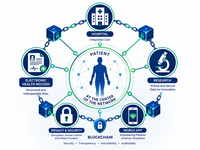
Background: Fragmentation of electronic health records in oncology hinders coordinated care, delays diagnoses, and limits therapeutic personalization. Blockchains promise to promote secure, interoperable, and patient-centered data governance; however, patient perceptions of blockchains remain underexplored, particularly in middle-income countries such as Brazil. Objective: We assessed opinions, attitudes, and willingness among patients with cancer to digitally share clinical information and the feasibility of applying blockchains to restructuring secure health data sharing in the Brazilian public health context. We had three research questions: (1) What is the level of digital health tool acceptance among patients with cancer in Brazil? (2) Which sociodemographic factors are associated with willingness to share health data? (3) Are blockchains feasible and acceptable for restructuring secure oncology data sharing? Methods: An exploratory, descriptive, cross-sectional self-report survey was conducted at Hospital Santa Izabel, a national oncology reference center in Salvador, Bahia, Brazil, between September and November 2023. A convenience sample of 110 outpatients with cancer was recruited systematically; data were collected via a self-administered questionnaire. The 20-item instrument, developed de novo and validated via expert panel and pilot testing, covered 5 content domains yielding 3 composite scoring domains: self-management, adherence, and governance. We used Cronbach α to assess internal consistency, independent 2-tailed tests, 1-way ANOVA, and Pearson correlations to compare domain scores across sociodemographic groups, and a chi-square goodness-of-fit test to examine trust proportions across recipient types. Results: We received sufficiently complete responses from 94.5% (104/110) of patients. The sample was predominantly female (63/98, 64.3%), self-identified as (mixed-race; 64/98, 65.3%), and lower income (55/96, 57.3% earned less than twice the minimum wage). Acceptance of technology was high: 86.4% (95/110) would use health apps and 89.1% (98/110) expressed interest in prevention-focused applications. Trust in data sharing varied significantly across recipient types (=210.4; <.001): 79.1% (87/110) trusted health care professionals, 51.8% (57/110) hospitals, 15.5% (17/110) the pharmaceutical industry, and 10% (11/110) the government. Anonymization and encryption significantly increased willingness to share (92/110, 83.6%). Younger patients (18‐59 years) showed significantly higher adherence scores than those aged ≥60 years (mean 76.49, SD 19.16 vs mean 65.83, SD 26.66; =2.29; =.02). Domain reliability was good to excellent (Cronbach α=0.8807 [adherence], 0.8504 [self-management], and 0.7576 [governance]). Conclusions: Patients with cancer in Brazil demonstrated high acceptance of digital health tools and openness to data sharing when privacy, security, and governance are guaranteed. This supports the feasibility of blockchain-based health data management systems, provided they incorporate patient-centered principles, digital inclusion strategies, and robust governance aligned with Brazilian regulations (the General Data Protection Law) and the Unified Health System (Sistema Único de Saúde) infrastructure. Importantly, patient support reflected acceptance of blockchain’s functional principles, data security, anonymization, and auditability rather than familiarity with the technology itself, a distinction with direct implications for future implementation studies. International Registered Report Identifier (IRRID): RR2-10.2196/89278