A machine learning model can improve genetic prediction of type 1 diabetes by as much as 10%, show results from a University of California, San Diego study.
The researchers used the machine‑learning model T1GRS to improve on a gold standard polygenic genetic risk score used to predict who is likely to develop the condition called GRS2.
Type 1 diabetes is an autoimmune condition that impacts around 2 million people in the U.S. While it is a multifactorial condition, genetics plays a big role and around 50% of a person’s susceptibility comes from genetics.
“The natural history of type 1 diabetes suggests that the disease occurs in genetically susceptible individuals exposed to environmental triggers, leading to the development of islet-specific autoantibodies and autoreactive T cells and progressive loss of insulin secretory function, although the underlying etiology is not fully understood,” write lead author Kyle Gaulton, PhD, associate professor of pediatrics at UC San Diego School of Medicine, and colleagues in Nature Genetics.
The GRS2 polygenic risk score has been widely tested and can be used to predict newborns who are at high risk of developing type 1 diabetes. While early prediction can’t necessarily stop the disease it can help to prevent emergencies like diabetic ketoacidosis at diagnosis, allow families time to prepare and could allow use of therapies to delay onset of the condition.
In this study, Gaulton and colleagues carried out a genome‑wide association study in 20,355 people with type 1 diabetes and 797,363 non‑diabetic Europeans, as well as a further analysis around the MHC region in 10,107 diabetic and 19,639 nondiabetic individuals.
“The MHC has ‘blocks’ of co-inherited genetic information that are very highly enriched in individuals with type 1 diabetes,” said co-first author Emily Griffin, PhD, a postdoctoral fellow in Gaulton’s lab. “If you have them, it doesn’t mean that you’re going to get diabetes, but if you don’t have them, it means you have a very low chance of getting diabetes.”
Overall 160 risk signals were identified, and the team trained their T1GRS model to predict who was likely to develop type 1 diabetes based on their genetics. The model was able to improve on the GRS2 model predictions by up to 10% in both populations of European and African American ancestry.
Overall the new score correctly flagged about 89 of 100 people with type 1 diabetes while correctly reassuring about 84 of 100 people without the disease.
“Our results highlight the value of combining the results of genetic association studies with machine learning methods to improve the prediction of complex diseases,” conclude the authors.
Cybersecurity was already under strain before AI entered the stack. Now, as AI expands the attack surface and adds new complexity, the limits of legacy approaches are becoming harder to ignore. This session from MIT Technology Review’s EmTech AI conference explores why security must be rethought with AI at its core, not layered on after the fact.
About the speaker
Tarique Mustafa, Cofounder, CEO, and CTO, GC Cybersecurity
Tarique Mustafa is Cofounder and CEO/CTO of two AI-powered cybersecurity companies: GCCybersecurity, Inc. and its data compliance spinout, Chorology, Inc. A prolific inventor and internationally recognized authority in knowledge representation, inference calculus, and AI planning, Tarique has spent his career applying autonomously collaborative AI to solve complex, ultra-high-scale challenges across cybersecurity, data security, and compliance — with deep expertise spanning Data Classification, DLP, and DSPM industries. His groundbreaking innovations and multiple USPTO patents have earned him global recognition, including frequent invitations to deliver keynote addresses at prestigious international security conferences and forums.
At GCCybersecurity, Tarique architected the core AI algorithms powering the company’s 4th and 5th generation fully autonomous data leak protection and exfiltration platform — among the most advanced platform of its kind. Prior to founding GCCybersecurity and Chorology, he served as founding CEO/CTO of NexTier Networks, a Silicon Valley provider of award-winning Data Leak Prevention solutions. With over 20 years of technical leadership experience, Tarique has held senior roles at Symantec, DHL Airways IT, MCI WorldCom, EDS, Andes Networks, and Nevis Networks, where he served as Principal Architect and built industry-leading security products leveraging next-generation security monitoring, event correlation, IDS/IPS, and SSL/IPSec technologies.
Tarique holds multiple approved and pending patents with the USPTO and has authored numerous research publications spanning Information & Data Security, Computer & Network Security, Software Architecture, Database Technologies, and Artificial Intelligence. A recipient of the prestigious Rotary International Scholarship for doctoral studies in Computer Science at the University of Southern California (USC), Tarique also holds master’s degrees in engineering and computer science from USC, and a bachelor’s degree in mechanical engineering from NED University of Engineering & Technology.
This is today’s edition of The Download, our weekday newsletter that provides a daily dose of what’s going on in the world of technology.
A new US phone network for Christians aims to block porn and gender-related content
A new US-wide cell phone network marketed to Christians is set to launch next week. It blocks porn using network-level controls that can’t be turned off—even by adult account owners.
It’s also rolling out a filter on sexual content aimed at blocking material related to gender and trans issues, optional but turned on by default across all plans.
The trouble is, many websites don’t fit neatly into one category. That leaves its maverick founder with broad, subjective control over what is allowed or banned. Read the full story.
—James O’Donnell
This startup’s new mechanistic interpretability tool lets you debug LLMs
The San Francisco–based startup Goodfire has released a new tool, Silico, that lets researchers peer inside an AI model and adjust its parameters during training. It could give users more control over how this technology is built than was once thought possible.
The goal is to make building AI models less like alchemy and more like a science. Using a technique called mechanistic interpretability, Silico maps the neurons and pathways inside a model and lets developers tweak them to reduce unwanted behaviors or steer outputs.
By exposing the “knobs and dials,” Goodfire hopes to bring AI training closer to traditional software engineering. Read the full story.
—Will Douglas Heaven
With mass firing, Trump deals a fresh blow to American science
This past week delivered another gut punch for science in the US. This time, the target was the National Science Foundation—a federal agency that funds major research projects to the tune of around $9 billion. On Friday, the 22 scientists overseeing those efforts were all fired.
Since 2025, the NSF has faced budget cuts, grant terminations, and mass firings, with staff numbers down sharply and many ambitious projects grinding to a halt. The result is a major shift in how American science is funded and governed. Discover what it means, and what’s next.
—Jessica Hamzelou
This article first appeared in The Checkup, MIT Technology Review’s weekly biotech newsletter. To receive it in your inbox every Thursday, and read articles like this first, sign up here.
China’s open-source bet: 10 Things That Matter in AI Right Now
Silicon Valley AI companies follow a familiar playbook: keep the models behind an API and charge for access. China’s leading AI labs are playing a different game, releasing “open-weight” models that developers can download, adapt, and run on their own hardware.
That approach went mainstream after DeepSeek open-sourced its R1 model, which matched top US systems at a fraction of the cost. It also won something subtler: goodwill with developers. A growing cohort of Chinese labs is now following the same blueprint.
As AI shifts from hype to deployment, open-source models are making the future of AI more multipolar than Silicon Valley expected. Read the full story.
—Caiwei Chen
China’s open-source bet is one of the 10 Things That Matter in AI Right Now, our list of the biggest ideas, trends, and advances in AI today. We’re unpacking one item from the list each day here in The Download, so stay tuned.
The must-reads
I’ve combed the internet to find you today’s most fun/important/scary/fascinating stories about technology.
1 Elon Musk has admitted that xAI trained Grok on OpenAI models “Distillation” is standard practice in AI, despite being legally dubious. (Wired $) + The White House has accused Chinese firms using distillation of theft. (BBC) + American labs are widely assumed to use similar techniques. (TechCrunch)
2A “de-extinction” startup wants to resurrect a long-lost antelope Colossal Biosciences wants to bring back the bluebuck. (Axios) + The company is using genomic editing to revive the animal. (Gizmodo) + It previously claimed to have cloned red wolves. (MIT Technology Review)
3 An OpenAI model outperformed ER doctors at diagnosing patients By analyzing health records data and information provided to physicians. (NPR) + But it still must be proven in real-world clinical trials. (Vox)
4Scientists are trying to power AI data centers with tiny nuclear reactors They could provide a new way to meet AI’s energy demands. (Gizmodo) + We did the math on AI’s energy footprint. (MIT Technology Review)
5Spotify has started verifying human artists A new badge will distinguish them from AI. (The Guardian) + Spotify has faced criticism for its handling of AI. (BBC)
6The US is backing a Congolese railway to break China’s grip on critical minerals The old railroad is key to the race for critical metals in Africa. (Rest of World) + The US is also searching for alternative sources. (MIT Technology Review)
7Huawei is set to overtake Nvidia in China’s AI chip market It’s expected to capture the largest market share this year. (FT $)
8Japan is building cardboard drones for the battlefield The flatpack designs are cheap, disposable, and built at scale. (404 Media)
9 The more young people use AI, the more they hate it Research shows that Gen Z doesn’t trust GenAI. (The Verge)
10 A new organoid can menstruate—and show how tissue repairs itself It’s revealing how the uterus can shed without scarring. (Nature)
Quote of the day
“I suspect that there are a number of people who do not want to put the future of humanity in Mr Musk’s hands.But we’re not going to get into that.”
—Judge Gonzalez Rogers rebukes attempts by Elon Musk’s lawyer to focus on AI’s existential risks as part of his lawsuit against OpenAI, the New York Times reports.
One More Thing
TMY350 VIA WIKIMEDIA COMMONS
This rare earth metal shows us the future of our planet’s resources
The materials we need to power our world are shifting from fossil fuels to energy sources that don’t produce greenhouse gas emissions.
Take neodymium, a rare earth metal used in powerful magnets that power everything from smartphones to wind turbines. Its story reveals many of the challenges we’ll likely face across the supply chain in the coming century and beyond.
BackgroundDepressive disorders are clinically heterogeneous and mechanistically complex psychiatric conditions. Transcranial direct current stimulation (tDCS), a key non-invasive neuromodulation technique, has expanded rapidly in both therapeutic application and mechanistic research. However, the field is marked by rapid publication growth, thematic diversity, and variability in evidence quality. A systematic quantitative synthesis is therefore needed to map the research landscape, identify hotspots, and inform future directions.MethodsA systematic search was conducted for English-language publications in the Web of Science Core Collection (WoSCC), Scopus, and PubMed using the terms (“Transcranial direct current stimulation” OR “tDCS”) AND (“depression” OR “major depressive disorder” OR “depressive disorder” OR “MDD”). Only articles and reviews were included. Records from 2026 and non-research publications, including conference abstracts, editorials, letters, news items, and errata, were excluded. Deduplication was performed using DOI-based matching followed by title-assisted matching. Bibliometrix (R), VOSviewer, and CiteSpace were used to analyze publication trends, contributions by countries/regions, institutions, authors, and journals, collaboration networks, keyword co-occurrence, thematic clustering, and burst terms. Citation analysis was based on WoSCC data only.ResultsResearch on tDCS for depression showed sustained growth, with marked acceleration after 2020 and a peak in 2024. The United States, Germany, and Brazil occupied central positions in both productivity and international collaboration, with the United States ranking first in publication volume. Major research hubs included the Universidade de São Paulo, the University of Toronto, and Harvard University, while Brain Stimulation, Journal of Affective Disorders, and Frontiers in Psychiatry were the leading publication venues. Highly cited studies mainly focused on neurophysiological mechanisms, pivotal randomized controlled trials, and evidence-based guidelines. Keyword analyses indicated a shift from early attention to cortical excitability, safety, and short-term efficacy toward a more integrated framework involving prefrontal-targeted stimulation, cognitive function, functional connectivity, treatment outcomes, and cross-disorder applications.ConclusiontDCS research in depression is entering a multidimensional and interdisciplinary phase, with increasing emphasis on network-level mechanisms and precision intervention. Functional connectivity is emerging as a potential biomarker for patient stratification and outcome prediction. Further progress depends on multicenter standardization, reproducible analytic pipelines, and high-quality comparative effectiveness research.
Cell and gene therapy encompasses a broad range of therapeutic interventions for diseases that have proved refractory to treatment with conventional pharmaceutical approaches. Perhaps the most familiar FDA-approved modality in the cell and gene therapy field is chimeric antigen receptor (CAR) T-cell therapy, which involves genetic modification of a patient’s own T cells to identify and eliminate malignant cell lineages in acute lymphoblastic leukemia, non-Hodgkin lymphoma, and multiple myeloma.
Although only 20 or so cell or gene therapies have been FDA-approved, the area holds considerable promise for investment. The global market was valued at nearly $9 billion in 2025, and growth has been projected at over 15% per year from 2026 to 2035. As with any pharmaceutical product, however, the potential of cell and gene therapy relies in large part upon minimizing risks to patient health from adverse effects. Numerous companies, from both prominent names in the field to smaller startups, are developing solutions to mitigate the deleterious consequences of cell and gene therapy.
Reducing cytokine release syndrome
Cytokines are a broad family of small proteins and peptides that cell lineages of the innate and adaptive immune systems employ to communicate with each other and coordinate timely and appropriately scaled responses to foreign antigen-containing cells. Cytokine release syndrome (CRS) occurs when hyperactivation of one or more immune lineages results in the release of excessive quantities of cytokines into the circulation.
“As a scientific community, we’ve been researching CAR T-cell therapy for over 30 years and have grown together in our understanding of the body’s immune response to treatment, from both a safety and efficacy perspective,” says Rosanna Ricafort, MD, vice president and global program lead of hematology and cell therapy at Bristol Myers Squibb. “We have evolved our ability to characterize, stage, and manage potential side effects, allowing for timely and thoughtful interventions of the most commonly associated side effects like CRS.”
Ricafort cited clinical data presented at the 2025 American Society for Clinical Oncology (ASCO) meeting in Chicago demonstrating that over 95% of instances of CRS and other adverse events arising from BMS’s CD19-directed CAR T-cell therapy (BreyanziR) occurred in the first two weeks after onset of therapy. “These and other studies have helped establish the largely predictable safety profile of CAR T-cell therapy to date,” Ricafort pointed out.
Minimizing side effects
The NF-κB and prostaglandin E2 pathways are prominent regulators of the activation and differentiation of pro-inflammatory T cell lineages. Excessive signaling through these pathways results in cytokine amplification, which contributes to CRS and immune effector cell-associated neurotoxicity syndrome (ICANS), a complication of some types of CAR T-cell therapy.
CytoAgents, a clinical-stage biotech company, is developing CTO1681, an orally administered prostaglandin signaling inhibitor that has been shown to offset CRS and ICANS toxicities associated with CAR T-cell therapy of lymphoma patients. At the 2025 European Society for Medical Oncology (ESMO) Immuno-Oncology Congress in London, CytoAgents presented non-clinical data showing that CTO1681 treatment reduced secretion of TNF-α, IL6, and other key CRS-associated cytokines with no impairment of CAR T-cell mediated cytotoxicity on lymphoma cells.
“These data suggest CTO1681 could enable safer CAR T-cell therapy administration, support outpatient treatment paradigms, and broaden patient access without compromising anti-tumor efficacy,” said Teresa Whalen, CEO at CytoAgents. CTO1681 is currently in Phase Ib/IIa trials for cancer patients undergoing CAR T-cell therapy, with potential expansion into additional therapeutic spaces including asthma and chronic obstructive pulmonary disease.
Adding immunosuppressants
A potential side effect of adeno-associated virus (AAV)-based gene transfer approaches is acute liver injury resulting in part from CRS in patients receiving AAV therapy. Duchenne muscular dystrophy (DMD) is a progressive, degenerative muscular disorder caused by mutations or changes in the DMD gene, resulting in reduced levels of the protein dystrophin.
Credit: Kateryna Con / Getty Images / Science Photo Library
Elevidys, developed by Sarepta Therapeutics, is an AAV-based therapy approved for the treatment of DMD that stimulates targeted production of a truncated form of dystrophin in skeletal muscle. “Individuals with non-ambulatory Duchenne face profound unmet need and fewer treatment options,” says Louise Rodino-Klapac, PhD, president of R&D and development and technical operations at Sarepta. Topline data released earlier this year showed that Elevidys treatment resulted in significant improvement in key clinical ambulatory metrics in patients.
As part of its ENDEAVOR clinical trial, Sarepta Therapeutics is evaluating the potential of supplementing Elevidys with sirolimus to reduce potential acute liver injury (ALI) complications. Sirolimus is a mammalian target of rapamycin (mTOR) kinase inhibitor that suppresses responses of T and B cells to interleukin 2, which functions to stimulate proliferation of helper, cytotoxic, and regulatory T cells.
Developing non-integrating therapies
As an alternative approach to supplementing cell and gene therapy modalities with existing immunosuppressants, other companies are modifying CAR T-cell therapy to reduce the risk of CRS and other side effects. Myasthenia gravis, a chronic fatigue-inducing autoimmune disorder in which signals between nerves and muscles are compromised, results in part from the secretion of autoantibodies from B-cell maturation antigen (BCMA)-expressing B plasma cells.
Conventional BCMA-directed CAR T-cell approaches rely on the integration of lentiviral or gamma-retroviral vectors to encode the CAR and typically involve lymphodepletion chemotherapy that can be accompanied by acute and delayed toxicity. In contrast, non-integrating (i.e., mRNA-based) BCMA-directed CAR T-cell therapies may circumvent this toxicity due to the lack of requirement for chemotherapy.
Cartesian Therapeutics is developing an mRNA-based BCMA-targeted CAR T-cell therapy for myasthenia gravis, Descartes-08. At the 2025 American Academy of Neurology (AAN) Annual Meeting in San Diego, results were reported of a Phase IIb clinical trial of Descartes-08 in myasthenia gravis. In the trial, adverse event rates were similar between groups receiving Descartes-08 and the placebo group, and were predominantly mild to moderate in nature, with no cases of CRS or ICANS reported.
“The impressive strength and duration of response shown in the data reinforce our confidence in the potential of Descartes-08 to transform the current treatment landscape in MG, offering patients a safe, flexible, and durable treatment option,” said Carsten Brunn, PhD, president and CEO of Cartesian.
Engineering chimeric receptors
Modifications of CAR T-cell therapy to improve clinical efficacy and reduce side effects can also encompass modification of the molecular structure of the chimeric receptor itself. D domains are highly selective targeting domains incorporated into newer generations of CARs that enhance targeting of pathological cell types and reduce immunogenic responses in patients that give rise to unwanted side effects.
One example of such next-generation CAR T-cell therapies, anito-cell, has been co-developed by Arcellx, Kite Pharma, and Gilead. Anito-cel is an autologous anti-BCMA CAR T-cell therapy for the treatment of relapsed/refractory multiple myeloma patients.
Phase II trial results in multiple myeloma presented at the 2025 American Society of Hematology (ASH) meeting in Orlando showed an overall response rate of 97% and a complete response rate of 68%. Importantly, in the context of side effects, there were no delayed neurological symptoms, and for most patients, only low-grade CRS was observed, which was resolved within a few days.
“The anito-cel D-domain BCMA binder could be important to our work in in vivo cell therapy, further strengthening our potential in oncology and inflammation,” said Daniel O’Day, chairman and CEO of Gilead. “Anito-cel could become a foundational treatment for multiple myeloma over time, including earlier lines of therapy.”
The groundbreaking partnership that successfully treated a rare metabolic disorder in KJ Muldoon, or “Baby KJ,” with personalized CRISPR therapy last year has led therapy developers, researchers, and regulators, including the FDA, to craft a pathway for expanding the universe of gene therapies to advance the development of N-of-1 gene-editing therapies.
In February, the FDA unveiled its Plausible Mechanism Pathway draft guidance, a series of initiatives designed to increase regulatory flexibility and spur the development of bespoke gene-editing therapies for rare and ultra-rare disorders, which collectively total about 30 million individuals in the United States.
“The Agency anticipates that substantial evidence of effectiveness for individualized therapies could be established based on a single adequate and well-controlled clinical investigation with confirmatory evidence,” the draft guidance stated.
Last June, at a historic roundtable of cell and gene therapy researchers and clinicians hosted by the FDA, base editing pioneer David Liu, PhD, of Harvard University and the Broad Institute of MIT and Harvard, stated: “With sufficient organization and federal support and partnership with the FDA, I believe it will be possible by 2030 to treat at least 1,000 patients with personalized genetic treatments.”
Meanwhile, conventional gene therapy development continued in 2025. Last year saw four U.S. gene therapy approvals, bringing the number of FDA-approved gene and cell therapies up to 26, according to the American Society of Gene and Cell Therapies (ASGCT)—more than half of the 40 tallied by the organization as being approved worldwide.
Of those 26, 18 were gene therapies, of which 10 had disclosed sales high enough to be included on this A-List, which ranks top-selling gene therapies based on sales and net product revenue figures furnished by the companies in regulatory filings, annual reports, and/or press releases. Each gene therapy is listed with its sponsor(s), type, indication, and initial FDA approval date.
Not included are gene therapies with sales below the top 10, a category that includes two gene therapies approved in 2025: Precigen’s Papzimeos (zopapogene imadenovec-drba), which generated $3.4 million in net product revenue last year after becoming the first-and-only FDA-approved treatment for adults with recurrent respiratory papillomatosis (RRP) in August; and Abeona Therapeutics’ Zevaskyn® (prademagene zamikeracel), an autologous cell sheet-based gene therapy approved to treat wounds in adults and children with recessive dystrophic epidermolysis bullosa (RDEB).
Three gene therapies did not have disclosed sales in 2025, including:
Encelto (revakinagene taroretcel-lwey), an allogeneic encapsulated cell-based gene therapy marketed by Neurotech Pharmaceuticals and indicated for the treatment of adults with idiopathic macular telangiectasia type 2 (MacTel).
Imlygic® (talimogene laherparepvec), a genetically modified oncolytic viral therapy marketed by BioVex (Amgen) and indicated for local treatment of unresectable cutaneous, subcutaneous, and nodal lesions in patients with melanoma recurrent after initial surgery.
Waskyra (etuvetidigene autotemcel), a cell-based gene therapy and the first FDA-approved treatment for Wiskott-Aldrich syndrome (WAS). Developer Fondazione Telethon is the first non-profit organization to have successfully led full development of an ex vivo gene therapy from lab research (at Milan’s San Raffaele Telethon Institute for Gene Therapy or SR-Tiget) to regulatory approval.
Also not included this year are sales of three gene therapies that had been marketed by Bluebird Bio: Beta thalassemia treatment Zynteglo (betibeglogene autotemcel), sickle cell disease treatment Lyfgenia® (lovotibeglogene autotemcel), and cerebral adrenoleukodystrophy (CALD) treatment Skysona® (elivaldogene autotemcel).
Last year, Bluebird Bio went private after being acquired by funds managed by Carlyle and SK Capital Partners, then rebranded in September as Genetix Biotherapeutics. Genetix does not disclose sales but did announce on March 2 that more than 100 patients received infusions of the three gene therapies during 2025.
Also last year, Pfizer halted development and commercialization of Beqvez (fidanacogene elaparvovec-dzkt), which had been co-marketed with Roche-owned Spark Therapeutics, after it generated no sales in 2024. Last August, Pfizer terminated its license agreement with Spark for Beqvez, an adeno-associated virus (AAV) vector-based gene therapy indicated for forms of moderate to severe hemophilia B in adults.
Top 10 Best Selling Gene Therapies
1. Zolgensma®(onasemnogene abeparvovec-xioi)
2025 Sales:$1.232 billion1
Sponsor(s): Novartis2
Type: AAV vector-based gene therapy
Indication(s): Treatment of pediatric patients less than two years of age with spinal muscular atrophy (SMA) with biallelic mutations in the survival motor neuron 1 (SMN1) gene.
Initial FDA Approval Date: May 24, 2019
2. Elevidys® (delandistrogene moxeparvovec-rokl)
2025 Sales:$898.7 million
Sponsor(s): Sarepta Therapeutics
Type: AAV vector-based gene therapy
Indication(s): Treatment of ambulatory pediatric patients aged four through five years with Duchenne muscular dystrophy (DMD) with a confirmed mutation in the DMD gene.3
Initial FDA Approval Date: June 22, 2023 (Accelerated Approval)
3. Vyjuvek® (beremagene geperpavec-svdt)
2025 Sales:$389.13 million
Sponsor(s): Krystal Biotech
Type: Herpes-simplex virus type 1 (HSV-1) vector-based gene therapy
Indication(s): Treatment of wounds in patients six months of age and older with dystrophic epidermolysis bullosa with mutation(s) in the collagen type VII alpha 1 chain (COL7A1) gene.
Indication(s): Treatment of adults with high-risk Bacillus Calmette-Guérin (BCG)-unresponsive non-muscle invasive bladder cancer (NMIBC) with carcinoma in situ (CIS) with or without papillary tumors.
Initial FDA Approval Date: December 16, 2022
5. Casgevy® (exagamglogene autotemcel; “exa-cel”)
2025 Sales:$115.8 million
Sponsor(s): Vertex Pharmaceuticals and CRISPR Therapeutics
Indication(s): Treatment of patients aged 12 years and older with sickle cell disease with recurrent vaso-occlusive crises (VOCs), or transfusion-dependent β-thalassemia (TDT).
Initial FDA Approval Date: December 8, 2023
6. Hemgenix®(etranacogene dezaparvovec-drlb)
2025 Sales:A$92 million ($64.9 million)4
Sponsor(s): CSL Behring
Type: AAV vector-based gene therapy
Indication(s): Treatment of adults with Hemophilia B (congenital Factor IX deficiency) who currently use Factor IX prophylaxis therapy, or have current or historical life-threatening hemorrhage, or have repeated, serious spontaneous bleeding episodes.
Indication(s): Treatment of patients with confirmed biallelic RPE65 mutation-associated retinal dystrophy. Patients must have viable retinal cells as determined by the treating physician(s).
Initial FDA Approval Date: December 18, 2017
9. Lenmeldy / Libmeldy(atidarsagene autotemcel)6
2025 Sales:¥6.4 billion ($40.2 million)
Sponsor(s): Orchard Therapeutics (a wholly owned subsidiary of Kyowa Kirin)
Indication(s): Treatment for children with pre-symptomatic late infantile (PSLI), pre-symptomatic early juvenile (PSEJ), or early symptomatic early juvenile (ESEJ) metachromatic leukodystrophy (MLD).
Indication(s): Treatment of adults with severe hemophilia A (congenital factor VIII deficiency with factor VIII activity < 1 IU/dL) without pre-existing antibodies to AAV serotype 5 detected by an FDA-approved test.
Initial FDA Approval Date: June 30, 2023
References
Includes sales of ITVISMA® (onasemnogene abeparvovec-brve), approved by the FDA in November 2025 to treat SMA in adult and pediatric patients two years of age and older with a confirmed mutation in the SMN1 gene. ITVISMA has the same active ingredient as Zolgensma but is administered via a single intrathecal injection, while Zolgensma is administered intravenously.
Novartis is the successor to AveXis, which successfully completed the development of Zolgensma in 2019 by receiving FDA approval for the therapy. In 2014, AveXis licensed from REGENXBIO the AAV9 vector used in the Phase I SMA clinical trial at Nationwide Children’s Hospital. REGENXBIO licensed exclusive rights to key intellectual property covering novel recombinant AAV vectors discovered at the University of Pennsylvania in the lab of James M. Wilson, MD, PhD.
Following the deaths of two DMD patients receiving Elevidys last year, Sarepta halted shipments of Elevidys for non-ambulatory patients and paused the Phase III ENVISION trial (NCT05881408). The study remained paused at deadline. Following a third death, that of an eight-year-old Brazilian boy, the FDA demanded Sarepta pause shipments of Elevidys to ambulant patients. Sarepta initially refused before agreeing in July 2025. A few days later, after an FDA reversal, Sarepta resumed Elevidys shipments to ambulant patients, after Brazilian authorities ruled out treatment with the gene therapy as a factor in the boy’s death.
Sales figure is for the fiscal year ending June 30, 2025. CSL Behring has since disclosed sales of $57 million ($40.2 million) for July–December 2025 but has only furnished a comparison to the year-ago period in terms of constant currency without disclosing a specific sales figure.
Eladocagene exuparvovec-tneq is marketed as Kebilidi in the U.S. and as Upstaza outside the U.S.
Atidarsagene autotemcel is marketed as Lenmeldy in the U.S. and as Libmeldy within the European Union.
Kunwoo Ryan Lee, PhD, knew as early as 2012 that solving the delivery problem would be crucial in fulfilling the promise of the newly discovered CRISPR-Cas9 gene editing technology. He felt strongly that gene editing had potential to transform medicine by curing genetic disorders, but the viral and non-viral vectors available at the time had significant drawbacks. With the support of CRISPR pioneers Jennifer Doudna and Stanley Qi, Lee completed his doctoral thesis on a gold nanoparticle delivery system for Cas9 ribonucleoprotein. He went on to co-found BreezeBio, formerly GenEdit, in 2016 with the aim of creating the next generation of gene editing-based therapeutics. To realize that goal, Lee and his team looked beyond traditional viral gene delivery systems and instead invented a new technology from the ground up.
Most clinical gene therapy trials use viral vectors, including retroviruses, lentiviruses, adenoviruses, and adeno-associated viruses. However, viral vectors are limited in the size of the gene they can deliver. They also tend to trigger strong immune reactions and usually can’t be dosed more than once due to acquired immunity.
Non-viral vectors are an alternative technology that offer greater gene loading capacity, more straightforward preparation, and less likelihood of triggering problematic immune reactions. BreezeBio and other biotechnology companies are reimagining gene delivery through non-viral approaches like targeted LNPs, transposons, and novel chemistry.
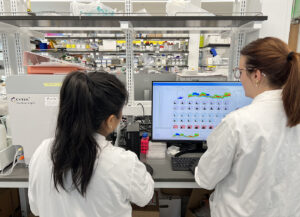
Flow cytometry analysis of immune cells in BreezeBio’s laboratory. [BreezeBio]
BreezeBio’s hydrophilic nanoparticle (HNP) platform, NanoGalaxy, hearkens back to Lee’s doctoral work. Lee said he and his cofounders realized that a hydrophobic molecule was needed to deliver a gene payload into cells, because the cell membrane is a lipid bilayer. Lee also noted that the best molecule for targeting different cell types is an antibody, a hydrophilic molecule. Pairing these two elements introduced a complex manufacturing challenge that the company solved by using a polyamide as a backbone structure and conjugating a hydrophobic small molecule to that backbone for targeting, resulting in the hydrophilic HNP. The company then used artificial intelligence to optimize HNPs for different tissue types.
“Using the platform, we have demonstrated that we can deliver to the spleen, immune system, heart, and lung,” Lee said. The firm also developed a set of nanoparticles targeted to the central nervous system.
Based on those targeted delivery profiles, the Brisbane, California-based BreezeBio has worked with multiple partners to provide delivery solutions for their products, including a multiyear collaboration with Genentech, a member of the Roche Group, signed in 2024. Meanwhile, the company is also advancing its own pipeline of therapeutics built on the NanoGalaxy platform, including a lead candidate for type 1 diabetes, as well as investigational therapies for autoimmune disease and cancer.
Lee said a key advantage of the NanoGalaxy platform for their pipeline, which heavily leans toward autoimmune disease, is that, unlike a viral vector, the company’s studies have shown it does not activate the innate immune system. “That enabled us to use our technology for autoimmune applications and in more targeted oncology applications, as well,” Lee said.
Snug as a bug in a rug
The red flour beetle, a notorious scourge of grain and cereal stores, is the surprising source of Bio-Techne’s transposon-based, non-viral gene delivery system. The system, dubbed TcBuster for the beetle’s scientific name, Tribolium castaneum, was invented by B-MoGen, a spin-out of the University of Minnesota, which was acquired in 2019 by Minneapolis-based Bio-Techne. Researchers at B-MoGen and Bio-Techne developed a hyperactive version of the natural TcBuster transposon by creating a library of three million unique genetic variants and screening each in mammalian cells. In a proof-of-concept study, CAR NK cells engineered using TcBuster demonstrated in vitro functionality and improved survival in a preclinical model of Burkitt lymphoma with a single dose.1
“The reason you want a hyperactive version is that wild-type transposon systems are fairly low activity,” said Miles Smith, PhD, a product manager for cell and gene therapy at Bio-Techne. “For generating a cell therapy, you want something that’s going to be comparable to the state of the field, and that’s lentivirus.”
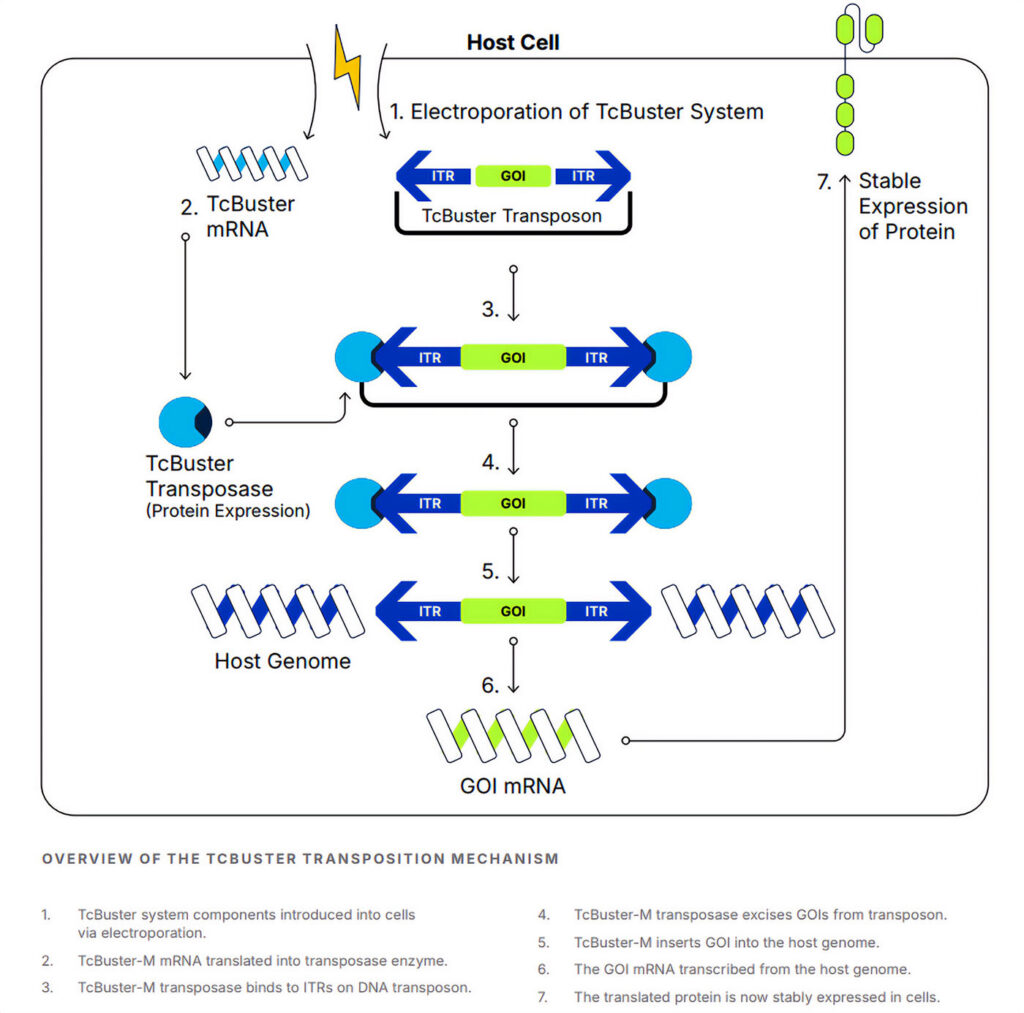
The TcBuster system is electroporated into cells where its components are translated, and TcBuster transposes and excises genes of interest and inserts DNA cargo into the host cell genome. [Bio-Techne]
Smith said the TcBuster system, which comprises an mRNA encoding transposase and a DNA transposon, can be produced faster than a lentiviral vector. The system is also more scalable, more cost-effective, and has increased gene cargo capacity, according to Smith. TcBuster can deliver multiple genes in a single vector, and it can be multiplexed with other gene therapy tools. “If you wanted to use base editors or CRISPR-based knockout gene editing in conjunction with TcBuster, you could do that in one step, compared to multiple steps with a viral system,” Smith said.
Unlike other commercial transposon systems for gene delivery, like Sleeping Beauty and PiggyBac, Smith said TcBuster is not restricted by exclusive licensing. “The turnaround time for GMP material is just a couple of months,” Smith said. “Versus something that might take a lot longer if you have to go through licensing or create a viral batch.”
Gene therapy SORTed
ReCode Therapeutics is developing a pipeline of genetic medicines based on its selective organ targeting (SORT) LNP platform, which adds an additional lipid to the standard LNP formulation, allowing it to zero in on specific organs. Conventional LNPs comprise four lipids—cholesterol, a helper phospholipid, a PEGylated lipid, and an ionizable lipid—that encapsulate a therapeutic gene cassette. These traditional LNPs are primarily taken up by the liver after intravenous administration, limiting their usefulness for other organs and systems. ReCode engineered its SORT LNPs with a biochemically distinct fifth lipid that enables the body to direct the particle to the targeted organ, such as the lung or spleen, bypassing the liver, if necessary.
“Because mRNA in a cell has a relatively short half-life, maybe a day or so, in order to have constant protein production, you need to administer it relatively frequently,” Vladimir Kharitonov, PhD, senior vice president of CMC and pharmaceutical sciences at ReCode, said. “With viral delivery, you can’t really administer it repeatedly.”
Scientists conducting qualification of the semi-automated filling and stoppering machines at ReCode’s laboratory in Menlo Park. [ReCode]
The Menlo Park, California-based firm’s two clinical-stage therapies are given by inhalation using a nebulizer. SORT lipids enable targeting specific cell types in the lung epithelium.
In 2024, ReCode presented preclinical data from its cystic fibrosis program showing its mRNA-based therapeutic RCT2100 significantly restored CFTR function in human bronchial epithelial cells derived from patients with cystic fibrosis. In vivo studies using a ferret model demonstrated improvement in mucociliary clearance. ReCode launched the first clinical trial of RCT2100 later that year. The LNP for RCT2100 contains SORT lipids to fine-tune its delivery to the airway epithelial cell types that have a defective or mutated CFTR protein, causing cystic fibrosis. The company is also developing a second mRNA therapy delivered via SORT LNP, RCT1100, for primary ciliary dyskinesia, which targets different cell types in the lung epithelium.
From idea to therapy faster
Gene delivery is just one of many services offered by GenScript to support research from discovery through clinical testing, including gene synthesis, CRISPR reagents, antibodies, and more.
“Gene editing is entering a new era, and the focus has shifted from discovery to translation,” said Jianpeng Wang, PhD, senior director of nucleic acid and peptide R&D at GenScript. “Our goal at GenScript is to help scientists move from idea to therapy faster.”
When it comes to non-viral vectors, the firm offers off-the-shelf and bespoke solutions to fit the customer’s need for delivery of DNA, RNA, siRNA, peptides, and other molecules. Through its targeted LNP service, GenScript offers LNPs designed to enhance precision in directing genetic material to cells. GenScript’s ReadyEdit LNP solutions include Cas9 knock-in and knock-out, Cas12 knock-out, and base or prime editing tailored for the customer’s needs.
“In our ecosystem, we include all of the materials needed,” Wang said. “This integration can help scientists evaluate gene editing efficiency early, both ex vivo and in vivo.”
Wang said the choice of a vector is heavily dependent on the specific therapeutic program. “There isn’t a universally effective or better way to deliver a therapy, either viral or non-viral,” Wang said. He noted, for example, that viral vectors remain a good choice when long-term gene expression is desired. And for viral vectors, the manufacturing process might be more mature, easing transfer to a contract development and manufacturing organization.
However, Wang cautioned that viral vectors still present certain safety concerns. “In recent years, an increasing number of scientists and the FDA have recognized these risks,” he said, “leading to a surge in interest for non-viral delivery methods—particularly for in vivo CAR T therapy and gene editing.”
GenScript has provided LNP services to several customers globally. The most advanced of those is using GenScript’s GMP CRISPR materials (gRNA, HDR templates, and nuclease) alongside a customized LNP encapsulation recipe and is preparing an investigational new drug application.
Foundational LNP science
Vancouver-based Genevant traces its scientific lineage through a string of predecessor companies dating back to the early 2000s and controls foundational intellectual property for the field. Based on its scientists’ work at Protiva Biotherapeutics, the intellectual property comes to Genevant via Arbutus Biopharma, which acquired Protiva in 2015 and partnered with Roivant in 2018 to establish Genevant.
Unlike many companies developing nucleic acid delivery platforms that focus on a single payload modality, Genevant has applied its LNP to many payloads, including mRNA, siRNA, and gene editors in fields spanning antiviral, oncology, and metabolic disorders. The firm’s LNP platform is part of the first RNA-LNP product to achieve regulatory approval, Alnylam Pharmaceuticals’ Onpattro (patisiran), a treatment for polyneuropathy in people with hereditary transthyretin-mediated amyloidosis. Genevant’s LNP technology is also behind Moderna’s COVID-19 vaccines, which were confirmed earlier this month with the resolution of a longstanding patent dispute. An infringement case against Pfizer and BioNTech is pending. Genevant collaborated with Chula Vaccine Research Center and the University of Pennsylvania to develop a COVID vaccine for low- and middle-income countries in Southeast Asia during the pandemic. The program had success, demonstrating non-inferiority to Pfizer and BioNTech’s Comirnaty in clinical trials.
Some key differentiators for Genevant’s LNPs include strategies for optimized delivery in non-human primates instead of mice,2 which has resulted in improved gene editing in the liver, and novel chemistries for biodegradable LNPs that prevent accumulation in tissue.3 The company has recently disclosed data showing targeted delivery to T cells for in vivo CAR T therapy, as well as hematopoietic stem and progenitor cells (HSPC) and hepatic stellate cells.
References
Skeate JG, Pomeroy EJ, Slipek NJ, et al. Evolution of the clinical-stage hyperactive TcBuster transposase as a platform for robust non-viral production of adoptive cellular therapies. Mol Ther. 2024;32(6):1817-1834. doi:10.1016/j.ymthe.2024.04.024
Lam K, Schreiner P, Leung A, et al. Optimizing lipid nanoparticles for delivery in primates. Adv Mater. Published online March 27, 2023. doi: 10.1002/adma.202211420
According to the American Brain Foundation, over one in three people around the world are affected by neurological conditions, the leading cause of illness and disability worldwide. This silent epidemic is not country-specific. Neurological conditions such as lysosomal storage disorders, rare enzyme deficiencies, and Alzheimer’s and Parkinson’s disease take their victims, regardless of age, race, or location.
For decades, scientists have struggled to deliver therapeutics to the brain, only to be thwarted by the highly protective blood-brain barrier (BBB). First-generation approaches demonstrated proof of principle but still require advancements to improve the ability to reach specific areas of the brain, or specific cell types, safely, and with sufficient dosage to enable meaningful therapeutic effects.
Although much remains unknown generally about brain biology and its defensive mechanisms, novel therapies for devastating neurological diseases are progressing into clinical trials. There is no magic bullet—no promises, no cures—but a gleaming light can be seen in this particular long and dark tunnel.
Dedicated scientists continue to work on gene therapies for the indications that most benefit from a once-and-done approach, in addition to neurological shuttles to address those disorders that require therapeutic tempering and dosage control.
Expanding platform technologies
In 2021, JCR Pharmaceuticals received regulatory approval for the first biotherapeutic, IZCARGO (pabinafusp alfa), designed to cross the BBB to deliver a therapeutic enzyme for the treatment of a lysosomal storage disorder called mucopolysaccharidosis type II (MPS II) or Hunter syndrome.
The platform technology has been expanded to exploit receptor-mediated transcytosis (RMT) to address other lysosomal storage and neurodegenerative diseases. Still, delivery to specific cells or parts of the brain remains challenging, along with efficient delivery of antisense oligonucleotides or siRNA.
“The issue is not delivery across the BBB, but the endosomal escape to efficiently suppress the target RNA,” said Hiroyuki Sonoda, PhD, representative director, president, and CSO, at JCR Pharmaceuticals. “Small molecule CNS delivery is related to physicochemical properties. The structural design needs to make them lipophilic, yet also able to evade typical transporter clearing mechanisms.”
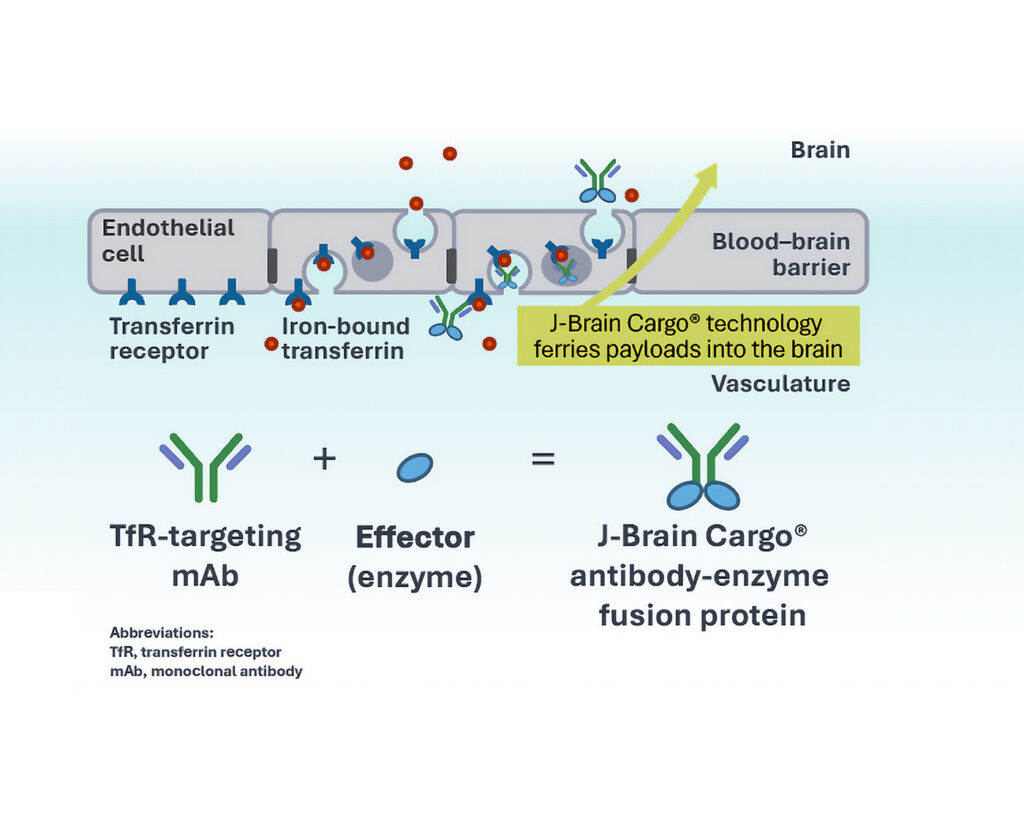
The first approved blood-brain barrier penetration technology was developed into the J-Brain Cargo platform that can help drugs cross the blood-brain barrier. [JCR Pharmaceuticals]
J‑Brain Cargo® uses RMT, mainly focusing on the transferrin receptor (TfR). Other promising candidates target different receptors. “We have successfully transported enzymes, antibodies, peptides, decoy receptors, antisense oligos, and siRNA into the CNS,” commented Sonoda. J‑Brain Cargo is particularly suited for enzyme replacement therapies in lysosomal storage disorders and conditions where dose control, reversibility, and titration are important.
For gene therapies, JCR developed the JUST-AAV platform technology. Novel changes in the capsid almost completely eliminate liver tropism. The modified capsids express miniaturized antibodies on the capsid surface against receptors on selected tissues, organs, or the BBB, enhancing targeted delivery. JUST‑AAV is for diseases where continuous transgene expression is desired to achieve the optimal effect.
Several candidates are in global clinical trials, including JR-141 (pabinafusp alfa) for individuals with MPS II (also known as Hunter syndrome), JR-171 to treat MPS I (also known as Hurler, Hurler Scheie, or Scheie syndromes), and JR-441 for individuals with MPS IIIA (also known as Sanfilippo syndrome A).
Programs in collaboration with MEDIPAL HOLDINGS CORPORATION are in different stages of clinical and pre-clinical development for individuals with MPS IIIB (also known as Sanfilippo syndrome B), Fucosidosis, and GM2 gangliosidosis (including Tay-Sachs and Sandhoff disease).
Collaborating with leading pharmaceutical companies is core to JCR’s strategy to bring these platform technologies to broader application. “We enable our partner by turning their biologics into CNS-penetrating versions of their original molecule,” said Sonoda.
JCR manufactures most of its drug products in-house. Last year, they were selected for the Ministry of Economy, Trade and Industry’s “Regenerative CDMO Subsidy” to expand biomanufacturing capacity for regenerative, cell, and gene therapies.
Optimizing BBB transport
“Protein engineering architecture differentiates our delivery technology along with its optimization for efficacy, safety, and tolerability,” said Ryan Watts, PhD, co-founder and CEO of Denali Therapeutics.
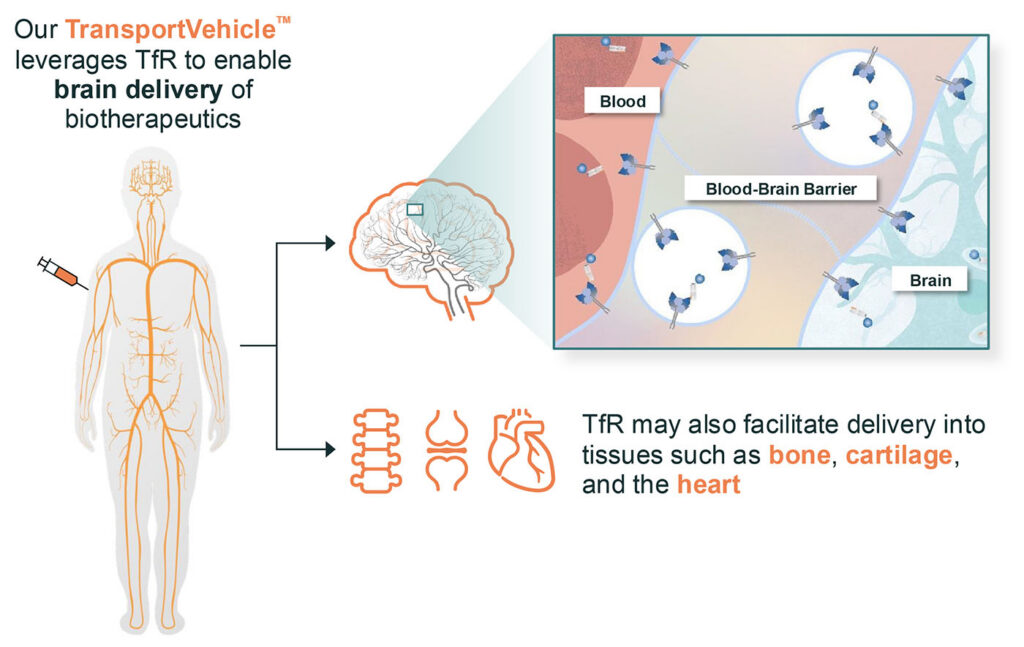
The TransportVehicle (TV) technology has the RMT binding site integrated directly into the constant domain (Fc) of an antibody for optimal properties and modularity. This allows the same TV sequences to transport a range of large molecule biotherapeutics such as enzymes, oligonucleotides, and antibodies for systemic administration. The engineered Fc domains bind to specific natural transport receptors expressed at the BBB, such as TfR.
The integration of the receptor-mediated transcytosis binding site into the TransportVehicle (TV) technology allows the same TV sequences to transport a range of large molecule biotherapeutics, such as enzymes, oligonucleotides, and antibodies, for systemic administration. [Denali Therapeutics]
“Our research recently demonstrated that a TV platform-enabled anti-Ab antibody improved distribution in the brain and significantly reduced risk of Amyloid-Related Imaging Abnormalities (ARIA) in a mouse model of Alzheimer’s disease, when compared with a conventional anti-Ab antibody.1 The study provides the first mechanistic insight for mitigating the risk of ARIA,” detailed Watts.
The Enzyme TransportVehicle (ETV) contains a fusion of a therapeutic enzyme. The Fc portion of the fusion molecule binds the apical surface of the TfR to avoid interference with normal iron transport.
In March 2026, Denali’s lead ETV program, Avlayah (tividenofusp alfa-eknm), received FDA accelerated approval for the pediatric treatment of the lysosomal storage disorder MPS II. Avlayah is the foundation for their broader ETV franchise, addressing other lysosomal storage disorders such as MPS IIIA. Results from the open-label Phase I/II clinical trial are available.2
Their Oligonucleotide TransportVehicle (OTV) platform is an engineered TV conjugated to an oligonucleotide for the systemic delivery of genetic medicines to the brain. Extensive characterization and research demonstrate the ability of OTV to elicit broad biodistribution of oligonucleotide therapies throughout the CNS following systemic exposure.
“For example, our investigational therapy DNL628 for the treatment of Alzheimer’s disease is designed to cross the BBB and reduce the tau protein by targeting the MAPT gene that encodes for tau,” explained Watts.
Lastly, the Antibody TransportVehicle (ATV) platform is designed to enable brain delivery of antibodies capable of selective immune activation and a targeted therapeutic approach after intravenous administration. The investigational anti-Ab antibody therapy DNL921, for example, is designed to reduce amyloid plaques and avoid ARIA.
The TV-enabled clinical development portfolio also includes candidates for frontotemporal dementia-granulin and Pompe disease.
Advancing clinical options
“It is exciting to begin to see that delivery through the BBB is possible using gene therapy or shuttle approaches,” said Todd Carter, PhD, CSO at Voyager Therapeutics. Although first-generation therapeutics are demonstrating meaningful levels of delivery, optimization, and improvement of the functionality, exposure duration, and therapeutic effects are still needed.
“For some diseases, gene therapy is the preferred treatment modality, as both the capsid and the payload can be modified to perform a specific job,” said Carter. But viral vector delivery for gene therapy has had problems with liver-based toxicity.
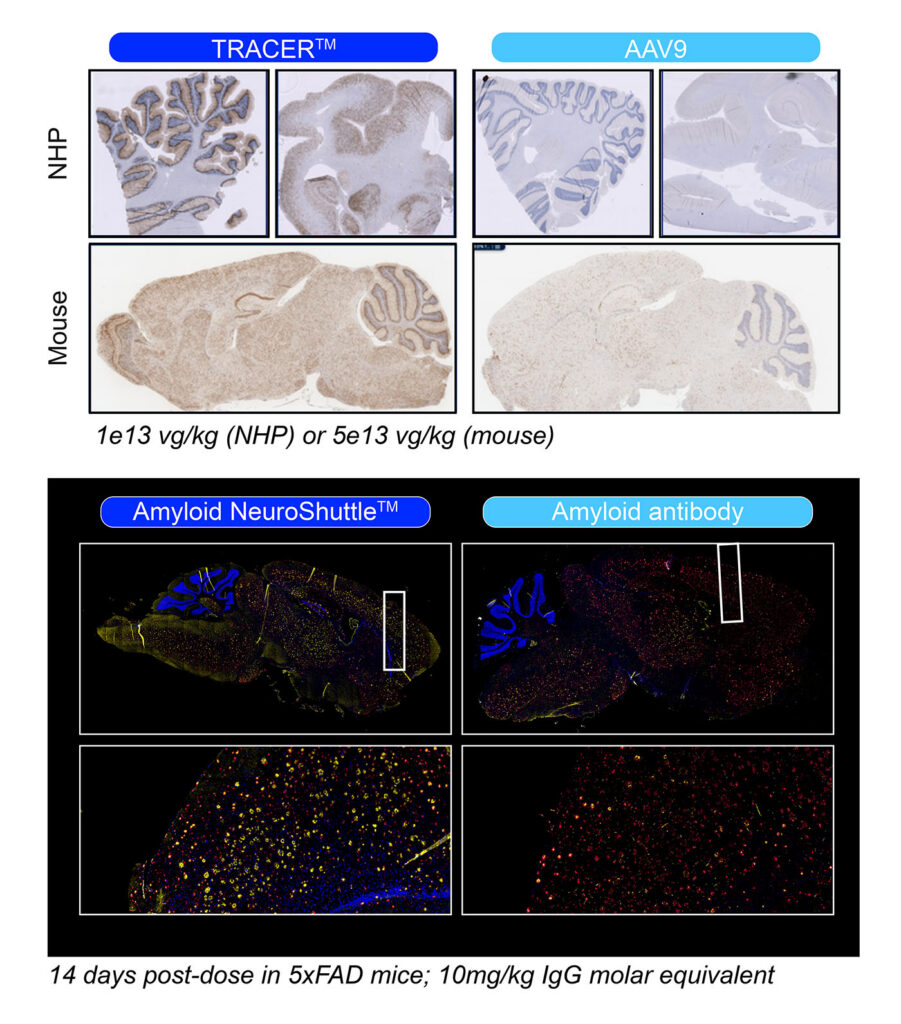
For the best human translation opportunities, Voyager developed a model in non-human primates (NHPs) requiring cross-species activity across multiple NHP species. This strategy resulted in the company’s TRACER (Tropism Redirection of AAV by Cell-type-specific Expression of RNA) technology, used to screen tens of millions of vector variants using barcoded libraries in which capsids were modified with slight insertions of seven to nine amino acids.
TRACER, Voyager’s unbiased capsid and receptor discovery engine, identified ALPL as a broadly enabling brain delivery receptor. [Voyager Therapeutics]
Successful expression in neurons demonstrated that the capsids crossing the BBB worked. Directed evolution improved them. “Next, we needed to determine the mechanism—the receptors they were targeting,” said Carter. This led to the identification of the receptor, alkaline phosphatase (ALPL), tissue nonspecific.
Now, Voyager has multiple families of capsids that mediate delivery into the brain, are detargeted from the liver, and, for the most advanced, have improved the capsid’s ability to target the brain using ALPL. “Using the ALPL receptor elevates delivery to the brain and allows us to substantially reduce dosage,” said Carter.
“I would not have picked ALPL just on face value,” added Mihalis Kariolis, PhD, vice president of non-viral therapeutics at Voyager Therapeutics. “It highlights the power of the unbiased TRACER approach. Expanding the number of brain delivery receptors provides highly differentiated options to reduce side effects and expand the diversity of treatment modalities.”
Both gene therapy and shuttle approaches have opportunities in different indications. Once-and-done gene therapy is not tweakable, whereas shuttle-based dosing is. “In our APOE gene therapy program, we want to reduce existing APOE4 and replace it with APOE2 permanently,” said Carter. “The shuttle has advantages in situations where permanent ongoing delivery is not required.”
Voyager’s most advanced program (VY7523) is a tau monoclonal antibody that is exquisitely specific for pathological tau. Data will be available in the second half of the year. A gene therapy (VY1706) moving into the clinic this year is designed to knock down tau mRNA and protein intracellularly. A collaboration with Neurocrine Biosciences focuses on Friedreich’s ataxia (FA) and is also expected to enter the clinic this year.
Combining transport receptors
The protective BBB is crucial for maintaining homeostasis and ensuring proper neurological function. Comprised of both cellular and acellular components, this sophisticated structure tightly regulates information flow between the periphery and the brain. According to Tanya Wallace, PhD, vice president of neuroscience discovery research at AbbVie, despite the BBB’s importance, many seemingly basic biological questions remain unanswered, fueling additional global research.
The complexity of the BBB also represents a significant bottleneck for advancing therapeutics targeting brain-related disorders. Historically, achieving therapeutically relevant levels of drugs in the brain has been a major challenge in treating serious diseases such as Alzheimer’s and Parkinson’s diseases. “A notable success story is the development of L-DOPA, a prodrug that leverages existing transport mechanisms to cross the BBB,” said Wallace. Once in the brain, L-DOPA is metabolized into dopamine, offering a key symptomatic treatment for Parkinson’s disease.
Breakthroughs in delivery now allow scientists to leverage more technologies that can bring not only small molecules but also complex biologics into the brain. The Modular Delivery (MODELTM) platform exemplifies this progress. The platform enables engineering of bispecific antibodies, capable of targeting naturally expressed BBB receptors such as TfR and CD98. TfR and CD98 are well-characterized at the BBB, and, together, they offer distinct advantages for increasing brain exposure to therapeutics.
“By engaging these transport pathways, the platform can enhance the uptake of a variety of therapeutics, including antibodies and oligonucleotides,” highlighted Wallace. “This multi-receptor strategy provides flexibility to optimize the balance of uptake, release, and distribution in the brain, paving the way for potentially more effective treatments across neurological disease areas.”
This platform technology facilitated the development of ABBV-1758, which is progressing in clinical development. ABBV-1758 utilizes TfR to transport a 3pE-Ab antibody across the BBB to enable the removal of amyloid beta plaques, a pathological hallmark of Alzheimer’s disease.
As scientists aspire to further refine delivery strategies, ongoing research is exploring additional receptors and innovative approaches, including insulin-like growth factor 1 receptor (IGF-1R) and brain cell-type-specific targeting. The field is rapidly evolving to advance more precise, personalized interventions for challenging neuroscience conditions.
“Successful brain delivery requires more than just advances in transport technology; it demands interdisciplinary collaboration, novel preclinical models, and thoughtful clinical translation,” Wallace pointed out. Continued biological research and investment into innovative discovery platforms will be crucial for bringing transformative therapies to patients with the greatest unmet needs.
References
Pizzo ME, Plowey ED, Khoury N et al. Transferrin receptor-targeted anti-amyloid antibody enhances brain delivery and mitigates ARIA. Science. 2025 Aug 7;389(6760):eads3204. doi: 10.1126/science.ads3204.
Muenzer J, Burton BK, Harmatz P et al. An intravenous brain-penetrant enzyme therapy for mucopolysaccharidosis II. N Engl J Med. 2026 Jan 1;394(1):39-50. doi: 10.1056/NEJMoa2508681.
Ajay Gannerkote, president of Integrated DNA Technologies (IDT), says what’s most exciting about CRISPR is its potential to shift medicine from managing disease to directly correcting its root cause. “For patients with severe genetic conditions, especially those with no existing treatment options, that represents a fundamental change in what’s possible,” he said.
IDT played a pivotal role in manufacturing the personalized gene editing therapy given to baby KJ Muldoon to treat his rare metabolic disorder. Today, KJ is free from the toxic ammonia buildup that drives a 50% mortality rate for his condition in infancy. While his story highlights the life-changing potential of gene editing, the field now wrestles with the next challenge: expanding these therapies to benefit broader patient populations.
In contrast to KJ’s urea cycle disorder, which stemmed from a single disease-causing mutation that could be precisely targeted, many genetic disorders arise from numerous mutations scattered across a gene where individualized corrections are too resource-intensive to scale.
Gannerkote says turning powerful gene editing tools into broadly accessible clinical therapies requires progress across multiple fronts. Many CRISPR therapies are still bespoke, with manufacturing processes that are not yet standardized or easily repeatable, leading to long timelines and high costs. In regulation, therapy developers and government regulators face a learning curve when evaluating new modalities, particularly when speed is critical for patients with life-threatening conditions.
Today’s gene editing companies reflect on what’s required to scale personalized CRISPR therapies for maximized impact in the clinic.
End-to-end
Sadik Kassim, PhD, CTO of Genomic Medicines at Danaher, explains that personalized therapies do not naturally lend themselves to traditional drug-development models. Gene editing companies are now seeking “platformization,” where common manufacturing processes are standardized, and limited elements, such as guide RNAs, are customized for each patient to reduce costs and speed timelines.
“Baby KJ’s treatment succeeded because multiple elements aligned simultaneously,” explained Kassim. The foundational science, which achieved successful gene corrections in animal models of phenylketonuria (PKU), an inherited metabolic disorder caused by mutations in the PAH gene that impair the enzyme responsible for breaking down phenylalanine, had already been developed in the academic labs led by Children’s Hospital of Philadelphia (CHOP) physician scientists, Rebecca Ahrens-Nicklas, MD, PhD, and Kiran Musunuru, MD, PhD. Teams were then able to move quickly when the clinical need became clear.
Regulatory engagement was also critical. Danaher teams worked directly with the FDA to streamline the treatment approval process without compromising patient safety. That collaboration compressed a timeline that would normally take 18–24 months down to roughly six months.
“Replicating this for future patients will require moving away from one‑off efforts and toward repeatable platforms with established processes, validated assays, and clearer regulatory precedents, so that speed becomes the norm rather than the exception,” Kassim said.
Amy Pooler, PhD, CSO of ElevateBio, agrees that the transition steps between therapy design and manufacturing are often where the greatest delays occur. ElevateBio seeks to address this bottleneck by building an end-to-end genetic medicine platform.
“A critical driver for the company is making sure we have a clear line of sight into manufacturing from the very beginning,” Pooler said. “One reason Baby KJ’s case was successful is that Danaher managed the handoffs smoothly.”
Pooler also describes developing genetic medicines as “building the plane while you’re flying it.” The field still lacks enough data to reliably predict patient outcomes. Every clinical trial readout provides a valuable lesson for the field.
“I’m excited about the clinical evidence that’s starting to accumulate, showing gene editing can be transformative for patients, which we didn’t have five to ten years ago,” she said.
Large gene, generalizable therapy
ElevateBio’s expanding CRISPR toolbox includes base, prime, and epigenetic editing. Notably, the Durham-based company’s AI platform generates novel recombinases for targeted gene insertion, an approach that holds promise as a generalizable medicine that could treat patients regardless of their underlying disease-causing mutation.
Using AI-guided design, ElevateBio explores entirely new regions of protein space to discover potent and highly specific recombinases that expand the range of diseases amenable to gene editing. These engineered enzymes, which possess 50% or less homology to known proteins, can access novel genomic regions that remain difficult to target with existing CRISPR technologies.
Ben Kleinstiver, PhD, associate investigator at Massachusetts General Hospital (MGH) and co-author of the NEJM study describing KJ’s case, says the FDA’s Plausible Mechanisms Pathway has helped address some of the regulatory challenges to streamline the path to the clinic. Yet, there remains a major motivation for pan-mutation approaches that are more widely applied across patients.
Kleinstiver’s research group, in collaboration with Full Circles Therapeutics, recently developed a circular single-stranded DNA donor (ssDNA) that enables safer kilobase-scale integration for human cells.1 The technology provides an alternative to double-stranded DNA (dsDNA) donors that evoke harmful immune responses yet are required for recognition by the diverse suite of genome editing enzymes. Notably, the new circular donor maintains recombinase compatibility by attaching a short region of dsDNA that can go undetected by the cytosolic DNA sensor and immune system activator, cGAS.
Patients now
While the gene editing field often concentrates on large indications driven by a single common mutation, Edward Kaye, MD, CEO and director of Aurora Therapeutics, aims to extend these technologies beyond the “lucky few” who share the same mutation.
Aurora’s leadership team, from left: Morgan Maeder, PhD, Edward Kaye, MD, and David Litvak, MBA [Aurora]
Co-founded by Jennifer Doudna, PhD, CRISPR Nobel Laureate, and Fyodor Urnov, PhD, scientific director of the Innovative Genomics Institute, Aurora launched in January to build a sustainable pipeline to scale rare disease treatments. Traditionally, developing therapies for these ultra-rare or N-of-1 conditions can require several million dollars for a single patient.
Aurora is pursuing an “umbrella IND” strategy that allows multiple guide RNAs to be evaluated within a single clinical trial. The company’s initial focus is on PKU.
PKU offers several advantages for early clinical development. Patients are routinely identified through newborn screening programs shortly after birth, which facilitates trial participant identification and enrollment. The condition also benefits from a clear regulatory precedent: reductions in phenylalanine levels are an established clinical endpoint used to move therapies toward approval.
“What we learn from PKU will be used for many other diseases because we have the systems in place,” said Kaye. “It expands gene editing into many more patients, by going after one disease first.”
Kaye also stresses the importance of engaging patient communities, whose input can ensure studies and regulatory processes are not overly burdensome for patients and families.
Maher Masoud, CEO of MaxCyte, emphasizes putting patients at the forefront. He adds that most gene-editing therapies in the clinic require significant patient conditioning, which can lead to lengthy treatment cycles and clinical trial timelines. Yet he sees these barriers to scale being eroded over the near term. As an example, modalities, such as allogeneic cell therapies, require far less patient conditioning and easier dosing regimens to support cheaper therapies.
In 2013, MaxCyte partnered with CRISPR Therapeutics on early work that led to the first FDA-approved therapy based on CRISPR-Cas9, Casgevy, with MaxCyte’s ExPERT electroporation platform enabling the efficient delivery of gene editing machinery into cells.
More than a decade later, the company has developed more than 1,000 applications and protocols. The broad engineering platform can repeatedly engineer batches of at least 20 billion cells using CRISPR-Cas9 in addition to base and prime editing.
Masoud says low-significant gene editing commercial success has been a bottleneck to scaling personalized therapies. Yet, he reiterates that CRISPR and other gene editing technologies were discovered a short 12 years ago.
“With CRISPR, we are finally seeing cures, Casgevy, LYFGENIA, and baby KJ are proof of that,” he says. “This is just the beginning.”
References
Tou, C.J., Xie, K., Ferreira da Silva, J., et al. Invasive DNA donors and recombinases license kilobase-scale writing. Nature. 2026. DOI: 10.1038/s41586-026-10241-z.
A new US-wide cell phone network marketed to Christians is set to launch next week. It blocks porn, which experts in network security say marks the first time a US cell plan has used network-level blocking for such content that can’t be turned off even by adult account owners. It’s also rolling out a filter on sexual content aimed at blocking material related to gender and trans issues, which will be optional but turned on by default across all plans.
The network, which is currently being tested ahead of its May 5 launch date, will be run by Radiant Mobile, a newly launched mobile virtual network operator (MVNO). These operators don’t own cell towers but buy bandwidth from the big providers (in this case, T-Mobile) and sell to specific demographics (President Trump announced his own MVNO last year called Trump Mobile; CREDOMobile sends donations to progressive causes).
“We are going to create—and we think we have every right to do so—an environment that is Jesus-centric, that is void of pornography, void of LGBT, void of trans,” Radiant Mobile’s founder, Paul Fisher, told MIT Technology Review. A representative for T-Mobile did not comment on whether these content blocks violate any of its policies. In a statement, the representative added that T-Mobile does not have a direct relationship with Radiant Mobile but instead works through the MVNO manager CompaxDigital.
Fisher says he’s recruited a mix of Christian influencers to advertise the plan and has also done outreach to thousands of churches around the country, offering a way to have Radiant donate a portion of congregants’ $30-per-month subscription fee to their church. Fisher has ambitions to market it beyond the US in other countries with significant Christian populations, like South Korea and Mexico.
At least one piece of Radiant’s pitch will sound familiar: the idea that the internet is awash in toxic sludge. It’s powered by content and algorithms that are making us more sad, hateful, and detached. A number of efforts aim to fix that, including contentious age verification laws and a coming wave of lawsuits alleging that social media companies knowingly got young users hooked on their platforms.
Fisher is pursuing the nuclear option. He says Radiant is working with the Israeli cybersecurity company Allot to block categories of content, such as material about violence or self-harm. Some categories are banned by default and cannot be allowed even for adult users.
This includes pornography. Chris Klimis, a minister in Orlando who was recruited to be the company’s chief operating officer, says part of the reason he got involved was to offer Christians a real way to “do something” about what he sees as a pornography crisis in the faith. He was appalled by a recent survey showing that 67% of pastors have a “personal history” with porn use. And he worries his six children will come across porn on their devices, even if only inadvertently.
“We’ve got to figure out some way to close the door to the digital space,” he says. “That’s what we’re trying to do.”
The technology to do this blocking is a blunt instrument: Allot groups website domains into more than a hundred categories, which include pornography but also violence, malware, gaming, and in Radiant Mobile’s case “sects,” which includes websites about Satanism. If one of its users tries to visit a website that belongs to a blocked category, the page won’t load. That’s harsher than app-based content blockers like Covenant Eyes, a Christian porn-quitting app that sends notifications to your friends or family if you slip up; those can be worked around or deleted.
“Blocking in the network is certainly not new,” says David Choffnes, a computer science professor and executive director of Northeastern University’s Cybersecurity and Privacy Institute. Such blocking is the backbone of censorship efforts by authoritarian governments, for example. But there are more benign ways it’s used too. US telecoms block particular domains known to be spreading malware and offer optional network-level controls to block adult content on kids’ phones. What is new is a US cell plan instituting network-level blocks that can’t be removed, even by adults.
The trouble is that most websites don’t fit neatly into one category, leaving Fisher with enormous and subjective control over which are allowed or banned. This is most apparent in his effort to block content related to gender identity.
Anthony Re, a sales director at Allot, says the company does not have a category specific to gender but that “LGBT content” tends to fall into its sexuality category, which is described on Radiant Mobile’s website as “sites that provide information on sex, sex and teenagers, and sexual education, without pornographic content.” This category is blocked by default for all phones, a setting that can be changed by adult account owners.
But if a news site starts hosting enough gender-related content, Fisher might not just label it as “press,” which is allowed, but also “sexuality,” thus blocking the whole domain to any phone with that category blocked.
Fisher illustrates the subjectivity of such decisions with a recent example involving Yale University. Its general website, www.yale.edu, is categorized by Allot as education. “But they have a subsection of one of their websites that’s totally focused on, you know, trans equality,” Fisher says, referring to lgbtq.yale.edu. Because it’s a distinct domain, Radiant Mobile is able to place it in the sexuality category and block it.
Yale’s main website remains unblocked, for now. “If we see [the LGBTQ content] on the front pages consistently of Yale University, we’ll block them too,” Fisher says.
Managing website block lists is a professional pivot for Fisher, who spent his career not in telecoms but in fashion; he was an agent for supermodels like Naomi Campbell and members of the Hilton and Getty families, and he later hosted a reality show in which he found people in rehab facilities and homeless shelters and tried to turn them into models. He ultimately left the industry and now says he regrets the role he played in it: “Am I proud that I spent 35 years creating star models or star influencers? Not at all.”
Last year, his friend and fellow fashion mogul Bernt Ullmann suggested he look at what Ryan Reynolds had built with his cell network Mint Mobile: It made buying a cell plan feel less like dealing with a utility and more like choosing a brand, and it had been acquired by T-Mobile in 2023 for $1.3 billion. Fisher liked the business model but didn’t have an audience in mind. Then came a late-night revelation. “God is talking to me,” Fisher recalls. “Do something in the faith-based industry.” He set out to build the first cell network that would let in only content deemed compatible with Christianity.
Fisher says the company has received $17.5 million in investment from Compax Ventures, part of the company serving as the technical middleman between Radiant and T-Mobile. Roger Bringmann, a vice president at Nvidia, is Radiant Mobile’s lead investor and silent partner (Bringmann recently funded a new complex at Austin Christian University in Texas, which bills itself as “the university for Christian entrepreneurs”).
To fill the gap left by all the sites being blocked, the company intends to offer access to a library of religious content, including AI-generated Biblevideos. It plans to use characters like Cinderella, Tinker Bell, and others (it has obtained rights from the entertainment and media company Elf Labs, which has been amassing rights to hundreds of children’s characters). “Those characters were originally constructed with a conservative perspective,” Klimis says. They’ll be used in AI-generated content alongside testimonials and devotionals.
Choffnes has technical doubts that the plan’s firewall will be as effective as promised, not least because “it’s really hard to come up with a list of every website you think is problematic.” But beyond that, he sees the internet, frustrating as it can be, as better open than closed. “I do believe in an open internet,” he says. “I also believe that a lot of the internet is toxic, but I don’t believe that this sledgehammer approach of blocking content is the right answer.”





 (zopapogene imadenovec-drba), which generated $3.4 million in net product revenue last year after becoming the first-and-only FDA-approved treatment for adults with recurrent respiratory papillomatosis (RRP) in August; and Abeona Therapeutics’ Zevaskyn® (prademagene zamikeracel), an autologous cell sheet-based gene therapy approved to treat wounds in adults and children with recessive dystrophic epidermolysis bullosa (RDEB).