

The Most Effective OCD Treatment Reaches Almost No One: Here’s What We Can Do About It

Rebecca Deusser, MS, MBA and Sanjaya Saxena, MD

“It took me years to find out that what I was dealing with was OCD!”

This is a phrase all too often repeated by people living with obsessive compulsive disorder. Currently, individuals live with OCD for an average of 7 years (Dell’Osso et al, 2019) before they even receive a diagnosis, all while symptoms may intensify and daily life often becomes increasingly constrained. 

Clinicians, researchers, and advocates have long raised this concern. What has been missing is clear data behind how many people with OCD in the U.S. are missed in clinical settings or are not receiving the most effective treatment.

When the International OCD Foundation undertook this analysis, the scale of the problem became unmistakable. Millions of people in America are currently struggling with OCD without the most effective treatment.

The challenges we detail in our new white paper, America’s OCD Care Crisis: National Findings on the Failure of Effective OCD Treatment to Reach Patients, are significant, but fixable. They are symptoms of structural oversights that can be changed. Effective, evidence-based treatment for OCD exists, and through intentional action, we can dramatically change these unacceptable outcomes for people with OCD.

Where People With OCD Fall Through the Cracks

Well established prevalence rates for OCD indicate that nearly 10 million people in America — roughly 3% (Ruscio et al, 2010; Stein et al,2025; Ringeisen et al, 2025) — will have OCD at some point in their lives. Yet our findings suggest that 75% of them are never even identified, and up to 95% aren’t receiving the most effective treatment for the disorder.

In our analysis, we discovered significant systemic breakdowns at several key points of a patient’s journey: screening, diagnosis, referral, and treatment.

  • Screening and Diagnosis: Receiving a clinical diagnosis is an important step toward recovery as it promotes understanding and opens paths to effective treatment. Yet our findings suggest that this crucial initial step is missing for many millions of people. Of the 10.4 million patient records reviewed in our analysis, only 0.51% received a formal OCD diagnosis, far below the 3% expected prevalence rate. 
  • Referral to appropriate care: After a diagnosis is obtained, a handoff to appropriate care is needed to keep the patient from falling out of the treatment pathway. Here, too, we found an alarming gap within our sample: more than 72% of patients identified as having OCD did not receive a referral for cognitive-behavioral therapy (CBT), the most effective treatment for OCD.
  • Effective Treatment: Decades of research has established Exposure and Response Prevention (ERP) therapy, a specific form of CBT, as the most effective, first-line therapy for OCD. Yet, an astounding 95-98% of people with OCD had not received ERP treatment. Even when people seek help — and even when they are diagnosed — the vast majority never reach the treatment most likely to help them recover.

What We Can Do About It

The breakdowns seen in each step of the care pathway reinforce the focus of IOCDF’s Vision 2030, our five-year strategy to address the systemic barriers that keep effective OCD treatment out of reach.

While the findings are stark, they illuminate many opportunities for change:

  • Identify symptoms earlier by implementing routine OCD screening in primary healthcare and mental health settings.
  • Support clinicians in better understanding and treating OCD by expanding training in assessment, diagnosis, and evidence-based treatment modalities.
  • Help people receive care that works by strengthening adherence to existing professional treatment guidelines.
  • Increase the number of people with OCD who receive effective treatment  by supporting affordable access to ERP and other evidence-based therapies.
  • Let people know they’re not alone by raising accurate public awareness of what OCD really is — and that it is treatable.

Vision 2030 outlines how the IOCDF is committing its resources, partnerships, and expertise toward advancing these priorities — by increasing awareness and community, expanding access to effective treatment, and advancing research. Together, these efforts are designed to work in concert, improving clinical training, implementing screening for early identification, strengthening pathways from diagnosis to care, and increasing the likelihood that people receive evidence-based treatment.

At the same time, the scale of the problem revealed in this report makes clear that progress depends on collective action across the field. Clinicians, health systems, educators, researchers, policymakers, advocates, and people with lived experience all have a role to play. Together, these efforts can help ensure that people with OCD reach effective treatment sooner, reducing years of unnecessary confusion and distress. 

How You Can Help

Join us in building better access to effective treatment for people with OCD:

The current state of treatment for OCD in the U.S. is sobering, but it is not the end of the story. OCD is treatable, recovery is possible, and change can happen as awareness grows and access expands. With continued effort, the gap between how many are struggling and how many receive effective care can begin to close. A brighter future is possible — and we can build it together.

References

  1. Dell’Osso, B., Benatti, B., Grancini, B., Vismara, M., De Carlo, V., Cirnigliaro, G., Albert, U., & Viganò, C. (2019). Investigating duration of illness and duration of untreated illness in obsessive compulsive disorder reveals patients remain at length pharmacologically untreated. International Journal of Psychiatry in Clinical Practice, 23(4), 311–313. https://doi.org/10.1080/13651501.2019.1621348
  2. Ruscio, A. M., Stein, D. J., Chiu, W. T., & Kessler, R. C. (2010). The epidemiology of obsessive-compulsive disorder in the National Comorbidity Survey Replication. Molecular Psychiatry, 15(1), 53-63. https://doi.org/10.1038/mp.2008.94
  3. Stein, D. J., Ruscio, A. M., Altwaijri, Y., Chiu, W. T., Sampson, N. A., Aguilar-Gaxiola, S., Al-Hamzawi, A., Alonso, J., Chardoul, S., Gureje, O., Hu, C., Karam, E. G., McGrath, J. J., Navarro-Mateu, F., Scott, K. M., Stagnaro, J. C., Torres, Y., Vladescu, C., Wciórka, J., Xavier, M., … Kessler, R. C. (2025). Obsessive-compulsive disorder in the World Mental Health surveys. Research Square, rs.3.rs-6090427. https://doi.org/10.21203/rs.3.rs-6090427/v1
  4. Ringeisen, H., Edlund, M., Guyer, H., Dever, J., Carpenter, L., Olfson, M., First, M., Geiger, P., Liao, D., Peytchev, A., Carr, C., Chwastiak, L., Dixon, L. B., Monroe-Devita, M., Scott Stroup, T., Swanson, J., Swartz, M., Gibbons, R., Stambaugh, L., Bareis, N., … Mental Health and Substance Use Disorders Prevalence Study Consortium (2025). Prevalence of past-year mental and substance use disorders, 2021-2022. Psychiatric Services (Washington, D.C.), 76(8), 720–728. https://doi.org/10.1176/appi.ps.20240329

IOCDF Training & Resources for Clinicians

When clinicians have easier access to best practices in OCD diagnosis and treatment, more people can receive effective care. The IOCDF’s Training Institute offers evidence-based programs for clinicians at every stage of practice, including:

  • A robust, on-demand webinar catalog (CE-eligible!) covering fundamentals, modalities, related disorders, and comorbidities. The catalog includes access to the free webinar, OCD Basics. 
  • IOCDF’s Training Institute offers intensive workshops and events, consultation groups, and more for clinicians of every level.
  • Professional Members at the IOCDF join a nationwide network of committed professionals, are eligible for listing on our Resource Directory, and have access to special pricing for Training Institute offerings.

The post The Most Effective OCD Treatment Reaches Almost No One: Here’s What We Can Do About It appeared first on International OCD Foundation.
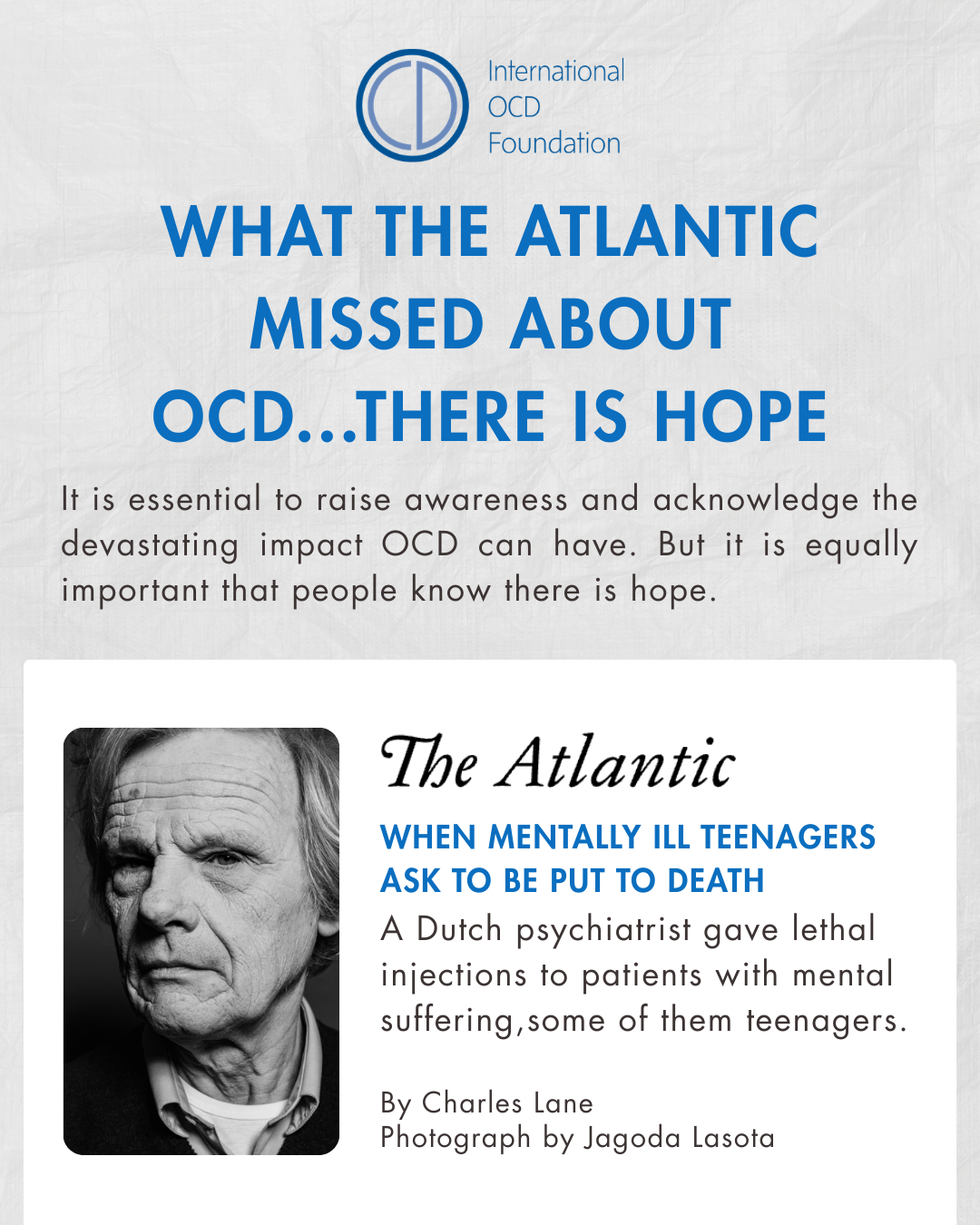
What The Atlantic Missed About OCD: There Is Hope

Dear Editor,

The Atlantic’s recent article, “When Mentally Ill Teenagers Ask to Be Put to Death,” brings needed attention to the profound and often misunderstood suffering caused by obsessive compulsive disorder (OCD). As the story illustrates, OCD can be severe, chronic, and life-threatening — so much so that individuals with OCD are at significantly elevated risk of suicide.

However, what is missing from this important conversation is an equally critical truth: effective, evidence-based treatments for OCD exist. Unfortunately, even after years in care, up to 98% of people never receive the many first, second, and third-line approaches that are available due to systemic breakdowns in proper screening, diagnosis, referral, and access to specialized care.

With appropriate care, many individuals who once felt trapped by their symptoms are able to reclaim their lives, pursue their goals, and thrive. At the International OCD Foundation, we regularly hear from people affected by OCD who have gone from a place of despair to one of hope because they were able to access evidence-based treatment, specifically Exposure and Response Prevention therapy (ERP). 

It is essential to raise awareness and acknowledge the devastating impact OCD can have. But it is equally important that people know there is hope. The tragic outcomes outlined in “When Mentally Ill Teenagers Ask to be Put To Death” are not inevitable. With continued efforts on raising accurate awareness of OCD and strengthening our systems of care around the globe, more people with OCD can access the effective, life-saving treatment they deserve.

For those seeking help, resources and treatment guidance are available at iocdf.org.

The post What The Atlantic Missed About OCD: There Is Hope appeared first on International OCD Foundation.

IOCDF Calls for Reinstatement of SAMHSA Grants, Renewed Commitment to Mental Health Support

The International OCD Foundation is alarmed by the apparent sudden and widespread termination of grants supporting vital mental health and addiction services previously funded through the U.S. Substance Abuse and Mental Health Services Administration (SAMHSA).

These programs provide life-saving services for individuals experiencing acute mental health crises and help prevent symptoms from escalating to emergency or inpatient levels of care.

As detailed in our recent white paper, America’s OCD Care Crisis, 95% of Americans with obsessive compulsive disorder (OCD) are not receiving the most effective treatment. When OCD goes untreated or is treated with approaches that are not evidence-based, individuals face increased distress, functional impairment, isolation, and elevated risk of crisis. Access to trained clinicians and community-based mental health services is essential for helping people remain safe during periods of heightened distress and navigate next steps for treatment.

At a time when so many people with OCD and related disorders already struggle to access appropriate care, reducing support for frontline mental health professionals further weakens an already fragile system.

The IOCDF urges the reinstatement of these grants and continued federal commitment to accessible, evidence-based mental health and addiction services for all who need them.

Contact your congressional representative now to support the reinstatement of SAMHSA grants >>

The post IOCDF Calls for Reinstatement of SAMHSA Grants, Renewed Commitment to Mental Health Support appeared first on International OCD Foundation.

Facing the Monster: My Journey Living with OCD and Finding Hope

by David Kedeme

I remember the day my white high top Puma sneakers my parents gifted me for Christmas became the exact opposite of the color they came boxed in. It was a post rainy day in middle school, on a mulch covered, semi grassy area we considered our soccer field with two benches representing goals. After enjoying an intense match, what I did not enjoy but assumingly brushed off was the fact of how dirty my shoes were. Fast forward to later that day, I spent hours cleaning the shoes, trying to restore them to their original look.

Something felt different than other times I cleaned.

Every speck had to be clean. The more time I spent, the more visible other “not as clean” areas of the shoes became, requiring their own dedicated time of cleaning. Slowly, this cascaded into many other aspects of life such as my bedroom and closet needing to be organized a certain way, a tornado of relentless doubts concerning my relationships, with this dark monster in my head controlling what I can do, think, and feel. It felt like an eternity but at the same time as if no time passed from when I first touched to clean those shoes to when I could not sleep in my own bedroom and instead slept downstairs due to not wanting to mess the space up and not being able to enter and exit my closet as easily, so needing to rewear clothes days on end. I thought that doing what the monster or voice or whatever it was wanted would lead me to peace, as the relief from the sky high anxiety and gloom that came from performing what I know now as compulsions came only to have what I learned were obsessions come back, if not stronger, reinforcing this vicious cycle. My parents noticed my change in behavior, from avoiding my room at most costs to being late to dinner by up to an hour or two at times. I had only vaguely heard of obsessive compulsive disorder, OCD, and brought the idea up to my parents. The landscape we were dealing with was completely new and I felt even more alone due to this in addition to the isolation the condition induces you to be in. But we began to look for therapists, where I started talk therapy, with the therapist trying their best but the therapy modality was not the right one for me. Next up was a hypnotherapist, which also did not work for me. I needed some action to be okay with the high emotion filled state I was in when the bouts came on, in other words, exposure and response prevention therapy. After doing some research, I landed upon NOCD, an OCD teletherapy and advocacy organization.

I could not believe what I was hearing through the basement, not my room, laptop screen about actually going into my room, and that was not even the worst part. I just had to open my closet, take clothes out, move items in my room, and not do anything. “Maybe it is, maybe it is not” was a phrase that my therapist told me throughout therapy. With the significant support of my family, therapist, and friends, I was able to be okay with not being okay. Exposure and response prevention therapy makes you face the monster, making you enter the state in which you experience high anxiety. The therapy makes you look the monster in the face and realize it was not that big, not talking or engaging with you, making you sit in the discomfort and not do anything you so desperately want to do. With this methodology and rigor, I was able to coexist with the beast, and slowly it shrank, still existing though. But that is okay. That happens.

OCD belongs to a category of disorders called Obsessive Compulsive and Related Disorders within the Diagnostic and Statistical Manual for Mental Disorders, Fifth Edition, a manual that influences not only how patients receive care but also research funding and medical training. Although not officially recognized in the manual, there are many discussed subtypes of OCD depending on the obsessions and or compulsions one experiences. Some people, like me, had symptoms that ebbed and flowed in terms of severity and percolated from subtype to subtype. My symptoms throughout my experience with the condition range from having to keep most of the items in my room a certain way, doubting whether I want to be with my partner, questioning my morals, wondering whether something happened in the past pertaining to people in my life even though it did not, and more. Throughout typing this, thoughts flood my head, similar to ones I experienced, say, six years ago.

I hope to be able to perform research in the condition as well as treat people who were and are in my shoes. With up to 242 million people worldwide meeting clinical diagnostic criteria for OCD, about 40 to 60 percent experiencing treatment resistant OCD, more than two thirds of the general public not being able to accurately identify OCD, and mental health still being stigmatized today, there is more needed to be done from all fronts. When one type of online treatment is sought, about two thirds of patients achieve a clinically significant outcome, but on average, it takes greater than seven years for someone to receive a diagnosis of OCD and it can take up to seventeen years for an individual diagnosed with OCD to receive treatment. This is a multifaceted problem that requires a multifaceted approach which requires a banding of people worldwide to come together to promote awareness of the condition and a safe space for people throughout who have OCD.

Today, as I am typing this, I still am experiencing many of the symptoms I have before. The condition does not just go away, but it does become more manageable. If you are struggling, there is hope, there is a way, no matter how impossible it feels. I felt as if there was none, no light at the end of the tunnel, spending many hours crying out asking why to a source I was not even aware of, answered only by my own repetitive thoughts. But as someone who has been there, you will be okay. Even if multiple therapeutic modalities do not work, you feel like you want to give up because a current exposure seems impossible to do, you feel more anxiety at times, you feel like you are letting people down if you do not improve, you feel like the monster you were once fighting off keeps going, keep going. Seek help in many ways, rely on your community, and for those who have a hard time finding one, we are here for you, the International OCD Foundation community, and I most certainly am as well. Thank you for reading this and I am sending you hope and luck wherever you are. You are never alone.

The post Facing the Monster: My Journey Living with OCD and Finding Hope appeared first on International OCD Foundation.