

Single-Cell Maps Reveal Genome Reorganization in Alzheimer’s Brain Cells

While Alzheimer’s disease is the most common cause of dementia, many of the molecular mechanisms that drive its progression remain poorly understood. While researchers have cataloged changes in gene activity across different brain cell types, a key unanswered question has been how the genome’s 3D organization influences those changes. Now, researchers have linked alterations in genome folding to disrupted gene regulation in Alzheimer’s disease, providing a new layer of insight into the biology of neurodegeneration.

The findings, published in Science in the paper “Single-cell multiomics connects 3D genome and transcriptome alterations in Alzheimer’s disease,” were reported by researchers from Carnegie Mellon University’s School of Computer Science, the University of Pittsburgh School of Medicine, the University of Washington, and collaborating institutions. Using single-cell multiomics, spatial transcriptomics, and artificial intelligence (AI), the team generated a multiscale view connecting genome structure, gene expression, and tissue organization in Alzheimer’s disease.

To investigate the role of genome architecture in Alzheimer’s disease, the researchers analyzed postmortem prefrontal cortex tissue from individuals with and without the disease. They used GAGE-seq (genome architecture and gene expression by sequencing), a technique that measures both gene expression and physical genome contacts in the same single cell. The team combined those data with chromatin accessibility data, spatial transcriptomic maps, and a transformer-based AI model called Hicformer, which integrates DNA sequence and 3D genome features to predict cell-type-specific gene activity.

The study revealed widespread changes in chromatin organization across major brain cell types. According to the paper, Alzheimer’s disease was associated with “reduced short-range interactions and increased longer-range interactions” within the genome. Active and inactive genomic regions also exhibited increased mixing, consistent with weaker compartment segregation. The researchers linked these structural changes to cell type–specific alterations in gene expression programs involved in disease-relevant pathways.

Researchers also observed weakening of promoter-proximal interactions and changes in regulatory elements, alongside evidence of senescence-related activation in microglia and sex-dependent dysregulation of X-linked genes in females. Integrating the molecular data with spatial transcriptomics revealed altered cellular neighborhoods and disrupted coordination of gene programs within diseased brain tissue. The authors wrote that the results connect “genome structure, gene regulation, and tissue organization through a unified multimodal analysis.”

Their predictive model Hicformer also demonstrated that “3D genome features provide information beyond DNA sequence alone for explaining AD-relevant gene expression, enabling prioritization of distal regulatory elements whose effects are mediated through chromatin contacts,” the authors wrote.

“Measuring gene activity and genome folding in the same cell allows us to directly connect chromosome structure with disease-related gene programs,” said Yang Zhang, PhD, a project scientist in Carnegie Mellon’s Computational Biology Department and co-lead author. “Across several kinds of brain cells, this paired view revealed a consistent signature of 3D genome reorganization in Alzheimer’s disease and helped us prioritize regulatory regions for future mechanistic and therapeutic investigation.”

The researchers concluded that genome folding represents a previously underappreciated regulatory layer associated with Alzheimer’s pathology. By creating a detailed map linking 3D genome remodeling to gene expression and tissue organization, the study provides a framework for future experiments aimed at determining which structural changes contribute directly to disease progression. This may also provide clues to future therapeutic focuses.

“Alzheimer’s disease cannot be understood one layer at a time,” said senior author Jian Ma, PhD, the Ray and Stephanie Lane Professor of Computational Biology at Carnegie Mellon University. “The genome’s 3D structure is a fundamental regulatory layer that helps to connect DNA sequence to gene activity. By integrating genome folding, cell state, and tissue context, we can move beyond cataloging disease-associated changes toward understanding how they fit together and which mechanisms to test next,” said Ma. “Alzheimer’s disease cannot be understood one layer at a time.”

The post Single-Cell Maps Reveal Genome Reorganization in Alzheimer’s Brain Cells appeared first on GEN – Genetic Engineering and Biotechnology News.
Turning Solar Power Into Protein

According to projections from the United Nations, global food demand could increase by around 60 percent by 2050, while only about two percent additional agricultural land is expected to become available. Researchers at the Technical University of Munich (TUM) report that they are exploring new approaches to safeguard food security. A team at the TUM Campus Straubing has developed a process for producing crucial amino acids from carbon dioxide, hydrogen, and renewable energy.

Viktoria Lehmann, a doctoral candidate at TUM, describes one potential application for biotechnologically produced amino acids.

“A dairy cow needs far more than the grass growing in its pasture. High milk yields require supplemental protein, which is typically supplied through animal feed. These feeds are enriched with amino acids, the chemical building blocks of proteins,” she explains. “Across livestock production systems worldwide, millions of tons of amino acids are used as feed additives. However, their production consumes large amounts of land, water, and other resources. We wanted to find a more resource-efficient way to meet this protein demand.”

In a recently published study “Plug and Play – Enzymatic Amino Acid Production from Methanol and Carbon Dioxide” in Nature Communications, the team demonstrated its approach. The concept behind it: solar energy is converted into electricity using photovoltaic systems. This electricity is used to generate hydrogen, which, together with carbon dioxide, is converted into methanol—an alcohol widely used in industry as a chemical precursor. Specialized enzymes then convert the methanol step by step into amino acids. Which amino acid is produced depends on the specific enzymes used.

“Plants use sunlight to build biomass, but they are relatively inefficient at doing so. We are investigating an alternative pathway in which renewable energy is first converted into chemical energy carriers and then into valuable protein building blocks,” notes Volker Sieber, PhD, professor of chemistry of Biogenic Resources and Rector of the TUM Campus Straubing. “In the long term, this approach could help make more productive use of available land and enable a more sustainable production of amino acids.”

A modular platform technology

In 2023, the researchers demonstrated the production of the amino acid L-alanine from green methanol. Their latest work expands the approach to a total of seven amino acids. “Our modular plug-and-play concept can be compared to a construction kit,” says Vivian Willers, PhD, whose doctoral research laid the foundation for the study. “What started with a single amino acid is increasingly evolving into a platform technology for producing protein building blocks from renewable energy.”

The team successfully produced the amino acids glycine, serine, L-aspartic acid, L-valine, L-glutamic acid, and L-proline. In the future, this technology could help reduce dependence on protein-rich feed ingredients such as soy, which are not always produced sustainably. These amino acids are also key components of nutrient media used in cultured meat production. As a result, the researchers see applications extending well beyond conventional agriculture.

While the team was able to demonstrate the entire process chain—from carbon dioxide via methanol ultimately to amino acids—the current production volumes are still too low for commercial use. The researchers are working to further improve the performance of the enzymes involved.

“Our work is primarily a proof of technological feasibility,” points out Sieber. “We have shown that a broad range of biologically relevant amino acids can be produced from CO₂-based methanol. This opens up new possibilities for the sustainable production of protein building blocks.”


The post Turning Solar Power Into Protein appeared first on GEN – Genetic Engineering and Biotechnology News.

Autism-Like Traits in Mice Improved After Single Rapamycin Dose

The results of a preclinical study led by UCLA Health researchers suggest that inflammation during pregnancy in mice can trigger autism-like brain and behavior changes in offspring, and that the effects may be rapidly but temporarily reversible in adulthood with a short-term dose of the immunosuppressive drug rapamycin.

The study showed that a single dose of rapamycin rapidly improved changes including brain overactivity, seizure risk, sensory sensitivity, repetitive behaviors, and abnormal brain functional network organization. Rapamycin itself is not considered a viable candidate for human therapy, as the effects of the drug were found to be temporary, with repeated dosing losing efficacy, and repeated use also having the potential for toxicity. However, the researchers said the study findings indicate that some autism-related brain changes may still be treatable in adulthood, and point to possible therapeutic approaches that target the underlying pathway rather than only symptoms.

“These results reframe how autism-associated symptoms might be treated,” said Janel Le Belle, PhD, an associate professor in the UCLA Department of Neurosurgery. “If the adult brain remains capable of functional normalization, then some features of autism may be successfully addressed without needing to correct underlying structural differences.” Le Belle is first author of the researchers’ published paper in Nature Communications, titled “Acute rapamycin treatment reveals distinct mechanisms of dysfunction in a maternal inflammation mouse model.”

Neurodevelopmental disorders result from the disruption of brain development in utero or in early life, with genetic, environmental, epigenetic, and immunological factors all potential contributors to complex pathogenesis, the authors wrote. Previous studies have shown that offspring of mothers who experience inflammation while pregnant have a higher likelihood of developing autism-associated traits such as repetitive behaviors and difficulty with social interaction, as well as brain overgrowth and disrupted sensory processing that continue into adulthood. “Maternal inflammatory response (MIR) during early mouse gestation induces a cascade of physiological and behavioral changes associated with autism spectrum disorder (ASD),” they stated.

Rapamycin has been shown in previous mouse autism studies to improve symptoms by suppressing an overactive mTOR pathway that signals cell growth and proliferation. What has been less clear is whether these brain changes could still be modifiable in adulthood, and whether rapamycin’s benefits came from long-term structural repair or faster functional changes. “We wanted to understand the mechanisms that underlie the effects of adult mTOR inhibition, where treatment isn’t aimed at preventing or reversing structural brain abnormalities,” the team stated.

For their newly reported study the scientists exposed pregnant mice to a mild inflammatory trigger early in gestation at a dose that was too low to make the mothers significantly ill. The resulting offspring went on to develop chronic brain and body-wide inflammation, mild brain overgrowth, overactive cell-signaling in the mTOR pathway, disorganized brain functional network connectivity and behaviors associated with autism.

When researchers gave adult offspring a single dose of rapamycin they found rapid improvement across nearly every measure. Neurons that had been firing abnormally calmed down, susceptibility to seizures dropped, brain regions that had been miscommunicating reorganized into more typical patterns and repetitive behaviors and sensory over-responsivity eased. These changes occurred within roughly two hours of drug administration, which was too rapid to be explained by the kind of physical rewiring of brain synapses that typically takes longer.

“The level of functional normalization achieved over this short time suggests new mechanisms by which possible treatments may act,” said the study’s senior author Harley Kornblum, MD, PhD, director of the UCLA Intellectual and Developmental Disabilities Research Center in the Semel Institute for Neuroscience and Human Behavior. “It suggests the adult brain may be more adaptable than we assumed, even when the underlying structural changes from early development are still there. This points us toward the brain’s functional circuitry, not just its physical structure, as a target for future treatment approaches.”

To understand the mechanisms of rapid rapamycin effects, researchers examined gene activity in brain cells before and after treatment. They found that rapamycin reversed abnormal expression of genes tied to autism, epilepsy and ion channel function, particularly in excitatory neurons, suggesting the drug works by quickly rebalancing brain cell excitability rather than by repairing structural brain differences.

The findings suggest that mTOR pathway activity, brain network organization and neuronal excitation levels as potential targets for future therapies aimed at specific autism symptoms such as sensory over-responsivity, a common but difficult-to-treat symptom of autism. “Our findings demonstrate that mTOR dysregulation drives dysfunctional brain development in MIR offspring but the adult brain remains amenable to rapid functional normalization, rescuing core and comorbid ASD associated brain and behavior phenotypes,” the authors stated.

Co-senior author and professor in the UCLA Department of Neurosurgery, Neil Harris, PhD, cautioned that the results showed the treatment effects to be temporary and that daily dosing produced tolerance over several weeks. This, along with rapamycin’s high potential for toxicity and the fact that these studies were performed in mice, makes it unsuitable for broad use in humans. “This points toward new therapeutic targets like sensory circuit neuromodulation or balancing neuronal inhibition and excitation, rather than toward rapamycin itself as a treatment,” Harris said. As the authors further commented in their paper, “Restoring excitatory/inhibitory imbalance and sensory functional network modularity may be important targets for therapeutically addressing multiple ASD phenotypes.”

The post Autism-Like Traits in Mice Improved After Single Rapamycin Dose appeared first on GEN – Genetic Engineering and Biotechnology News.

Midlife Brain Aging Linked to Immune Cell Remodeling, Blood-Brain Barrier Decline

New data from a National Institutes of Health-funded study shows that midlife, the immune cell landscape of the hippocampus, undergoes substantial remodeling. It points to a potential mechanism by which aging may contribute to the chronic neuroinflammation commonly seen in neurodegenerative disease. Details are published in a new Science paper titled “Epigenetic and 3D genome reprogramming during the aging of human hippocampus.”

The work was done by a collaborative team of scientists from the University of California, San Diego, the New York Genome Center, and the University of California, Irvine. According to the paper, the scientists analyzed postmortem hippocampal tissue from 40 neurologically healthy adults aged 20 to 95 years old. 

Digging into the details, the scientists used traditional measures of gene expression alongside more advanced techniques to analyze the genome’s 3D architecture and epigenome. “Gene expression tells us what a cell is doing today, but epigenetic signatures preserve information about where a cell came from,” said Nathan Zemke, PhD, director of single-cell genomics at the UC San Diego Center for Epigenomics and first author on the study. “By combining these approaches, we uncovered a major shift in the identity and lineage of immune cells in the aging human brain’s immune cells that gene expression data alone would not have revealed.”

They found that the brain’s primary immune cells progressively decline from age 50 to 75 years of age, and are replaced by cells with elevated inflammatory signatures and other features that resemble the characteristics of peripheral blood-derived immune cells. It raises questions as to whether microglia, which emerge during embryonic development, may not renew throughout the human lifespan as previously thought. The data also showed that cells that typically maintain the protective blood-brain barrier deteriorated with age. And across many brain cell types, aging accompanied a widespread and coordinated disruption of genome architecture.

“The progressive structural disruptions were closely linked to shifts in gene regulation and cell identity, potentially revealing a fundamental feature of aging in the human brain,” said Bing Ren, PhD, scientific director and CEO of the New York Genome Center, and professor of genetics and development at Columbia University. Ren is also a corresponding author on the study, 

Future studies will investigate the mechanisms driving the loss of resident microglia and determine whether the newly identified immune-cell transition contributes directly to Alzheimer’s disease and other age-related neurological disorders. Insights from the current study as well as others could provide new opportunities to develop therapies that help to preserve brain function and reduce vulnerability to neurodegenerative disease.

The post Midlife Brain Aging Linked to Immune Cell Remodeling, Blood-Brain Barrier Decline appeared first on GEN – Genetic Engineering and Biotechnology News.

Samsung Proposes Offer to Acquire Swiss CDMO Specializing in Peptides

Samsung Biologics made an all-cash public tender offer of approximately $1.8 billion to acquire Switzerland-based PolyPeptide Group, a CDMO specializing in peptide-based active pharmaceutical ingredients (APIs).

Samsung views the deal as expanding its capabilities beyond antibodies and ADCs to include peptide therapeutics, particularly in obesity and diabetes, including GLP-1 therapies, while advancing innovation across high-growth areas such as oncology and other emerging indications. The transaction brings together Samsung Biologics’ global manufacturing scale with PolyPeptide’s specialized peptide expertise to create a differentiated, end-to-end multi-modality CDMO platform, notes a Samsung spokesperson.

PolyPeptide operates an integrated development-to-commercial model with growth focused on a modular, automation approach which, the company points out, gives it the flexibility to adapt quickly to changing market demand.

The planned acquisition extends beyond adding capacity in that it also lays the foundation for Samsung Biologics’ next phase of growth, supported by a strong pipeline of active peptide projects that includes a deep late-stage portfolio, notes a Samsung official. PolyPeptide operates global sites across Sweden, Belgium, France, the U.S., India, together with a corporate office in Switzerland and a separate Innovation Center in Strasbourg, France, with capabilities in R&D, development, and commercial manufacturing.

Upon completion of the transaction, Samsung will bring together PolyPeptide’s experienced team and specialized peptide expertise with Samsung’s scientific and manufacturing strengths and global operations, says John Rim, chairman of the board of directors and CEO of Samsung Biologics.

“This acquisition reinforces our long-term growth strategy by not only broadening our service portfolio with modality expansion into peptides including GLP-1, but by also boosting our geographic reach and proximity further within the U.S., Europe, and India,” continues Rim.

“After a comprehensive review of strategic options, the Board is convinced that Samsung Biologics’ offer is compelling for our shareholders, delivering an attractive cash price and immediate, certain value today,” adds Peter Wilden, chairman of the board of directors of PolyPeptide. “At the same time, it represents a transformational opportunity to accelerate our strategic ambitions at a scale we could not reach alone.”


The post Samsung Proposes Offer to Acquire Swiss CDMO Specializing in Peptides appeared first on GEN – Genetic Engineering and Biotechnology News.

The power line that could reshape New York’s grid is hitting snags

On July 3, as a heat wave swept the region, New York State’s grid imported 52 gigawatt-hours of electricity from Canada—enough to meet about 9% of its total electricity demand that day.

Some of that power shuttled in on a 339-mile power line stretching from Quebec to Queens called the Champlain Hudson Power Express (CHPE). It opened in May and is officially the longest underground transmission line in North America.

An underground power line might not sound all that exciting, but this could be a big deal for the state’s grid planning, and for emissions. It could provide up to 20% of New York City’s electricity demand, largely with abundant hydropower from Quebec.

One wrinkle: The line has been down for most of this month, and some experts are concerned about how drought will affect the power supply feeding it. Let’s look at how the CHPE transmission line could help shape the future of our grid, and what barriers it needs to overcome to make a difference.

Planning for the CHPE (which is charmingly pronounced “chippy”) started 15 years ago, with the permitting process formally beginning in March 2010. The vision was to build infrastructure to better connect Quebec and southern New York.

Over 99% of Quebec’s electricity comes from renewable sources; most demand is met with hydropower, though the province’s wind capacity is growing quickly. New York has some hydropower of its own, as well as nuclear and wind, but the state still relies on fossil fuels for most of its energy generation.

Transmission Developers, a company owned by the alternative asset management firm Blackstone, and Hydro-Québec, the province’s manager of generation and transmission, partnered to build CHPE. Construction began in late 2022 and wrapped up earlier this year. The total cost for the privately funded project turned out to be  $6 billion.

The construction of this line was a feat. It’s made up of a bundle of two high-voltage direct-current power cables, each measuring roughly five inches across. Developers buried the bundle underground or underwater across the length of New York State. Much of the line was laid at the bottom of the Hudson River, requiring special boats that shot water jets deep into the sediment to create trenches for the cable.

Connecting grids together can help accelerate the transition away from fossil fuels. The ability to move electricity to where it’s needed could also help limit the amount of new capacity we need to build. Research has shown that interconnection can help cut emissions and lower system costs.

But CHPE is off to a slow start and has seen two outages so far. The first, on July 1, was reportedly caused by a trip at a converter on the Canadian side of the border. The second outage began on July 4, and the power line is still down as of the morning of July 22.

Some experts say this isn’t unusual for a new infrastructure project. Other power lines have seen similar startup challenges, and the equipment hasn’t really been fully tested until it’s in operation, Normand Mousseau, a physics professor at Université de Montréal, told the Gazette.

Officials traced the issue to a damaged section of cable on the US side of the border, and the company that manufactured the line sent experts to investigate the cause, according to reporting from RTO Insider, a trade publication. 

The damaged portion of the cable has been removed and replaced, says Lynn St-Laurent, a spokesperson for Hydro-Québec. “It is currently estimated that the remaining work, including necessary post-repair testing, will be completed by the weekend.”

Similar woes have afflicted the New England Clean Energy Connect line, which opened in January, stretching 145 miles from Quebec to Maine. That project has also seen outages, and very little additional energy has flowed into the Northeast.

The good news for New York is that the grid wasn’t relying on CHPE yet. “Our planning studies did not assume CHPE would be available this summer, and that was one reason the grid performed reliably during the heat wave earlier this month,” Kevin Lanahan, a spokesperson for the New York Independent System Operator, the state’s grid management company, said in a statement. “A core principle of reliability planning is not relying on any single project.” 

The idea is that eventually, states and regions will be able to rely—at least in part—on these projects, so there is pressure to get them working smoothly: Building massive transmission lines is a major long-term investment. In future years, as the equipment gets stress-tested and utilities begin to feel more confident in the projects’ reliability, they could play a bigger role on the grid.

One thing to keep an eye on moving forward is the condition of Quebec’s hydropower fleet: The region has seen intense drought for the past three years, eating into the water reserves used to generate electricity. That could mean there won’t always be abundant hydropower to ship across the border—even if the transmission lines are able to carry it. 

This article is from The Spark, MIT Technology Review’s weekly climate newsletter. To receive it in your inbox every Wednesday, sign up here

A spatial view of tumor neoantigen recognition

Nature Biotechnology, Published online: 22 July 2026; doi:10.1038/s41587-026-03203-3

The cell-by-cell interactions between neoantigen-expressing tumor cells and tumor-specific T cells remained largely unexplored. A single-cell spatial transcriptomics framework enables mapping of neoantigen-expressing tumor cells and tumor-infiltrating T cells, as well as T cell receptor sequencing. This approach reveals distinct immune niches in the tumor microenvironment and their properties that determine tumor-specific responses.

Transmissible Cancer Discovered in Freshwater Fish

Researchers headed by a team at the University of Vermont have discovered that mysterious black skin lesions afflicting catfish in Lake Memphremagog and other New England and Canadian lakes are caused by a transmissible form of cancer, the first ever identified in a freshwater fish species. The scientists’ studies showed that the cancer cells behave more like parasites than conventional tumors, moving from fish to fish.

The discovery marks only the fourth type of transmissible cancer identified in the animal kingdom, and the first in any fish or freshwater species. Previous ones include the Tasmanian devil’s facial tumor disease, a transmissible venereal tumor in dogs, and transmissible leukemia-like diseases in clams, mussels, and other bivalve mollusks. The researchers do emphasize that the disease poses no known risk to humans. The cancer cells cannot infect or survive in another species, and the fish are safe to handle and study.

The new discovery sheds light on how cancer can spread in the wild, and raises important questions about where this cancer originated, how it will affect fish health and populations, and also how cancer works in all animals including humans.

Julie Dragon, PhD, a researcher at the UVM Cancer Center in the Larner College of Medicine, suggests that understanding this newly discovered transmissible cancer could offer new insights into cancer biology more broadly. “By studying how cancers survive and spread outside their original host, we can learn a great deal about what keeps cancers contained—and what happens when those boundaries break down,” she said. “These fish provide an opportunity to look at evolution of cancer.”

Dragon is co-lead author of the researchers’ published report in Nature, titled “Brown bullhead catfish melanoma represents a novel transmissible cancer,” in which they stated, “We found extensive genomic evidence to suggest these melanistic lesions represent a transmissible cancer, to our knowledge, the first known occurrence in a fish species and the first found in a freshwater aquatic setting.”

Since 2012, anglers and biologists have reported a striking increase in brown bullhead catfish (Ameiurus nebulosus) with raised black skin patches in the cross-border lake shared by Vermont and Quebec. By 2014, nearly one in three fish showed the dark lesions. Because brown bullhead are considered indicators of environmental quality, the researchers suspected a contaminant or pathogen linked to pollution. “At first, we thought this disease might be a virus, but that wasn’t panning out,” said Dragon.

Instead, scientists found that these lesions turned out to be melanoma, a skin cancer. “This was surprising,” Dragon said, “and we wanted to know how a bottom-dwelling fish was getting a cancer we associate with exposure to too much sunlight.” For their reported study Dragon and colleagues took what she describes as a “deep dive,” into the genetics of the cancer cells.

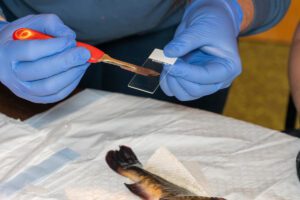
UVM professor and cancer researcher Julie Dragon co-leads dissection and tissue collection of catfish with melanoma skin cancer at the Gateway Center on the shore of Lake Memphremagog, Newport, Vermont. Additional participants: Elizabeth Murchison, professor at the University of Cambridge, UK; her post-doctoral associate Zoe Clarke; USGS post-doctoral research fish health biologist Cheyenne Smith; her undergraduate student intern Sam Williams (not shown in these photos); Peter Emerson, fish biologist with the Vermont Department of Fish & Wildlife. The team sampled tissue from 17 fish.
UVM professor and cancer researcher Julie Dragon co-leads dissection and tissue collection of catfish with melanoma skin cancer at the Gateway Center on the shore of Lake Memphremagog, Newport, Vermont. Additional participants: Elizabeth Murchison, professor at the University of Cambridge, U.K.; her post-doctoral associate Zoe Clarke; USGS post-doctoral research fish health biologist Cheyenne Smith; her undergraduate student intern Sam Williams (not shown in these photos); Peter Emerson, fish biologist with the Vermont Department of Fish & Wildlife. The team sampled tissue from 17 fish. [University of Vermont]

Using whole-genome sequencing, the team compared DNA from tumors and healthy tissues in affected fish. They expected to find a genetic mutation that makes the fish susceptible to having their own cells become cancerous. Instead, they found that the cancer cells were much more closely related to each other than to their host fish—the signature of a clonally transmissible cancer, in which tumor cells themselves act as infectious agents.

“Hundreds of thousands of genetic variants are shared among tumor samples but absent from host fish, vastly exceeding levels seen in conventional cancers,” the authors reported in their paper.

The research team is now working to understand how the cancer cells spread between animals. “It seems to only happen in larger fish that are of spawning age,” said study co-lead Mark Henderson, PhD, fish biologist at UVM’s Rubenstein School of Environment and Natural Resources. “Maybe some part of spawning behavior leads to the spreading of the cancer between animals.”

The study notes that pollutants or hormonal changes could weaken immune systems, making the lake’s brown bullhead fish more vulnerable to infection. Naturally occurring arsenic may also play a role. The team did find that the fish cancer cells have elevated levels of arsenic and the geographic distribution of the cancer appears to have correlation with levels of arsenic in the lakes’ surrounding soil. “Arsenic is found naturally throughout New England, and there’s really high concentrations of it in the Vermont’s Northeast Kingdom as well as up through Maine, which is where we’ve also seen evidence of this cancer,” said Henderson.

The cancer’s ecological impact remains uncertain. Some transmissible cancers are devastating—the Tasmanian devil tumor has wiped out 90% of some populations. In contrast, the dog tumor has coexisted with its hosts and has done for thousands of years. In Lake Memphremagog, heavily diseased bullhead can survive for years, but long-term population effects are still unknown.

The researchers are beginning to explore how long this cancer may have been around, and how common transmissible cancers may be. They are exploring ponds and rivers in Massachusetts to learn more about the distribution of the cancer and to see if it may have originated there. “Our contention is that maybe it’s not as rare as everyone thinks. We’re just not seeing it,” said Dragon. “In the case of transmissible cancers, it may be that we don’t see many simply because we aren’t looking for them.”

In their paper the team concluded, “Although we cannot rule out a role for conventional pathogens in the original emergence or ecological transmission of this disease, the genomic evidence presented here overwhelmingly supports a transmissible cancer in which the tumor cells themselves act as the infectious entity.”

The post Transmissible Cancer Discovered in Freshwater Fish appeared first on GEN – Genetic Engineering and Biotechnology News.

AI Protein Engineering Model Designed for Biomanufacturing

A cell engineering model designed specifically for the biomanufacturing environment could go a long way toward optimizing host cell performance, reducing development timelines, and streamlining biomanufacturing platform design.

“There’s a real challenge in determining how to engineer a host cell’s genome to maximize its performance in a biomanufacturing application.” That’s the difficulty laid out by Shawn Manchester, PhD, CEO, Triplebar Bio, and a view that’s shared by Yun Song, PhD, professor, University of California, Berkeley, and the industry innovation organization BioMADE. The three, with support from the National Science Foundation, are developing such an AI-informed cell engineering model to solve that challenge.

What’s most notable is that this AI-informed predictive and optimization model focuses on the biomanufacturing environment. The large-scale, application-specific training database is being designed to handle bench- to commercial-scale biomanufacturing.

Biomanufacturing-relevant environment

As Manchester says, “There aren’t a lot of organisms that have naturally evolved to make proteins they’ve never seen before, in an environment they’re not well-evolved for. Our ability to generate data in a setting that is relevant to biomanufacturing and to do so at the scale of hundreds of thousands of cells and data points is innovative…and it’s not something that many others are looking at. Most people are working on AI for protein engineering of therapeutics and other molecules as opposed to cell engineering for use in biomanufacturing.”

This project focuses on data capture from Pichia pastoris as the host cell producing five different proteins that are relevant for bioprocessing, food production, and defense. The learnings will be incorporated into Triplebar’s other programs, too, including optimization for its Chinese hamster ovary (CHO) cells, Manchester says.

“Improving the scalability of these proteins directly benefits [not just bioindustrial or biopharmaceutical applications, but a broad range of] biomanufacturing,” Brandon Simmons-Rawls, program manager, BioMADE, emphasizes.

This AI project combines two core technologies deployed at Triplebar:

  • Droplet microfluidics, in which a cell is encapsulated in a water and oil emulsion alongside a fluorescent-based sensor to quantify protein production
  • Multimodal transformer-based AI model

The genomes and transcriptomes of cells that make either more or less protein than baseline are sequenced and fed into the AI’s very large, labeled training sets to identify correlations between genotypes and phenotypes. These correlations are important patterns about how the genome works, Manchester explains, and can be used to generate new genomic designs for optimization of the host cell to the biomanufacturing process.

“We first pre-train models on all relevant sequencing data from thousands of genomes, which gives us an underlying structure to the genome. Then we fine-tune those models with the genotype-phenotype data we generate in the biomanufacturing-relevant environment. This allows us to understand which of those patterns in the genome relate to biomanufacturing-specific performance,” Manchester says.

Once this AI-enabled model rolls out, Manchester says he envisions it being used by bioindustrial and biopharma companies that “need to improve the productivity or efficiency of the organism they use in manufacturing. Results should be faster and more efficient than those derived using guess-and-check methods based on our current understanding of how these organisms work.

“The goal is for people to log onto this AI tool, identify what they’re making and what they’ve done, and ask the AI what else they can do to improve performance,” he continues. “The model will serve them specific genetic designs that they can deploy in their organism.”

Manchester predicts that more than 10% of the designs will produce meaningful improvements—significantly more than traditional, early-stage design-build-test cycles. This streamlines the cell engineering cycle by focusing on modifications likely to yield performance improvements that are most meaningful for biomanufacturing.

The post AI Protein Engineering Model Designed for Biomanufacturing appeared first on GEN – Genetic Engineering and Biotechnology News.