

<![CDATA[Poor schizophrenia control drives relapse, homelessness and caregiver strain; data show $367B burden—why relapse prevention and LAIs matter.]]>
Surf Therapy: A Powerful Low-Intensity Approach in Global Youth Mental Health Care
By Mai El Shoush, Partnerships Campaign Manager, Stavros Niarchos Foundation (SNF) Global Center for Child and Adolescent Mental Health at the Child Mind Institute
In Conversation with Waves for Change
The world’s oceans have long been profound forces that shape coastlines, cultures, and scientific discovery. And today, through targeted programs, they also serve as therapeutic environments transforming youth mental health worldwide.
As global health systems continue to explore solutions that minimize resource constraints while addressing child and adolescent mental health demands, innovative approaches like surf therapy are demonstrating remarkable effectiveness as low-intensity initiatives. From the beaches of California to the coastal communities of South Africa, Australia, Hawai’i, the United Kingdom, and Senegal, these programs are creating accessible entry points for young people.
Wave for Change (W4C) — a South Africa-based organization and valued implementation partner of the Stavros Niarchos Foundation (SNF) Global Center at the Child Mind Institute — has developed an evidence-based Surf Therapy program for youth in underserved communities. We spoke with their chief development officer Paula Yarrow and senior grant manager Jill Sloan about the award-winning program. As a highly regarded Cape Town‑based NGO that uses surfing as a therapeutic tool to support youth mental health, W4C offers safe spaces, evidence‑based emotional regulation tools, community mentorship, and a pathway to resilience for young people growing up in challenging environments.
The partnership includes the identification of workforce gaps and training needs for frontline workers such as NGOs, to further expand evidence-based support and brief interventions through culturally appropriate, low-intensity psychological therapy approaches. The context-specific training materials are expected to be piloted later in the year in South Africa and are intended to improve access to quality mental health care for young people.
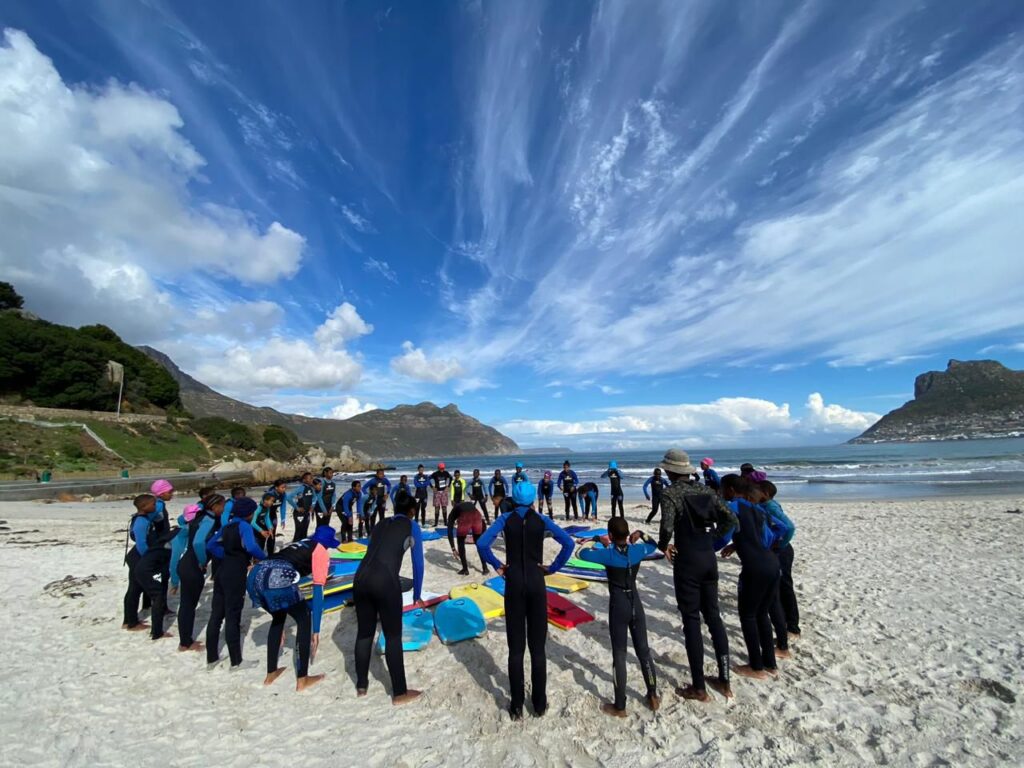
W4C launched Surf Therapy in 2009, which has since helped more than 10,000 adolescents experiencing high-stress environments gain valuable coping skills across its hubs in the Western and Eastern Cape as well as Cape Town. Participants learn how to build positive social networks and develop self-regulation skills to support healthy emotional and behavioral responses to stress, with coaches themselves aged between 18-25. The program creates a fun, culturally relevant environment through the Take 5 model — a framework W4C has designed to be adapted for a range of sports, arts, and cultural initiatives. The model has been utilized by several leading global organizations, including UNICEF.
Waves for Change also played a key role in the founding of the International Surf Therapy Organization (ISTO), connecting practitioners, clinicians, and researchers to advance science research, raise awareness, and support surf therapy.

How does Waves for Change use evidence-based Surf Therapy and capacity building as a solution to fill the gap in youth mental health care?
Approximately 90 percent of the world’s adolescents live in low- and middle-income countries (LMICs). In the most underserved communities, adolescents may experience repeated exposure to violence, unmet basic needs, and limited access to safe spaces or trusted caregivers. Typically, there are very few mental health services that are accessible to such youth.
The more Adverse Childhood Experiences (ACEs) a child or adolescent has whilst growing up, the more likely they are to develop toxic stress — an ongoing stress state without respite. This can often lead to mental health conditions such as anxiety, depression, substance misuse, and cognitive impairment. This can also result in the development of physical health conditions such as heart disease as they grow into adulthood.
The main problem we’ve identified is that there aren’t enough trained workforces (e.g., sports coaches, youth facilitators) that are able to deliver simple, fun, structured play-based sessions with consistency at scale. Our work provides a response to this issue within the adolescent mental health promotion and illness prevention arena. Additionally, our initiatives significantly increase the number of individuals — coaches, teachers, mentors or others — who are already in contact with young adolescents and can provide them with mental health support to foster their immediate and longer-term mental health.
How has Waves for Change adapted the organization’s Surf Therapy program to develop the Take 5 model?
Waves for Change’s Take 5 training model has been incubated, tested, and rigorously evaluated within W4C’s award-winning Surf Therapy program. Take 5 distils the key components of our Surf Therapy program, providing coaches with the essential skills they need to build and sustain caring relationships with children. And it uses a simple teaching routine that creates consistently engaging, fun, structured programs for children and adolescents that suit their language, culture, and context.
Take 5 is low intensity and cost-effective — tailored for high-stress environments and the unique mental wellness needs of adolescents living in multidimensional poverty, conflict, or crisis.
How has partnering with young people to research and co-develop programs made the work more impactful?
In research studies we’ve conducted, adolescent participants (ages 10-16) reported experiencing between 6-8 adverse events every year, including violence and abuse. When asked what sorts of spaces they wanted to see at Waves for Change, the adolescents identified core components such as access to a safe space where they could have fun, be heard, and learn skills to cope. These components now form the bedrock of our Surf Therapy program. We initially worked with 9-12-year-olds and have since developed the follow-on programme for adolescents up to age 16 who have graduated the Surf Therapy programme. This is called Surf Club and is available to all Surf Therapy graduates.
Waves for Change also conducts pre- and post-intervention surveys with participants to monitor the impact of our work. Our coaches (ages 18-25) are at the frontline of delivering our services. A key role they play is to listen with care and respect to the adolescents’ concerns, and to share them with our Child Protection team for review and follow-up when needed.
What makes your partnership with the SNF Global Center at the Child Mind Institute unique?
Working with the Child Mind Institute allows Waves for Change to collaborate with and learn from colleagues doing similar work in the adolescent mental health space across South Africa, the United Kingdom, and Brazil. The partnership offers an opportunity to learn about approaches that have been successful in other health systems. It has also allowed Waves for Change to share detailed information about the training and supervision protocol used to develop key competencies in the coach workforce that leads Surf Therapy in South Africa. This has helped the Child Mind Institute to develop a comprehensive guide for other similar workforces.
Can you expand on the importance of partnerships in strengthening youth mental health care and community empowerment?
Partnerships allow for the consolidation of skills and resources so that a greater impact can be achieved. For example, at Waves for Change, we work with over 70 referral partners every year to identify young adolescents who can benefit from our Surf Therapy program. We are also partnering with the Department of Cultural Affairs and Sport to use our Take 5 model to train MOD and YearBeyond coaches and mentors, who are already reaching large numbers of children and young adolescents through their work. And we’re contributing to building the broader ecosystem of mental health support for adolescents and children by training large national NGOs, government agencies, and humanitarian organizations with our Take 5 model.
How can non-profits further help foster strong peer networks and inclusive safe spaces?
Some of the key lessons we have learnt are the following:
- In the field of youth mental health, make youth the leaders on program implementation
- Provide youth with skills, opportunities, supervision, and support so that they can grow and develop further
- Maintain a strong culture of protection, respect, and communication so that all participants feel safe, welcome, accepted, and heard
Read more about W4C’s Surf Therapy from Youth Liaison Officer, Azola Sibanda and Training Manager Jamie-Lee Davids
The post Surf Therapy: A Powerful Low-Intensity Approach in Global Youth Mental Health Care appeared first on Child Mind Institute.
<![CDATA[Oral zervimesine blocks toxic amyloid and alpha-synuclein oligomers, as Cognition maps FDA strategy for Lewy body trials.]]>
Implementing advanced AI technologies in finance
In finance departments that have long been defined by precision and control, AI has arrived less as a neatly managed upgrade than as a quiet insurgency. Employees are already using it while leadership races to impose structure, governance, and strategy after the fact. The result is a paradox: one of the most tightly regulated functions in the enterprise is now among the most experimentally transformed.

What’s emerging is a layered shift in how work gets done. From variance commentary and fraud detection to contract review and close narrative drafting, AI is embedding itself across workflows, particularly where unstructured data once slowed down everything. Yet, as Glenn Hopper, head of AI and managing director at VAi Consulting, puts it, “the proliferation of AI happened kind of before governance and before a real plan came about.” That bottom-up adoption is forcing a recalibration at the top, where executives must now reconcile productivity gains with oversight, risk, and accountability.
Just as critical is reframing AI’s role. “AI as a means to an end, as opposed to AI being the end,” says Ranga Bodla, VP of industry and field marketing at Oracle NetSuite, underscores a growing consensus: the technology is most effective when it disappears into existing processes rather than outright replaces them. Embedded systems, seamless integrations, and tools like model context protocol (MCP) are accelerating this shift, making AI an ambient capability. Notably, ease of integration, not cost savings or new features, has become the strongest driver of adoption.
Still, the real constraint may be neither data nor technology, but people. “Talent is the actual root cause,” Hopper argues, pointing to a widening gap between domain expertise and AI fluency. Even as concerns about data security and model opacity persist, the more pressing risk may be misunderstanding the tools altogether or restricting them so tightly that employees look for workarounds beyond leadership control. “The auditability of it, I think, is critical,” Bodla notes.
Looking ahead, the trajectory is clear but variable. AI agents capable of executing complex, multi-step tasks are beginning to materialize, while expanding context windows and interoperable systems promise deeper, more persistent intelligence. But the real transformation may be a gradual shift toward systems that bolster judgement, automate routines, and allow finance teams to spend less time reconciling the past and more time shaping what comes next.
This webcast is produced in partnership with Oracle NetSuite.
Register to watch the webcast.
This content was produced by Insights, the custom content arm of MIT Technology Review. It was not written by MIT Technology Review’s editorial staff. It was researched, designed, and written by human writers, editors, analysts, and illustrators. This includes the writing of surveys and collection of data for surveys. AI tools that may have been used were limited to secondary production processes that passed thorough human review.
Innovation abounds in device charging
The changes may be less perceptible than in smartphones, tablets, or wearables, but chargers have also been quietly reinvented over the last decade. At one time a bulky mix of tangled cables and connectors, slow to perform and prone to overheating, they’re now smaller, safer, and faster, thanks to a slew of technological advances.

These advances include a switch to gallium nitride (GaN), which has now usurped silicon as the preferred semiconductor, capable of handling higher voltages, faster switches, and more efficient conduction. Multi-port chargers, coupled with an industry-wide shift toward USB-C standardization, mean a single charger can handle multiple devices. And early smart chargers are also trickling onto the market, able to dynamically distribute power and carry out autonomous safety checks.
Combined, these have repositioned chargers as differentiated standalone devices, rather than peripheral accessories.
But, manufacturers say there is much further to go if chargers are to accommodate the demands of a connected ecosystem now made up of an estimated 20 billion devices, according to IoT Analytics.
“Charging products are undergoing a fundamental identity shift—from accessory to primary component,” says Mario Wu, general manager for North America at Anker Innovations. “This is not simply a functional upgrade; It is a repositioning of charging’s role within the broader digital lifestyle ecosystem. As charging becomes normalized, the charger is no longer an appendage to your devices—it is the infrastructure underlying every digital experience.”
Pillars of performance
If this vision for the future of charging sounds ambitious, there are concrete advancements to back it up. Newly refined semiconductors are already bolstering power and performance, building on the gains delivered by GaN with some sweeping changes to systems architecture.
To take advantage of the fast-moving technology, Anker launched GaNPrime 2.0, which combines GaN materials with higher-frequency controllers and other power devices, achieving higher power output and lower heat generation, explains Wu. For example, the addition of a multi-level buck converter converts voltage from a binary on/off pattern, to multiple, smaller steps that create smoother transitions and reduce stress on components. Combined with Anker’s proprietary control algorithm, this simultaneously achieves a more compact product design and reduced energy loss.
Changes such as this mean secondary-stage power conversion now reaches over 99.5%, says Wu, and some products can maintain 140 watts on a single port without falling below optimal levels. “In traditional setups, you might use three separate chargers—adding up to roughly 210 watts combined,” says Wu. “But Anker’s Prime 160W Charger with PowerIQ 5.0 can charge those same three devices in roughly the same time because it dynamically reallocates unused capacity instead of locking it in place.”
But if GaNPrime 2.0 represents where the architecture stands today, it’s by no means the end point. Says Wu, “The next phase of GaN development focuses on higher frequency switching: When paired with breakthroughs in materials and control technology, higher switching frequency enables lower energy loss, improved conversion efficiency, and even more compact designs.”
Other third-generation semiconductors like silicon carbide (SiC) will also have a role to play. Already deployed at scale in EV inverters and industrial power systems, Wu explains that SiC can deliver “exceptional, high-temperature stability and reliable support for high-voltage, high-power applications.” Improving circuit design using SiC to make it compact and cost-effective for smaller devices has proven a stumbling block until now, but Wu is hopeful that as manufacturing scales up, the material will become “an increasingly credible direction.”
Without constraints
Consumers also demand portability in their device charger. They want chargers without the spatial constraints of wires or surface-to-surface connection—or what’s known as imperceptible charging.
Wireless charging innovations today go part of the way, but they’re based on the principle of magnetic coupling—i.e., only when transmitter and receiver coils are aligned is energy transfer efficient and stable. That means devices must be in contact with the charging pad surface.
But research into technologies that use magnetic resonance and infrared are moving the dial. Best known for creating non-invasive imaging in health care via MRIs, magnetic resonance uses magnetic fields to allow energy transfer over greater distances by tuning transmitter and receiver coils to the same resonant frequency. Transmitters emit an oscillating magnetic field from which the receiver can extract energy even if coils are not perfectly aligned. This “significantly relaxes placement requirements for users, [but currently] the trade-off is reduced transmission efficiency,” says Wu.
Infrared wireless charging also represents a meaningful area ripe for exploration, Wu adds. This sees infrared beams deliver energy to photovoltaic receivers on devices, with transmitters installable at any location so long as there is clear line-of-sight to the device. This enables wireless power delivery across meters rather than centimetres. He explains, “The core challenge it currently faces is further increasing power levels, and related research is ongoing.”
Wu says Anker is engaged in technical exchanges with both universities and industry associations to find workarounds for these trade-offs. “Our strategy is to remain at the forefront: continuously tracking, conducting in-depth evaluations, and delivering the next generation of wireless charging technology to users the moment it matures and becomes viable.”
Levelling up intelligence
If the power, performance, and portability of chargers have made incremental gains in the last decade, though, then imbuing devices with smart capabilities is arguably more of a step change in what users might expect.
Wu defines smart charging as “the shift from passive power delivery to active, adaptive energy management.” In short, if conventional chargers supply fixed current, then smart chargers can read device signals, monitor conditions, and adjust their output accordingly to optimize speed, safety, and efficiency.
Some products on the market already hint at these possibilities.
Next-gen chargers already deliver dynamic power allocation, for example, recognizing individual device IDs to adapt the distribution of power to multiple devices simultaneously. But in 10 years’ time, the goal is to create chargers that go much further, says Wu, capable of autonomously managing energy across multiple connected devices, communicating with users, and adaptively optimizing performance.
“Smart charging will feel less like a feature and more like an invisible service—one where the system knows your devices better than you do: anticipating needs, intervening before battery degradation sets in, and managing the full energy picture across everything you own,” he summarizes.
These future charging systems will understand each device’s specific needs and deliver the right charge, at the right moment, balancing longevity with performance, without the current trade-offs. A single device will serve an entire household, Wu believes, working imperceptibly in the background to balance multiple devices without spatial restraints. And they’ll proactively engage with users, too, providing feedback and updates via personable interfaces.
That may sound highly conceptual, but it’s a far closer technological reality than you’d think, Wu insists. “The transition [to smart charging] is actively underway” and chargers will soon join the ranks of devices deemed indispensable for day-to-day life, albeit as understated as ever.
This content was produced by Insights, the custom content arm of MIT Technology Review. It was not written by MIT Technology Review’s editorial staff. It was researched, designed, and written by human writers, editors, analysts, and illustrators. This includes the writing of surveys and collection of data for surveys. AI tools that may have been used were limited to secondary production processes that passed thorough human review.
Palantir to be granted ‘unlimited access’ to NHS patient data
The NHS is granting staff from companies including Palantir ‘unlimited access’ to identifiable patient data while working on its FDP.
The Download: the hantavirus outbreak and Musk v. Altman week 2
This is today’s edition of The Download, our weekday newsletter that provides a daily dose of what’s going on in the world of technology.
Here’s what you need to know about the cruise ship hantavirus outbreak
Last week, eight passengers aboard a Dutch-flagged cruise ship contracted a type of hantavirus transmitted by rats. Three have since died. But health experts stress that this situation is nothing like the coronavirus outbreak in 2020.
The Andes virus is known to spread between people, and there are no specific antiviral treatments or vaccines. Yet transmission appears to require a specific form of contact that the cruise ship fostered.
Here’s what you need to know about the outbreak—and why experts believe it can be contained.
—Jessica Hamzelou
This story is part of MIT Technology Review Explains, our series untangling the complex, messy world of technology to help you understand what’s coming next. You can read more from the series here.
Musk v. Altman week 2: OpenAI fires back, and Shivon Zilis reveals that Musk tried to poach Sam Altman
In the second week of the landmark trial between Elon Musk and OpenAI, Musk’s motivations for bringing the suit came under intense scrutiny.
OpenAI president Greg Brockman testified that Musk had pushed for the company to create a for-profit entity, while Shivon Zilis, a former board member, revealed that the Tesla tycoon had sought to lure Sam Altman to a new AI venture.
The courtroom also heard about Brockman’s private journals, Musk’s abandoned plans for a rival AI lab, and the moment he stormed out of a pivotal meeting carrying a painting of a Tesla.
Here’s what happened in the second week of the trial—and what’s coming next.
—Michelle Kim
Michelle Kim, who’s also a lawyer, has been in court on each day of the Musk v. Altman trial. To keep up with her ongoing coverage of their legal showdown, follow @techreview or @michelletomkim on X.
How LLMs could supercharge mass surveillance in the US: 10 Things That Matter in AI Right Now
There are pieces of your life scattered all over the internet, and some of them are for sale. Data brokers collect web searches, financial records, and location data from millions of people and sell them to various clients, including the US government.
While gathering that data has become easier in the smartphone era, making use of it at scale has remained difficult. But researchers are beginning to show that LLM agents can connect anonymized data to real people quickly, cheaply, and at a massive scale.
—Grace Huckin
“How LLMs could supercharge mass surveillance in the US” is a feature accompanying MIT Technology Review’s 10 Things That Matter in AI Right Now, our guide to what’s really worth your attention in the busy, buzzy world of AI. Check out the full list of the big ideas, trends, and advances in the field here.
The must-reads
I’ve combed the internet to find you today’s most fun/important/scary/fascinating stories about technology.
1 Meta’s embrace of AI is making employees miserable
Workers feel pressured to use the tech while fearing AI-driven layoffs. (NYT $)
+ They’re also unhappy about Meta tracking them to train AI. (The Verge)
+ AI’s rise has been described as “the most joyless tech revolution ever.” (WSJ $)
+ Gen-Z is particularly fed up with it. (NYT $)
+ We’ve entered the era of AI malaise. (MIT Technology Review)
2 South Korea’s military wants robots to fill gaps in troop numbers
It’s in talks with Hyundai to bring robotics to the front lines. (Bloomberg $)
+ They could include Boston Dynamics’ Spot and a new exoskeleton. (SCMP)
+ South Korea’s military has shrunk by 20% over six years. (BBC)
3 OpenAI is being sued over ChatGPT’s alleged role in guiding a mass shooter
A lawsuit claims the bot said targeting children would bring more attention. (NBC)
+ Florida’s AG has opened a criminal investigation into the case. (NPR)
+ Does AI cause or amplify delusions? (MIT Technology Review)
4 The Canvas hack was the biggest-ever student data privacy disaster
It exposes the risks of centralizing the data of millions of students. (404 Media)
+ While the platform is back online, the hack disrupted university exams. (NPR)
+ The breach is part of a trend of edtech vulnerabilities. (WP $)
5 Alibaba has joined China’s “chat to buy” shopping craze
By integrating AI assistant Qwen into its e-commerce platforms. (Reuters $)
+ Companies are betting that chat is the future of online shopping. (SCMP)
+ OpenClaw is a driving force behind the trend. (MIT Technology Review)
6 Cybercrime increasingly comes with threats of physical violence
In the US, the physical threats rose more than twofold last year. (BBC)
7 AI’s next phase plays into TSMC’s hands
Taiwan’s chip-making giant stands to gain from the supply squeeze. (WSJ $)
8 Europe is confronting life without American tech
Dependence on Silicon Valley is a growing geopolitical concern. (FT $)
9 The US, UK, and China top new rankings for AI in life sciences
Switzerland and Germany follow in the AI Competitiveness Index. (SCMP)
10 The Pentagon has released a massive trove of declassified UFO files
Including newly declassified documents, images and footage. (New Scientist)
+ The files contain reports of “orbs,” “saucers,” and lunar “flashes.” (Wired $)
+ Here’s how to spot an alien. (MIT Technology Review)
Quote of the day
“There’s a real sense where ‘safety’ isn’t a bad word anymore.”
—Nathan Calvin, general counsel at Encode, a nonprofit AI advocacy group, tells the Washington Post that Anthropic’s Mythos has forced a White House reset on AI safety.
One More Thing

NASA/JPL-CALTECH
Inside NASA’s bid to make spacecraft as small as possible
As NASA’s InSight lander descended to Mars in November 2018, two tiny spacecraft tracked its progress. InSight had touched down, they reported, and survived its treacherous journey.
The mission offered a pathway to cheaper space exploration, with small, low-cost probes launching far more often than multibillion-dollar flagship missions. But there’s a catch: miniaturization can only go so far before it collides with the hard limits of physics.
NASA still hopes small sats could transform planetary exploration. But first, scientists and engineers have to figure out what these tiny spacecraft can realistically do.
Discover how small spacecraft could pave the way for giant leaps into the cosmos.
—David W. Brown
We can still have nice things
A place for comfort, fun, and distraction to brighten up your day. (Got any ideas? Drop me a line.)
+ In a grand tribute to a four-legged hero, Cambodia has erected a statue to honor a rat.
+ A 1957 comedy accidentally made a seriously prescient prediction about office automation.
+ Explore the physics of the train that wouldn’t fall over—a monorail that promised to revolutionize travel.
+ Are you a true cinephile? Prove it with these daily movie quote challenges.
Haemodynamic correlates of bilateral 6 Hz transcranial alternating current stimulation during working memory enhancement revealed by fNIRS
IntroductionTheta-band transcranial alternating current stimulation (tACS) has been proposed to enhance working memory (WM) by entraining endogenous oscillations, yet the haemodynamic signatures accompanying theta-tACS–related WM gains remain unclear. We investigated whether 6 Hz tACS modulates prefrontal task-evoked haemodynamic responses during WM and whether such changes relate to behavioral improvement.MethodsIn a randomized, single-blind, sham-controlled design, healthy adults (18–30 years) were allocated to 6 Hz tACS or sham (initially n = 25 per group). Stimulation (1mA peak-to-peak, 20min, 30-sramp-up/down) was delivered bilaterally over the dorsolateral prefrontal cortex (DLPFC; F3/F4). Participants completed the Digit Span Test and N-back tasks (1-, 2-, 3-back) before and after stimulation. During N-back performance, fNIRS recorded bilateral DLPFC signals. Task-evoked oxygenated hemoglobin (HbO) β coefficients were estimated using a general linear model. Group differences in pre–post changes were tested using within-/between-group analyses and ANCOVA, with brain–behavior coupling assessed via Spearman correlation.ResultsAfter fNIRS quality control, 44 participants were included in the final analysis; six participants were excluded because more than 30% of channels were identified as low quality. Relative to sham, 6 Hz tACS produced greater improvements in backward Digit Span and total Digit Span. In the N-back task, accuracy improved selectively under the high-load 3-back condition (between-group change: [F(1.40) = 12.29, p_adj = 0.0034, η2p = 0.24)], whereas reaction time showed no significant between-group differences. fNIRS revealed post-stimulation increases in left DLPFC HbO-β during 3-back, with a significant between-group β-change at one channel [(F(1.40) = 10.69, p_adj = 0.035)]. Within the 6 Hz group, 3-back accuracy gains correlated positively with β-change in the left DLPFC (ρ = 0.44, p_adj = 0.039).ConclusionBilateral 6 Hz tACS selectively enhances high-load WM accuracy and is accompanied by increased task-evoked haemodynamic activation in the left DLPFC. The observed brain–behavior coupling suggests that theta-frequency neuromodulation may facilitate executive control under high cognitive demand via strengthened prefrontal neurovascular responses.
Steroid receptor coactivator-1: integrating steroid hormone signals to regulate brain function and disease
Steroid receptor coactivator-1 (SRC-1), also known as nuclear receptor coactivator-1 (NCOA1), represents the first identified member of the p160 nuclear receptor coactivator family and plays a pivotal role in integrating steroid hormone signals, regulating gene transcription, and maintaining neural homeostasis in the central nervous system (CNS). SRC-1 exhibits region-specific, cell-type-specific, and sexually dimorphic expression patterns in the brain, with prominent distribution in key regions including the hippocampus, cerebral cortex, hypothalamus, and amygdala. Functional studies demonstrate that SRC-1 participates in diverse neural functions such as learning and memory, energy metabolism, emotional regulation, and reproductive behavior through modulation of synaptic plasticity-related genes, neurotrophic factors, and metabolic pathways. Aberrant SRC-1 expression is closely associated with neurodegenerative diseases, autism spectrum disorders, and glioblastoma. This review systematically summarizes the molecular structure, expression characteristics, physiological functions of SRC-1, and its roles in neurological disorders, while discussing its potential applications as a diagnostic biomarker and therapeutic target.
Exploring the neuroprotective potential of ligustrazine: a preclinical meta-analysis and machine learning perspective on cerebral ischemia-reperfusion injury
ObjectiveThis study aimed to assess the efficacy of ligustrazine in treating cerebral ischemia-reperfusion (I/R) injury and construct a preclinical evidence framework by meta-analysis and machine learning.MethodsA systematic search was conducted for preclinical studies published in PubMed, Embase, Web of Science, and the Cochrane Library up to June 25, 2024. The inclusion criteria encompassed preclinical animal studies pertinent to the topic. Data extraction was performed independently by two individuals, Stata 17.0 software was used for quantitative analysis, R (version 4.3.3) and Python (version 3.11.4) were used for machine learning with neurological function score as the dependent variable.ResultsA total of 23 articles were included, involving 381 animals in the meta-analysis and 321 animals in the machine learning component. Ligustrazine significantly improved neurofunctional scores (NFS) [Longa criteria, SMD = −1.59, 95%CI (−2.16, −1.01), P < 0.001; mNSS criteria, SMD = −1.67, 95%CI (−2.36, −0.97), P < 0.001], cerebral infarct volume (%) [SMD = −2.56, 95%CI (−3.03, −2.09), P < 0.001], and BBB [SMD = −3.06, 95%CI (−4.53, −1.59), P < 0.001]. Furthermore, machine learning analyses, with NFS as the dependent variable, identified the time of first dose, duration, and dose as key determinants of neurofunctional improvement with ligustrazine. Notably, model interpretation suggested that greater improvements were more likely to occur when the initial administration of ligustrazine occurred within 24 h prior to (or 2.21 h post) the ischemic event, at a dosage of 23.53–34.69 mg/kg/day (or 45.71 to 75.65 mg/kg/day), and with an administration duration exceeding 71.43 h.ConclusionThe combination of meta-analysis and machine learning in this study not only confirms that ligustrazine is effective in reducing cerebral I/R injury, but also provides a framework for elucidating the preclinical intervention variables, thus offering novel insights for optimizing preclinical strategies of ligustrazine in cerebral I/R injury.