

Wearable electronic “tattoos” painted onto the skin could allow comfortable and reliable health monitoring to personalized designs.
The flexible electrodes, outlined in PNAS, represent a pathway to the next generation of wearable systems for healthcare.
The novel devices are made of intrinsically conductible polymers that conform to the skin and maintain reliable connections to electronic systems, allowing stable electrophysiological monitoring.
Their ability to create bespoke designs could be particularly useful for long-term use in children, adolescents, and people sensitive to potential stigmatization.
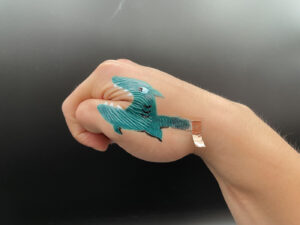
The researchers describe their invention “as a personalized and scalable solution for next-generation electronic tattoos that combine ultra conformality, customizability, and long-term reliability, accelerating their translation into clinical diagnostics and interactive bioelectronic systems.”
The current gold-standard electrodes of wet silver/silver chloride gels can dry out and produce inaccurate readings during motion.
The team therefore developed a paintable, drawn-on-skin dry electrode based on the biocompatible polymer poly (3,4-ethylenedioxythiophene): poly (styrene sulfonate (PEDOT:PSS).
The conductive ink can be painted onto microtextured skin with a commercial paintbrush and even go through hair.
It comprises polyvinyl alcohol as a mechanically supportive network, PEDOT:PSS as a conductive filler, and 4-dodecylbenzenesulfonic acid (DBSA) as both conductive additive and plasticizer, in a water-ethanol cosolvent system.
The resulting WE-PPD (water-ethanol-PVA/PEDOT:PSS/DBSA) electrode is breathable, sticks well to the skin, and conforms to it closely, minimizing skin contact impedance.
The paintable formulation also enables it to penetrate porous silver textile to form a robust soft-rigid connection.
In proof-of-concept demonstrations, the team demonstrated the versatility of the electrodes for biopotential monitoring and human-machine interfaces.
It was tested across wireless long-term electrocardiography recordings, robotic hand control based on electromyogram, and electroencephalogram-based neural response detection.
The absence of imaging artifacts also demonstrated its potential for multimodal MRI imaging and electrophysiological (EP) recordings, noted first author Wanqing Zhang, a PhD research assistant at Penn State University, and co-workers.
The team added: “The ability to customize the electrode appearance transforms WE-PPD from a conventional medical device into a user-friendly and aesthetically integrated wearable technology.
“For example, electrodes can be designed with cartoon patterns, which may reduce anxiety and improve acceptance among pediatric users by making EP monitoring less intimidating.
“Such personalization not only improves physiological comfort but also enhances social acceptance, user experience, and long-term compliance during continuous health monitoring.”
The post Paint-on Electrodes Enable Bespoke Health Monitoring appeared first on Inside Precision Medicine.