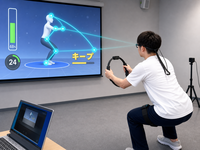
<strong>Background:</strong> Exergames integrate motor, cognitive, and postural-control demands; however, how specific task-demand manipulations influence gaze allocation during exergame performance remains insufficiently characterized. <strong>Objective:</strong> This exploratory pilot study used a within-participant design to examine whether gaze allocation and task performance differed across baseline, concurrent cognitive-task, and unilateral-squat conditions during squat-based exergaming in healthy young adults. <strong>Methods:</strong> Eight healthy adults (mean age 20, SD 1 years; 7 men and 1 woman) used a squat-based exergame (<i>Ring Fit Adventure</i>; Nintendo) under 3 randomized conditions: baseline, concurrent cognitive task, and unilateral squats. In the concurrent cognitive task condition, participants performed serial subtraction during squatting. In the unilateral-squat condition, participants performed single-leg squats, which were intended to increase support-leg muscular demand as well as postural and motor-control requirements. Execution time, squat score, arithmetic performance, and eye-tracking metrics were recorded. Primary gaze outcomes were the proportion of fixation time and fixation counts allocated to predefined areas of interest (AOIs; command, avatar, and score) and to regions outside these areas across the entire trial. Differences from the baseline condition were examined using Dunnett tests or paired Wilcoxon signed-rank tests with Holm adjustment, and effect sizes were reported. <strong>Results:</strong> Exergame execution time increased from 31.0 (SD 3.3) seconds in the baseline condition to 38.2 (SD 6.1) seconds in the concurrent cognitive task condition and to 34.3 (SD 6.0) seconds in the unilateral-squat condition. In contrast, the squat score decreased from 98.8 (SD 2.8) in the baseline condition to 69.6 (SD 18.3) in the unilateral-squat condition. For fixation counts, allocation to the command AOI decreased from 44.8% (SD 11.4%) in the baseline condition to 32.1% (SD 8.9%) in the concurrent cognitive task condition and 36.2% (SD 8.5%) in the unilateral-squat condition. Outside AOI fixation counts increased in the concurrent cognitive task condition (55.7%, SD 8.6%) relative to the baseline condition (36%, SD 16.9%). <strong>Conclusions:</strong> In this exploratory within-participant pilot study, adding a concurrent cognitive task and performing unilateral squats resulted in different patterns of performance change and fixation count redistribution during squat-based exergaming. These preliminary findings suggest that AOI-based gaze allocation metrics may help characterize task demand–related attentional shifts in this setting. Larger confirmatory studies with more diverse samples and individual-level validation are needed before these metrics can be considered for adaptive or clinical applications.