

Background: Elder mistreatment (EM) is a significant public health problem that is frequently underdetected and underreported. Insufficient public recognition and engagement have been hypothesized as one contributor to this underreporting; however, few data sources exist to quantify public awareness or engagement with EM at the population level. Objective: This study examined relative internet search interest in EM compared with other forms of abuse (child abuse and domestic violence) in the United States using Google Trends data. Methods: We analyzed Google Trends data to compare the Relative Search Index (RSI) for the terms “elder abuse,” “child abuse,” and “domestic violence” in the United States from December 2018 to December 2023. RSI values reflect normalized search activity relative to the maximum search volume within the specified period. Results: Mean RSI values for “elder abuse” were substantially lower than those for “child abuse” (11.35 vs 50.21) and “domestic violence” (6.96 vs 63.50). Ad hoc tests for stationarity indicated that RSI values for all 3 terms remained stable over the 5-year study period. During Elder Abuse Awareness Month, RSI for “elder abuse” increased relative to “child abuse” and “domestic violence” by 8.3 and 5.7 points, respectively, compared with other months of the year. Conclusions: Relative search interest in elder abuse appears to be persistently lower than that for child abuse and domestic violence, despite modest increases during Elder Abuse Awareness Month. Although Google Trends does not provide a validated measure of public awareness, search-based metrics such as RSI may offer a scalable, low-cost complement to traditional data sources for contextualizing public engagement with EM and informing future awareness, detection, and prevention efforts.
<img src="https://jmir-production.s3.us-east-2.amazonaws.com/thumbs/c61b6ae514b9fbbb46e3ceb6ec8ca2e5" />
AACR 2026: A Video Update from San Diego
The American Association for Cancer Research (AACR) meeting is off and running in San Diego. Julianna LeMieux, PhD, Deputy Editor in Chief at GEN, and Damian Doherty, Editor in Chief at Inside Precision Medicine, are on the ground—in the talks, expo hall, and press room, covering as much of the news as they can. Here, they take a moment to chat about the first few days at the meeting.
The post AACR 2026: A Video Update from San Diego appeared first on GEN – Genetic Engineering and Biotechnology News.
CPC Biotech debuts unified bioprocess fluid portfolio
NEWS RELEASE: Introducing CPC Biotech – one brand uniting critical fluid management components New brand unites CPC’s Biopharma connector products with PSG Biotech’s pump, flow meter and sensor expertise – creating an integrated portfolio for the biopharmaceutical industry CPC Biotech to make its public debut at INTERPHEX 2026, April 21–23, Javits Center, New York City Roseville,…
The post CPC Biotech debuts unified bioprocess fluid portfolio appeared first on Medical Design and Outsourcing.
Henry Schein discloses exec pay for longtime CEO Stan Bergman’s final year
Henry Schein reported pay increases for three of its five executives in 2025, while median employee pay increased from the year before. The Melville, New York-based medical product supplier is the 11th-largest medical device company in the world, according to Medical Design & Outsourcing’s 2025 Medtech Big 100 ranking by revenue. Since then, Henry Schein increased…
The post Henry Schein discloses exec pay for longtime CEO Stan Bergman’s final year appeared first on Medical Design and Outsourcing.
STAT+: Tortugas Neuroscience launches with hopes to develop drugs for brain disorders, other conditions
A new startup has found that the Chinese biotech industry is good for more than obesity drugs and cancer therapies.
The company, Tortugas Neuroscience, launched Tuesday with plans to develop two schizophrenia and tinnitus drugs licensed from Chinese drugmaker Jiangsu Hansoh Pharmaceutical Group. The startup will also test two other medicines for focal epilepsy and encephalopathies that were originally created by Japanese pharmaceutical company Eisai Co. Ltd.
Tortugas has $106 million from Cure Ventures, The Column Group, and AN Ventures to begin testing the drugs in mid-stage trials in the U.S.
Opinion: The U.S. health care system is built around looking backward
In outpatient medicine, decisions move quickly.
A prescription is sent to a pharmacy. A referral goes out to a specialist. A test is ordered. From the patient’s perspective, the process feels immediate. Care begins moving forward as soon as the visit ends.
Adapting Behavioral Interventions for Dementia to Address NCDs and Mental Health
Conditions: Mental Health; Non Communicable Diseases; Dementia
Interventions: Behavioral: BECOME-D Intervention
Sponsors: Possible; University of California, San Francisco; National Institute of Mental Health (NIMH); Ministry of Health and Population, Nepal
Completed
Interventions: Behavioral: BECOME-D Intervention
Sponsors: Possible; University of California, San Francisco; National Institute of Mental Health (NIMH); Ministry of Health and Population, Nepal
Completed
CleanAssure Launched as an ISO Class 5 Controlled Cleanroom for Sterile Single-Use Assemblies
Freudenberg Medical, a Kaiserslautern, Germany-based contract design manufacturing partner, launched CleanAssure, a new ISO Class 5 controlled cleanroom designed to deliver clean and sterile single-use assemblies for biopharmaceutical customers, according to the company.
Freudenberg Medical manufactures silicone and thermoplastic elastomer (TPE) tubing for bioprocessing and critical fluid transfer. The company specializes in seamless, overmolded single-use assemblies used in vaccine production, cell cultivation, fluid transfer, and fill-finish operations.
The controlled cleanroom enables customers to receive ready-to-use washed, dried, and gamma sterilized single-use assemblies with the highest product quality, sterility, and process consistency, noted Rudi Gall, vp, global pharma, Freudenberg Medical.
“CleanAssure allows us to support our customers beyond component manufacturing,” he said. “By integrating controlled cleaning and sterilization into our single-use assembly services, we help reduce contamination risk, streamline validation activities, and support a reliable supply for our customers. We can now support customers with their entire component value chain and allow them to focus on their core manufacturing capability.”
Freudenberg’s cleaning process uses ultrapure water and air, operating within ISO 5 conditions. The water is produced using a multi-stage filtration process, resulting in high-purity water specifically suitable for pharmaceutical applications.
Key biopharma industry challenges
Biopharmaceutical manufacturers increasingly rely on single-use systems but face ongoing challenges related to cleaning validation, contamination risk, and production downtime. Customer-managed cleaning processes are often time-intensive, costly, and require additional resources while directly impacting supply reliability, according to Gall.
The company explained that its controlled cleaning environment addresses these challenges by reducing cross-contamination risk through tightly controlled ISO Class 5 processing; alleviating customer cleaning validation burden by delivering assemblies washed and sterilized under cGMP, validated conditions; minimizing production downtime by removing cleaning as a process step; and supporting a consistent, reliable supply of high-quality single-use assemblies.
Freudenberg will be attending INTERPHEX New York, April 21–23, Booth 1673, to exhibit its new products and services.
The post CleanAssure Launched as an ISO Class 5 Controlled Cleanroom for Sterile Single-Use Assemblies appeared first on GEN – Genetic Engineering and Biotechnology News.
CRISPR Screens Map Human T‑Cell Genes That Promote or Block HIV Infection
How does HIV, armed with only nine genes, manage to hijack the immune system so effectively? For decades, researchers have known that the virus depends on human proteins to enter, replicate, and persist—yet the full roster of those host factors has remained elusive. One major reason: most HIV studies have relied on immortalized cell lines rather than the primary CD4+ T cells the virus actually infects in the body. As a result, scientists have lacked a comprehensive picture of how real human T cells respond when HIV attacks.
A new study from Gladstone Institutes and the University of California, San Francisco (UCSF), changes that. In the study, titled “Systematic Discovery of Pro- and Anti-HIV Host Factors in Primary Human CD4+ T Cells” and published in Cell, researchers report the first genome‑wide map of human genes that either promote or restrict HIV infection in primary human CD4+ T cells, offering a long‑sought blueprint of the host–virus interface.
“HIV has been a global crisis for over 40 years,” said Alex Marson, MD, PhD, director of the Gladstone‑UCSF Institute of Genomic Immunology and senior author of the study. “By studying human T cells, which are the primary target of the virus, we’ve finally mapped the genes—many of which were previously unknown—that influence whether or not they can be infected by HIV.”
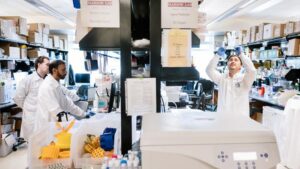
Achieving this required overcoming a fundamental technical barrier. “One challenge of using real human T cells for research is they’re very difficult to infect with HIV; out of a whole dish of cells, typically only one or two percent would get infected,” said first author Ujjwal Rathore, PhD. After years of optimization, the team pushed infection rates to roughly 70%, enabling genome‑scale CRISPR perturbations in primary cells for the first time.
With that platform in hand, the researchers performed orthogonal genome‑wide CRISPR activation (CRISPRa) and CRISPR knockout (CRISPRn) screens in CD4+ T cells, systematically testing nearly every human gene. Disrupting genes revealed those HIV depends on, while overactivating genes exposed natural antiviral defenses that HIV normally suppresses. “Over‑activating the genes gave us a wealth of information,” said co–first author Eli Dugan, a PhD candidate in Marson’s lab. “We discovered natural antiviral proteins that were previously invisible because the virus could effectively silence them.”
Across both screens, the team identified hundreds of host factors that shape HIV infection. Among the most striking were two previously unrecognized antiviral proteins: PI16 and PPID (Cyp40). “PI16 interacts with host factors involved in HIV fusion and inhibits viral entry, whereas PPID, a paralog of the proviral cyclophilin CypA, binds capsid and reduces nuclear import of the HIV core,” wrote the authors. Targeted mutagenesis, along with structural modeling and evolutionary analyses, pinpointed residues essential for PPID’s restriction activity, and engineered variants were up to tenfold more potent, according to Dugan.
To test whether these defenses could counter real‑world viral strains, the team collaborated with HIV pioneer Jay Levy, MD, who provided isolates from the early AIDS epidemic. Elevated levels of PI16 or PPID restricted even these aggressive HIV strains.
“This was the first genome‑wide effort to show how human genes affect HIV infection in cells taken directly from human blood samples,” said Nevan Krogan, PhD, director of the HIV Accessory and Regulatory Complexes (HARC) Center. “Our findings could eventually lead to new treatments that help the body’s immune system resist the virus.”
Beyond identifying antiviral factors, the study offers the potential for a powerful new platform for probing HIV latency—the persistent reservoir that evades antiretroviral therapy. “Now, we have the platform to ask the biggest questions in the field,” Rathore said, “and hopefully learn how to eliminate hidden HIV that current drugs can’t reach.”
The post CRISPR Screens Map Human T‑Cell Genes That Promote or Block HIV Infection appeared first on GEN – Genetic Engineering and Biotechnology News.
Policy implications for halting human trafficking and sexual exploitation at U.S. colleges and universities: results from a 12-campus survey
Human trafficking is a priority concern in the U.S, but few research studies have investigated the nature and extent of its occurrence on U.S. college campuses nor strategies to stop it. The objective of this research was to identify its occurrence (force/coercion/fraud into sex exchanges for something of monetary or other value) among college students in San Diego County and Imperial Valley, California, where some of the highest documented rates of human trafficking occur nationally, and its implications for policy. Methods: College students (n = 971) from 12 campuses in Southern California responded to fliers posted on their campuses by completing online self-administered surveys. Results: Nearly one in five students (18%) surveyed reported experiencing human trafficking in college. In bivariate analyses, trafficked students were more likely to be BIPOC, LGBTQ, foster youth, fraternity/sorority members, use illicit substances, experience abuse (physical, emotional, sexual, or being told to recruit others), transport/sell drugs, perform labor, and exchange sex for grades/schoolwork. Multiple logistic regression analyses (adjusting for age, sexual orientation, race) revealed those trafficked were more likely as college students to exchange sex across the U.S.-Mexico border (OR = 4.02; CI: 2.52-6.17), be inhibited to seek academic counseling (OR = 2.58; CI = 1.63-4.10), acquire a sexually transmitted infection (OR:1.63; CI: 1.04-2.57), wonder how they would afford their next meal (OR:1.20; CI: 1.03-1.40), and feel pressure from others (i.e., instructors, peers) to engage in sex (OR:2.69; CI:11.75-4.12). Conclusions: Strategies may need to: 1) expand Title IX implementation to encompass human trafficking/sexual exploitation information at all universities, and 2) amend or introduce state laws mandating human trafficking prevention awareness training at schools to include colleges/universities.