ASGCT 2026: Rare Instance of AAV Integration into Human Genome Linked to Brain Tumor

Rebecca Ahrens-Niklas
Rebecca Ahrens-Niklas, MD, PhD

BOSTON — A team at Children’s Hospital of Philadelphia (CHOP) led by Rebecca Ahrens-Niklas, MD, PhD, and Lindsey George, MD, has described a case of a brain tumor linked to a rare integration of adeno-associated virus (AAV).

George presented the work at the American Society of Gene and Cell Therapy (ASGCT) conference in a plenary talk selected as the “presidential abstract” by ASGCT president, Terry Flotte, MD. The study, “Neuroepithelial tumor with AAV integration after intracisternal magna vector delivery,” was published in the New England Journal of Medicine.

Lindsey George
Lindsey George, MD

Over the past 25 years, some 6,000 patients have been treated with some form of AAV gene therapy. In all that time, George said, there have been no established long-term safety concerns, although genome integration events have been reported in mouse and dog studies. But the case documented by George and colleagues at CHOP suggests that the gene therapy field may need to pay more attention to this potential occurrence.


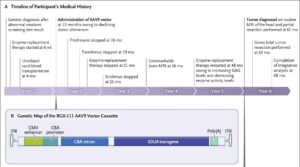
The story began with a 5-year-old boy with an inherited lysosomal disorder, severe MPS1 deficiency (Hurler subtype). The patient received enzyme replacement therapy at six weeks of age, followed by a cord blood stem cell transplant at age four months.

Investigators chose to perform gene therapy when the patient was 13 months old to deliver the iduronidase (IDUA) gene. The vector chosen was an AAV9 serotype, using a cytomegalovirus enhancer and a chicken beta-actin promoter driving the gene. The virus was administered into the boy’s cisterna magna in the base of the skull.

When the boy was five years old, a routine neurological scan revealed a large intraventricular mass that had not been observed two years earlier. Analysis of the tumor revealed it was a PLAG1-driven neuroepithelial tumor—indeed, PLAG1 expression was almost 300 times higher than in other central nervous system tumors studied at CHOP. (PLAG1 is usually only expressed during embryogenesis.)

Surgery to remove the tumor was successful. Eight months after surgery, there are no signs of tumor growth. The boy is also showing advanced neurocognitive function.


Tumor typing

George described RNA sequencing of the tumor, which revealed the fusion of a fragment of the AAV9 vector cassette to exon 5 of the PLAG1 gene on chromosome 8. The resulting transcript is predicted to encode a PLAG1 derivative containing five zinc-finger DNA-binding domains and a C-terminal transcriptional activation domain, which was previously reported to function as a transcriptional activator.

Adeno-associated virus
Credit: Dr_Microbe / iStock / Getty Images Plus

Curiously, the chimeric junction also included a segment of human chromosome 10, which George suspects originated during the vector manufacturing process. The integration event was present in about 40% of the total reads, suggesting integration into one of the two PLAG1 alleles.

George concluded her talk by noting that while the clinical outcome in this patient is so far encouraging, this is evidence that AAV integration can be associated with oncogenesis. The study underscores the need to monitor the most heavily transduced tissues after AAV gene therapy.

While the gene therapy community should be cautious in extrapolating this single case report across all AAV gene therapy programs, George said the study supports the use of the lowest feasible vector dose as well as tissue-specific promoters.

A) Timeline of the patient’s medical history; B) Diagram of AAV gene therapy cassette. [The New England Journal of Medicine ©2026]

George noted that detection of the integrated AAV vector DNA was challenging, in part because of rearrangements of vector DNA. The use of several complementary techniques—long-read DNA sequencing, targeted PCR amplification, and RNA sequencing—was required to confirm the integration.

George and coworkers closed their paper, noting that, “Our findings support the hypothesis that rare AAV integration can contribute to human oncogenesis, which emphasizes the need to optimize gene delivery methods and monitor transduced tissues after treatment.”

The post ASGCT 2026: Rare Instance of AAV Integration into Human Genome Linked to Brain Tumor appeared first on GEN – Genetic Engineering and Biotechnology News.

Autonomic dysreflexia: the concealed killer behind recurrent cerebral hemorrhage in spinal cord injury—a case report with management insights

Autonomic dysreflexia (AD) is a potentially life-threatening complication of high-level spinal cord injury (SCI), marked by paroxysmal hypertension. Although cerebrovascular events can be triggered by severe hypertension, the direct association between AD and intracerebral hemorrhage (ICH) necessitates increased clinical awareness. We present a case of a 71-year-old male with a complete C3 SCI (American Spinal Injury Association Impairment Scale grade A). On May 24, 2025, the patient developed an acute episode of AD following defecation, characterized by a sudden, severe headache and transient loss of consciousness, with elevated blood pressure (BP) of 178/101 mmHg. Emergency computed tomography revealed a right occipital ICH (3.6 × 1.8 cm) with concomitant subarachnoid hemorrhage. A follow-up cranial imaging examination on June 21, 2025, revealed a new contralateral hematoma (3.4 × 3.0 cm) in the left frontal lobe. Notably, a follow-up 24-h ambulatory blood pressure monitoring performed between the two hemorrhagic events (on June 20, 2025) revealed markedly elevated blood pressure variability, with a systolic BP standard deviation of 32.7 mmHg (compared with 31.8 mmHg recorded before the initial hemorrhage). Pre-event 24-h ambulatory blood pressure monitoring performed on March 21, 2025, had already demonstrated marked blood pressure variability (BPV), which may reflect the patient’s underlying autonomic dysregulation. The association between this extreme BPV and the subsequent ICH remains a subject for hypothesis generation. The hematomas resolved following a regimen of antihypertensive therapy (nitrendipine), osmotic diuresis (mannitol), and meticulous management of triggering factors. This case demonstrates that AD in high cervical SCI can precipitate severe ICH, with extreme BPV potentially serving as a synergistic risk factor. Clinicians should maintain high vigilance for new-onset severe headache in patients with SCI at or above T6, ensuring prompt BP assessment and identification of AD triggers. Future studies are required to investigate whether long-term BPV stabilization could mitigate hemorrhagic risk in this population.

How Chinese short dramas became AI content machines

In a dimly lit bedroom, a frightened young woman is thrown onto a bed by a tall, muscular man. He grabs her hand, and flame-like vines crawl across her body, fusing with her flesh. She levitates, then drops. A dragon-shaped tattoo appears across her chest.

“Two months,” the man says. “Give me an heir, or I will eat you.”

The scene is from Carrying the Dragon King’s Baby, one of the many hundreds of short dramas that appear on apps like DramaWave and ReelShort. There’s just something about this one that isn’t quite right. The lighting may be glossy and cinematic, but the show has an odd visual texture like something between a movie and a video game cutscene. 

That’s because Carrying the Dragon King’s Baby is part of a new trend for making these shows entirely with AI: no actors, camera operators, cinematographers, or CGI specialists required.

China’s short drama industry has boomed since its launch, in 2018. These ultrashort, melodramatic, and often smutty shows are designed for smartphone viewing, with episodes often running just one or two minutes long: Viewers can finish an entire series in as little as 30 minutes to an hour. The films are made for endless scrolling, packed with emotional confrontations and melodramatic plot twists. The trend’s growth is driven by apps that bombard TikTok, Instagram, and Facebook with cliffhanger-heavy ads designed to lure viewers into buying subscriptions. In 2024, China’s short drama market reached roughly $6.9 billion in revenue, surpassing the country’s annual box office earnings for the first time. 

Since 2022, Chinese short drama companies have aggressively expanded overseas, translating existing hits and producing localized series featuring local actors. Globally, short drama apps have approached a billion cumulative downloads. The United States is the biggest market outside of China, providing around 50% of the revenue, according to research firm DataEye.

Now the industry is reinventing itself. Chinese short drama companies—already masters of low-budget, algorithmically optimized entertainment—are embracing generative AI to produce content faster and cheaper than ever. An average of 470 AI-generated short dramas were released every day in January, according to DataEye. Short-drama companies like Kunlun Tech are ramping up AI productions, shrinking film crews, and reorganizing the labor pipeline from the ground up. For some studios, AI has moved from being a supporting tool to providing the backbone of production itself.

Infinite stories, infinite tropes

Short dramas are already famously low-budget. But AI has made them dramatically cheaper to mass-produce, helping to accelerate the entire process—and save money. Production timelines have collapsed. Conceptualization, script writing, casting, shooting, and editing used to take three to four months. With AI, the process can now take less than a month, says Tang Tang, vice president at short-drama platform FlexTV. Producing a short drama in North America once cost roughly $200,000, but AI can cut that cost by 80% to 90%, according to Tang.

After expanding into the US market, Chinese short drama companies largely followed the same playbook they used in China: Buy traffic aggressively on TikTok, Facebook, and YouTube; offer a handful of free episodes; then charge viewers to unlock the rest inside the companies’ apps. Decisions about what to produce next are often driven less by creative instinct than by performance data. “We look at what themes, plotlines, and writers resonate with audiences, then quickly adjust,” says Tang.

The industry operates at a relentless pace. “Everyone expects quick returns,” Tang says. “In China, if a series doesn’t break even within a month, the industry considers it a failure.” 

As a result, screenwriters who spoke with MIT Technology Review said platforms often categorize projects using highly specific keywords that encompass everything from genre and setting to plot structure, such as “campus romance,” “gang rivalry,” “enemies to lovers,” or “rags to riches.” Recently, one of the most popular genres has been “reborn revenge,” a fantasy trope in which a wronged protagonist is miraculously reborn and given a chance to change their fate.

“You kind of have to keep the emotional intensity extremely high throughout the show, using the same plot devices over and over again: sudden deaths, betrayals, physical violence, huge confrontations,” says Phoenix Zhu, a freelance short drama screenwriter based in Suzhou. “It’s common to sacrifice narrative logic for shock value, because otherwise people are more likely to scroll away.”

Those simple tropes have made the format particularly compatible with AI-generated production. Earlier this year, FlexTV halted all traditionally shot productions and shifted entirely to AI-generated dramas. Kunlun Tech, the parent company of drama apps DramaWave and FreeReels, began producing AI-generated short dramas in 2025 and now offers more than 1,000 AI titles on its platforms. StoReels, another popular short drama company targeting a global audience, has said it aims to produce 100 AI-generated dramas per month.

“People’s attention spans are getting shorter, and serialized drama naturally has to get shorter,” says Han “Daniel” Fang, the CEO of Kunlun Tech. Fang told MIT Technology Review that the company is not going to stop investing in traditionally shot short dramas with real actors. But the company is expanding AI-generated productions and gradually increasing their share on its platforms as a low-cost way to experiment with new genres, themes, and ideas. “We want to bring the amount of AI work to 20% of the platform,” Fang says.

The format is also rapidly growing overseas. Research firm Omdia estimates that the global microdrama market reached $11 billion in 2025 and will grow to $14 billion by the end of 2026. The United States is expected to generate $1.5 billion in revenue in that market this year.

“No one comes to short dramas expecting high art,” says investor Shangguan Hong, former partner of Legend Capital. “The short-drama industry already stands out from traditional TV and filmmaking by being real-time and data-driven. AI only furthers that logic. In a sense, short drama is perfectly compatible with AI.”

Inside the content machine

The industry’s AI revolution is already changing the type of roles required to make short dramas. 

Phoenix Zhu graduated from college in 2024 with a degree in philosophy. After months of rejections from traditional media and film studios, she eventually found work writing scripts for short dramas. “It was a very difficult job market for young people,” Zhu says. “I couldn’t afford to be picky about what I wrote.”

To support herself, Zhu worked a string of part-time jobs, including as a barista, a flower seller, and an event coordinator, while taking freelance writing gigs online for advertising and education companies. In April 2025, she sold her first short-drama script for around 20,000 yuan (approximately $2,945). More commissions followed, and she thought her career was finally beginning to pick up.

Then AI arrived. Two projects already in the contract stage were abruptly canceled, Zhu says. Rates across the industry began falling. The raises she expected as she gained more experience never materialized. 

Still, writers like Zhu have been among the less disrupted workers in the industry. Many production roles on traditional filming sets have disappeared almost entirely from AI-generated productions.

“We could shrink the production team down to around 10 people,” says Tang, vice president at FlexTV. Like many companies in the industry, FlexTV relies primarily on Chinese writers and production teams, even for shows featuring non-Chinese characters and targeting overseas audiences. The reason is not just lower costs, Tang says, but also that Chinese writers better understand the pacing and narrative rhythm of short dramas.

Instead of camera crews, lighting technicians, makeup artists, and visual effects teams, AI productions now rely on smaller groups consisting largely of producers, writers, AI directors, and “AI asset curators.”

An AI asset curator translates scripts into prompts and generates reference images of characters, costumes, and scenes for AI video models to follow. MIT Technology Review found hundreds of job listings for the role on Chinese job sites, many requiring little prior industry experience beyond familiarity with AI tools.

“The technology has improved enormously just in the past few months,” says Hanzhong Bai, an AI short-drama producer based in Beijing. Bai says it is common for AI asset curators to use prompts like “combine the faces of these celebrities I like” when generating characters. Studios typically use a mix of tools, including Google’s image-generation model Nano Banana, ByteDance’s Seedance, and Kuaishou’s Kling.

For producers like Bai, AI also makes it economically viable to produce genres that were previously too expensive for short dramas, especially fantasy series requiring elaborate visual effects, costumes, or makeup. “We’ll see many more dragon and mermaid shows for exactly this reason,” Bai says.

The compressed production cycle has also changed the writing process itself. Writers once had two to three months to finish a script. Now, Zhu says, platforms often expect delivery within a month. Scripts can also be rougher and more flexible, since scenes, visuals, and even plot details can be changed later through prompts.

As a result, writers increasingly have to write for AI models as much as for human audiences. Zhu says she now has to describe scenes with far greater visual specificity, effectively taking on responsibilities once handled by cinematographers or visual effects teams.

“Before AI, writing ‘He gave her a cold stare’ might have been enough,” Zhu says. “Now I might need to write, ‘Cold beams of light shot out from his eyes.’”

Fang of Kunlun Tech believes the future quality of AI-generated short dramas is ultimately a numbers game. “Good ideas and good writing still stand out,” Fang says. “The quality [of AI short drama] will improve simply because more people with strong ideas will be able to make their shows.”


Why isn’t alcohol seen as a public health emergency?

Alcohol kills more Americans than any other drug by a wide margin. But discussions about substance use epidemics in the U.S. are usually centered around drugs like fentanyl or meth. In fact, most people in the U.S. do not see alcohol is as much of a public health problem at all.

My STAT colleagues, reporters Isabella Cueto and Lev Facher, spent months examining this contradiction — how can such a dangerous substance be treated with such ambivalence? Earlier this week they launched a new STAT series “The Deadliest Drug” that aims to answer that question.

Read the rest…

STAT+: Top U.S. officials pressured Germany to pay more for prescription drugs

WASHINGTON — Over a recent breakfast, U.S. officials had a message for the German ambassador: pay more for pharmaceuticals.

The meeting, between U.S. Trade Representative Jamieson Greer, chief health department adviser Chris Klomp, and German Ambassador Jens Hanefeld, was part of a larger push from the Trump administration to get other countries to pay more for medications as the U.S. pays less, according to a person familiar with the meeting.

The U.S. officials discussed the possible use of tariffs under Section 301 — which grants the government authority to combat trade practices considered “unfair.” The move would be similar to the tactic of threatening new tariffs to get other countries to pay more for drugs. The ambassador agreed to review the matter with officials in Germany, but no deal was made, the person said. 

Continue to STAT+ to read the full story…

DOJ accuses Yale and UCLA medical schools of discriminating against white and Asian applicants

The Justice Department sent a letter to Yale School of Medicine on Thursday, alleging it was illegally discriminating against applicants who are not Black or Hispanic, following a similar missive sent last week to the University of California, Los Angeles medical school.

A 2023 Supreme Court ruling prohibited the use of affirmative action in admission decisions, but the Trump administration accused the medical schools of continuing discriminatory practices despite that decision, citing differences in average test scores and GPAs between students of different racial groups over the past three admissions cycles. 

Read the rest…

AI in Healthcare: Symposium Insights

For years, artificial intelligence (AI) has been growing behind the scenes of our lives. Starting off as modifications of not‑so‑simple algorithms, early large language models could barely string a few words together, much like early vision systems that struggled to distinguish a lamppost from a cat in digital images. More recently AI has not just grown but proliferated—like Darwin’s finches in the Galapagos—into nearly every niche available in the digital world.

AI has infiltrated into daily life personally and professionally for many, and while modern healthcare has historically been hesitant to adapt to new technologies, Raghav Mani, director of Digital Health at Nvidia, pointed out that healthcare is adopting AI at three times the rate of other industries. Clearly, there is a lot to discuss, which is why The New York Academy of Sciences and the Windreich Department of Artificial Intelligence and Human Health at the Icahn School of Medicine at Mount Sinai co-hosted the 3rd annual “New Wave of AI in Healthcare,” a two-day symposium on May 12 and 13 with the goal of opening discourse between researchers, clinicians, industry leaders and other interested parties on all topics related to AI and healthcare.

Day one

The first day opened with a lightning round of welcome remarks from organizers expressing their personal experience with AI in healthcare research and practice. While some, like Nicholas Dirks, PhD, president and CEO of The New York Academy of Sciences shared concerns about how to maintain human involvement in AI use, he also expressed awe stating that “The pace of progress is breathtaking.”

Others were more practical in their assessments. Lisa Stump, chief digital information officer at Mount Sinai Health System asserted, “The future is not something we enter, it’s something we create.” Similarly, Brendan G. Carr, MD, CEO, Mount Sinai Health System, described AI as a “new partner” to aid clinicians in synthesizing the vast and growing clinical data. Girish N. Nadkarni, MD, a nephrologist and practicing clinician at Icahn School of Medicine at Mount Sinai summarized the whole event before the first talk even began: “The real question is not IF AI will transform healthcare, but HOW.”

The keynote presentation leading day one’s discussions endeavored to answer that very question. With his talk entitled, “Harnessing the power of Platform Thinking to Transform Healthcare,” John Halamka, MD, president of the Mayo Clinic Platform, spent 30 minutes exploring the power of data while questioning how AI is and should be used to analyze the varied data currently available, but cautioned that this is no simple task when considering the sources of data and potential restrictions on data use. He spoke about practical applications of AI data analysis that have and can be done, including in drug discovery. He also pointed out that AI can fill gaps in the healthcare workforce.

The day continued with four talks exploring different aspects of AI model use in healthcare. Marina Sirota, PhD, professor at the University of California, San Francisco spoke about how clinical data can be used for predictive medicine. Others, including Mani and Jonathan Carlson, PhD, vice president and managing director of Microsoft Heath Futures, discussed how AI agents and models can be used as part of hospital and clinician toolkits at multiple levels—not just as data analysis engines, but also to aid in synthesizing patient data and diagnostic support. Rounding out the discussion, Azra Bihorac, MD, senior associate dean for research at the University of Florida described how AI models need to be validated just like any other tool. She also pointed out that while AI is continuously improving in its ability to assess problems and suggest the next best course of action, human input is vital for collaborative success.

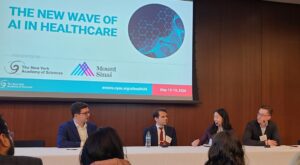
Panel discussion moderated by Robert Freeman, DNP. Panelists from left to right: Pierre Elias, MD, Karen Wong, MD and Alexander Fedotov, PhD

The final talks for day one focused on how AI can be used directly with patient care situations. Following their individual talks on how AI can be integrated into electronic health records (EHR), combining models to develop new insights, or reimagining diagnosis ability to improve diagnostic equity, the final three speakers engaged in a dynamic, and sometimes heated panel discussion. Karen Wong, MD, a physician at Epic, Alexander Fedotov, PhD, director of AI digital precision health at AstraZeneca and Pierre Elias, MD, assistant professor at Columbia University Irving Medical Center each shared their thoughts on how AI will be used in the near future. While they were all in agreement that AI cannot replace clinicians, they also recognized that AI will be a disruptive force, but it’s up to clinicians to take responsibility to use the technology as appropriate but to rely on their intuition and judgement as trained professionals. When opining on the future of AI use in healthcare five years from now, Fedotov stated, “I would still want to see humans at the helm of all the decision maker processes.”

Day two

While the first day laid the foundations for AI use in healthcare spanning bench to bedside, the second day of the symposium included more discussion and criticism of AI on the logistic level.

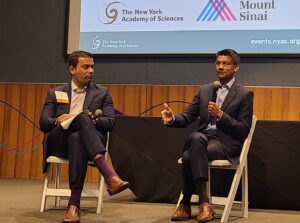
Fireside chat between Girish N. Nadkarni, MD and Dave A. Chokshi, MD

The day began with a keynote fireside chat between Nadkarni and Dave A. Chokshi, MD, a physician and professor at City University of New York, and former NYC health commissioner. He spoke about his leadership experiences, sharing many anecdotes of his time as a public health advocate and communicator during the COVID-19 pandemic. When questioned on the importance of communication considering the state of healthcare and declining trust of the public—especially with the increased use of AI, which has the potential of adding layers of feelings of abandonment, surveillance, and impersonalization—Chokshi pointed out that “It makes relationships even more important that we know then are.” He stressed that a his job, as a clinician, is to build trust with patients, and make sure that they return for care. While he envisions AI being transformative to healthcare in the next few years, he cautioned that listening and integrating feedback from front line users, clinical staff and patients, will be vital.

The morning continued with talks exploring AI’s use in research and learning in healthcare. Joshua C. Denny, MD, CEO of NIH All of Us Research, delivered a detailed summary of the progress and of the All of Us project. Despite recent funding concerns and cuts, the project scope remains on track, and researchers world-wide are utilizing the data derived from this project and how the project leads are working to establish parameters and modules for researchers to more easily implement AI in their data analysis. Andrew Gruen, PhD, standards lead at MLCommons, then spoke animatedly about the importance of establishing standards and benchmarks for AI use in researcher and healthcare settings. He spoke candidly on the need to not just train AI but to have external evaluation and validation of AI models.

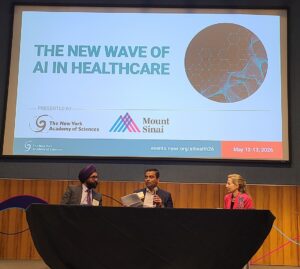
Panel discussion moderated by Girish N. Nadkarni, MD. From left to right: Karandeep Singh, MD, Girish N. Nadkarni, MD, and Vardit Ravitsky, PhD

The symposium concluded with multiple discussions on the interactions between AI and humans—not just as a tool, but by viewing the use of AI in the broader scale. Karandeep Singh, MD, executive director for health innovation at the University of California, San Diego explored various opinions of clincians and patients on the use of AI, while pointing out that the use of AI in healthcare settings should be thoughtfully considered before implantation. Meanwhile, Vardit Ravitsky, PhD, president and CEO of The Hastings Center for Bioethics, discussed the ethics behind AI use as a direct to patient setting, specifically as a patient-used chatbot. In a debate following their respective talks, the two delved deeply into the risks associated with AI use, both on the patient side with chatbots and with scribe technologies used by clinicians and patients. They often agreed on the need for transparency in AI usage, but specific AI applications, like uses of AI robots in the home to combat loneliness in the elderly resulted in disagreements.

The final talk presented by Tanzeem Choudhury, PhD, chief of health innovation at Cornell Tech, brought many previously discussed topics together. Her research explores how AI can be used in treatment of mental health, describing how AI can be used in multiple aspects of mental health therapy from recording physiological symptoms with wearables to using chatbots for various functions. She cautioned that while these tools may eventually be transformative, the current state of AI use in mental health is still growing.

The closing remarks by Alexander Charney, MD, PhD, professor at Icahn School of Medicine at Mount Sinai summarized the event well. He shared that throughout the symposium he imagined what clinicians and researchers from 100 years ago and from 100 years in the future would think about the current state of healthcare and about the challenges being faced now with how to incorporate AI. He said, “We aren’t the first group of human beings to deal with powerful technology and figuring out how we’re going to use it to change society.” He hopes that the people from the past would see that we understand and respect the past and learn from it being rigorous in our research and testing, while the people from the future will look on us with pride at our fearless and tenacity in the face of new technology. He hopes that both groups would see that we “tried to do the right thing.” He ended saying that he does see all of that here along with passion and coming together of everyone at the meeting.

The post AI in Healthcare: Symposium Insights appeared first on Inside Precision Medicine.

Molecular Anchors Help Tumor Therapies Stay Longer on Cancer Cells

For cancer therapies to work, they need to stay in proximity to the target diseased tissues for long enough. To help with that challenge, a group of scientists, led by a team at University of California, San Francisco (UCSF), have developed a drug carrier that physically anchors itself to cancer cell membrane, which helps to improve drug retention and effectiveness. Full details are published in a new ACS Central Science paper titled “A Prodrug Strategy to Conditionally Trap Therapeutic Payloads for Improved Tumor Retention.”

“Retaining drugs within tumors is an often-overlooked dimension of drug development that nevertheless greatly impacts the therapeutic window and outcomes,” said Michael Evans, PhD, a professor in the department of radiology and biomedical imaging at UCSF and a corresponding author on the study. In fact, approaches that deliver cancer therapeutics to tumors but lack dedicated mechanisms to ensure tumor retention often lose efficacy within a few days of drug administration. 

Previously, Evans and others designed drug delivery systems called restricted interaction peptides or RIPs that can deliver diverse therapeutic cargos including cytotoxins and radioisotopes. They work by changing shape when processed by disease-associated enzymes. These allow them to embed in cell membranes, tethering their drug payloads in place, promoting cellular uptake and improving effectiveness. Building on that work, the scientists engineered RIPs to interact with fibroblast activation protein, a serine protease that is prevalent in solid tumors and fibrosis. 

Imaging studies of cancer cell cultures showed that a fluorescently tagged RIP was rapidly taken up by the cells. Then when the scientists attached an anticancer drug, monomethyl auristatin E or MMAE, to the RIP, they found that the drug-peptide combination was as effective in killing cancer cells as the drug alone. Furthermore, when the drug-peptide combination was injected into mice with human cancers, it selectively targeted tumor tissue and was more effective at shrinking tumors than the unmodified drug with fewer side effects. The scientists observed similar results when they attached RIPs to radioactive copper isotopes which are commonly used in nuclear imaging and radiotherapy. 

The scientists expect to initiate Phase I clinical imaging studies of the RIP-radioactive copper isotope pairing in human cancer patients later in 2026 in collaboration with a company that is developing RIPs into therapeutics. 


The post Molecular Anchors Help Tumor Therapies Stay Longer on Cancer Cells appeared first on GEN – Genetic Engineering and Biotechnology News.

Prior Heart Attack Linked to Faster Cognitive Decline Over Time

People who have experienced a heart attack, including those who had a “silent” heart attack that hadn’t been previously diagnosed, showed faster declines in memory and thinking skills over time, according to a study published in the journal Stroke. Researchers found that evidence of a previous myocardial infarction was associated with an accelerated rate of cognitive decline and a higher likelihood of developing cognitive impairment during more than a decade of follow-up, indicating this a cohort of patients who may need to take more proactive measures to retain cognitive acuity as they age.

“Having had a heart attack in the past may speed up the decline in memory and thinking over time,” said study lead author Mohamed Ridha, MD, an assistant professor of neurology at The Ohio State University. “Given the rising burden of dementia and cognitive decline among Americans, it is important to understand how cardiovascular disease affects their brain health. This knowledge can help heart attack survivors take steps to improve their brain health as they age.”

The research analyzed data from 20,923 adults enrolled in the REGARDS (Reasons for Geographic and Racial Differences in Stroke) study, a national cohort designed to examine racial and geographic disparities in stroke outcomes in the United States. Participants, who were enrolled between 2003 and 2007, had interpretable electrocardiograms and no evidence of cognitive impairment at the start of the study. Their average age was 63 years, with 62% identified as White adults and 38% as Black adults.

The team used a combination of self-reported medical history and electrocardiogram readings to determine if participants had evidence of a prior heart attack. The patients in the study were categorized into groups: those who had self-reported a heart attack, a clinically recognized heart attack confirmed by electrocardiogram, and silent heart attack, defined as electrocardiographic evidence of myocardial infarction without a prior diagnosis.

All participants took part in an annual telephone-based cognitive screening for a median of 10.1 years. The six-question assessment evaluated orientation and memory recall, with lower scores indicating poorer cognitive performance. Investigators adjusted for other factors that are known to be associated with cognitive decline including age, sex, race, education, exercise frequency, diabetes, smoking, blood pressure, depression, kidney function, and cardiovascular events that occurred during follow-up.

Among the study population, 2,183 participants had evidence of prior myocardial infarction at baseline. Of those cases, 1,098 were self-reported heart attacks, 281 were clinically recognized heart attacks confirmed by electrocardiogram, and 804 were silent heart attacks. Nearly 37% of all heart attacks identified in the study were clinically silent.

Compared with participants without a prior heart attack, heart attack survivors had an annual risk of developing cognitive impairment that was 5% higher that patients who had not suffered a heart attack. The accelerated decline was observed across all categories of prior heart attack, including silent myocardial infarction and was also consistent across races and sex.

The study adds to prior research that has linked cardiovascular disease and dementia risk and noted the importance of identifying such patients. “Previous investigations of incident coronary ischemic events have demonstrated that the impact on cognitive function is not immediate but manifests as a subsequent accelerated rate of long-term cognitive decline,” the researchers wrote. “Vascular contributions to cognitive impairment, including stroke, are prevalent and potentially modifiable factors underlying cognitive decline.”

The findings could help clinicians provide preventative care, since electrocardiograms and patient history are commonly available in routine practice. These tools could help clinicians identify patients who may benefit from counseling and monitoring related to cognitive health and Ridha noted that clinicians caring for heart attack survivors should discuss ways to reduce the risk of cognitive decline and dementia as patients age.

While the biological mechanisms linking heart attack and cognitive decline remain uncertain, the discussion proposed possible contributors, including microvascular disease, silent cerebral infarcts, systemic inflammation, reduced blood flow to the brain, and impaired amyloid clearance.

The post Prior Heart Attack Linked to Faster Cognitive Decline Over Time appeared first on Inside Precision Medicine.

STAT+: CDC plans to transfer monkeys to nonprofit’s sanctuary as it seeks to reduce animal testing

As part of efforts to phase out the use of monkeys in research, the Centers for Disease Control and Prevention intends to transfer more than 160 macaques to Born Free USA, a nonprofit that runs a large primate sanctuary in Texas.

The agency is trying to move quickly due to the “unusual and compelling urgency” of finding housing for the monkeys, according to a notice about the proposed contract that was posted on a procurement website run by the General Services Administration.

A timeline for the transfer was not specified, but the agency is accepting responses until May 28.

Continue to STAT+ to read the full story…