Males who discuss suicide seek help less often than females, report finds

Death by suicide is a male emergency. Although three times as many women as men report suicidal ideation and attempts, the vast majority of deaths by suicide in the U.S. — up to 80% — are among men. The reasons: higher impulsivity, lower reported fear of death, and, crucially, easy access to guns. 

The most recent report from Crisis Text Line — a nonprofit working with the 988 Suicide & Crisis Lifeline to provide free and confidential text-based mental health support —  sheds light on another explanation: Men reach out for help a lot less than women. 

Read the rest…

Applications Open for the SNF Global Center Communicator Fellowship

The Stavros Niarchos Foundation (SNF) Global Center for Child and Adolescent Mental Health at the Child Mind Institute launches its next two-year fellowship for professionals pursuing evidence-based approaches across diverse, underserved global communities

New York, NY—Applications are now open for the 2026 Communicator Fellowship at the Stavros Niarchos Foundation (SNF) Global Center for Child and Adolescent Mental Health at the Child Mind Institute. The fellowship is designed to support a new generation of communicators working to shape child and adolescent mental health care in low- and middle-income countries, in addition to the SNF Global Center’s core country offices in Brazil, Greece, and South Africa. Up to three professionals working in public communications, including journalists, broadcasters, and podcasters, will be selected for the two-year program.

The Communicator Fellowship is part of the SNF Global Center’s broader mission to reduce gaps in data and care, catalyze system-level advancements, and transform child and adolescent mental health care by turning evidence into action, scaling culturally appropriate solutions, and building a global network of experts so young people everywhere can access support when they need it.

The application deadline is June 15, 2026. Fellows will be selected and announced by early August 2026. In addition to financial support of up to $100,000 USD, fellows will receive training, mentorship, and networking opportunities.

At a time when one in five young people are experiencing mental health or learning challenges, with most cases beginning by age 14, effective and accurate communication is urgently needed.

At the Child Mind Institute, we believe that translating research into accessible knowledge that empowers young people, families, and communities is integral to advancing mental health care. The Communicator Fellowship builds on this commitment by supporting professionals who can bring evidence-based mental health information to the public in clear, engaging, and culturally relevant ways.

Vinicius Gaby Vieira Rego, MD, of Brazil, a current Communicator Fellow with the support of the Institute of Psychiatry at the University of São Paulo, exemplifies this mission. Working with youth, Dr. Rego is co-creating a multi-platform literacy hub designed to combat harmful misinformation by empowering Brazil’s young leaders.

“I am deeply grateful for the opportunity to join the SNF Global Center’s network of fellows to support adolescent mental health in Brazil through communication,” said Dr. Rego. “This fellowship will enable a multi-channel communication project aimed at strengthening mental health literacy and peer-support capacity — with young people and for young people — across the country.”

As a fellow, Dr. Rego’s work directly addresses complex mental health challenges faced by young people in Brazil, while contributing to broader global efforts to improve communication about mental health care.

“In the current digital environment, where adolescents are exposed to a high volume of mental health content, the need for evidence-based information that resonates with young people has never been greater,” said Guilherme Polanczyk, MD, PhD, associate professor of Child and Adolescent Psychiatry at the University of São Paulo. “We are proud to endorse a project committed to supporting how young people and their communities understand and reflect on their mental health.”

Other current fellows are leading high-impact projects dispelling misinformation, reducing stigma, and increasing youth engagement — all while bringing critical attention to links among mental health, climate change, and human rights. Through partnerships, these efforts are transforming the future of youth mental health across the globe.

“Vinicius’s project is ambitious, and with the support of the Institute of Psychiatry at the University of São Paulo, we know it will provide young people in Brazil with much-needed resources to support their mental health,” said Peter Raucci, Director of Global Fellowship Strategy of the SNF Global Center at the Child Mind Institute. “What we’re seeing through the Communicator Fellowship is how quickly ideas can move from concept to culturally relevant, real-world impact.”

SNF Global Center Communicator Fellowship

Application deadline: June 15, 2026

Fellows announced: August 2026

Program resources


About the SNF Global Center at the Child Mind Institute
The Stavros Niarchos Foundation (SNF) Global Center for Child and Adolescent Mental Health at the Child Mind Institute brings together the Child Mind Institute’s expertise as a leading independent nonprofit in children’s mental health and the Stavros Niarchos Foundation’s deep commitment to supporting collaborative projects to improve access to quality health care worldwide. The center is building partnerships to drive advances in under-researched areas of children and adolescents’ mental health, and expand access to culturally appropriate training, resources, and treatment in low- and middle-income countries. This work is conducted by the Child Mind Institute with support from SNF through its Global Health Initiative (GHI).

About the Child Mind Institute
The Child Mind Institute is dedicated to transforming the lives of children and families struggling with mental health and learning disorders by giving them the help they need. We’ve become the leading independent nonprofit in children’s mental health by providing gold-standard, evidence-based care, delivering educational resources to millions of families each year, training educators in underserved communities, and developing tomorrow’s breakthrough treatments.

The post Applications Open for the SNF Global Center Communicator Fellowship appeared first on Child Mind Institute.

Fostering breakthrough AI innovation through customer-back engineering

Despite years of digitization, organizations capture less than one-third of the value expected from digital investments, according to McKinsey research. That’s because most big companies begin with technological capabilities and bolt applications onto them, rather than starting with customer needs and working backward to technology solutions. Not prioritizing the customer can create fragmented solutions; disjointed customer experiences; and ultimately, failed transformations.

Organizations that achieve outsized results from AI flip the script. They adopt a “customer-back engineering” mindset, putting customers at the heart of technology transformation.

It’s a strategy in which products and services are developed with the customer experience first in mind, including the customers’ challenges, needs, and expectations. Product development teams then work backward in a nimble and agile way to find the steps necessary to design and build solutions that achieve the desired experience.

“When you get your engineers closer to customers, you get a lot more sideways innovation,” says Ashish Agrawal, managing vice president of business cards and payments tech at Capital One. “That leads to a multiplier effect, because engineers can approach a problem from a different dimension that can be unique to the sales or product perspective.”

The case for customer-centricity in engineering

Engineers are problem-solvers by nature, says Agrawal. When they hear about challenges customers are experiencing, or how they are using products and services in the real world, they can devise ways to efficiently address customer needs, since they are naturally closer to systems and data than many other teams across the company.

“Fostering a customer-centric culture has a motivational effect on engineers when they actually start seeing how the core changes they’re making, or the features they’re adding, are having a direct impact on the lives of customers,” says Agrawal.

It also takes discipline. Agrawal explains that Capital One has set a goal for every engineer in his organization to establish several touchpoints with customers throughout the year in different forms, including:

  • Digital empathy sessions to observe user journeys and identify where users hit friction
  • Embedded customer support for periods of time to deepen understanding of servicing needs
  • Engineering ride-alongs, in which engineers join customer success, sales, and support staff on calls or on-site visits
  • Hackathon competitions to build solutions around real customer problems

The AI opportunities with customer-centricity

“The biggest challenge engineers within large companies face is a lack of direct access to customers,” says Agrawal. “This can make it harder for technologists to work with customers to identify problems and innovate solutions.”

AI has accelerated the challenges as well as the opportunities. The lifecycle of launching products has become significantly faster. But the good news is that engineers are closer to the data that feeds into AI, so they can more rapidly apply AI-informed data techniques to solve customer problems.

Agrawal outlines a recent scenario: In the customer servicing space, conversations can instantly be summarized and give a customer agent context on the member’s original request and remaining action points. Agentic AI can also be enabled to ask pointed follow-up questions about the interaction that would otherwise take human agents time to read through the entire thread.

“A solution would have been a lot harder in an ecosystem without a lot of high-quality data,” says Agrawal. “But when you combine a rich data ecosystem with agentic tools, you move from incremental fixes to high-velocity transformation.”

By investing in AI data and tools and focusing on rapid experimentation, Agrawal says the cycle of deploying solutions can be accelerated. Teams learn that if they meet customer needs and iterate on a wider range of solutions much faster, then the entire innovation cycle speeds up.

For example, Capital One used customer insights to build a state-of-the-art, multi-agent AI framework called Chat Concierge to enhance the customer experience for car buyers and dealers. In a single conversation, Chat Concierge can perform tasks like comparing vehicles to help car buyers decide on the best choice and scheduling test drives or appointments with salespeople.

Agrawal explains that car buyers can engage with Chat Concierge directly through participating dealer websites. Dealers can access and can take over the chat through Navigator Platform. The AI assistant consists of multiple logical agents that work together to mimic human reasoning, allowing it to provide information and take action based on the customer’s requests.


The elements of an AI-first mindset

According to a recent MIT Technology Review Insights survey, 70% of leaders say their firm uses agentic AI to some degree. Roughly half of executives say agentic AI systems are highly capable of improving fraud detection (56%) and security (51%), reducing cost and increasing efficiency (41%), and improving the customer experience (41%).

Looking into the future, achieving these outcomes looks even more likely. More than half of the banking executives surveyed say they expect to continue to improve fraud detection (75%), security (64%), and the customer experience (51%). Agentic AI use cases that show strong potential to transform the customer experience in financial services include responding to customer services requests, adjusting bill payments to align with regular paychecks, or extracting key terms and conditions from financial agreements.

Placing the customer at the center of a transformation requires an AI-first mindset. Companies must shift from simply augmenting an existing product to fundamentally reimagining the problem and the user’s needs through the lens of AI’s capabilities.

A few best practices that Agrawal recommends include:

Reimagine the core function of AI to solve a user’s problem: “The true value isn’t in chasing the AI hype; it’s in solving meaningful customer problems. By focusing on impact, we ensure that our innovation isn’t just fast; it’s transformative,” says Agrawal.

Start with high-quality, well-governed data as the foundation: “Data readiness and unified information across systems are the non-negotiable foundations of AI. A clean data layer is what orchestrates the agentic loop— enabling the perception, reasoning, and execution required to solve a customer’s problem before they even have to ask,” explains Agrawal.

Rebuild workflows with AI embedded from the start: “People treat models as black boxes, but agentic systems require tremendous rigor and oversight. Having a data ecosystem that is well-governed and responsible AI standards are essential pillars for building trust in these systems,” says Agrawal.

Build a cross-functional team involving data science, engineering, product, design, and other partners: Agrawal advises, “It’s important to be open and nimble to transforming how we work and create impact as AI becomes more integrated into workflows. It’s also important to take a ‘crawl, walk, run approach’ if you are new to AI, as opposed to simply jumping into it.”

In the end, achieving end-to-end transformation depends on empowering engineers and partner teams to start with customer needs and work backward to technology solutions, rather than starting with technological capabilities first and finding applications for them. When organizations make a customer-back approach second nature, they are able to not only reimagine the customer experience from the inside out, but to also place the customer front and center from the very start.

This content was produced by Insights, the custom content arm of MIT Technology Review. It was not written by MIT Technology Review’s editorial staff. It was researched, designed, and written by human writers, editors, analysts, and illustrators. This includes the writing of surveys and collection of data for surveys. AI tools that may have been used were limited to secondary production processes that passed thorough human review.

Surf Therapy: A Powerful Low-Intensity Approach in Global Youth Mental Health Care


By Mai El Shoush, Partnerships Campaign Manager, Stavros Niarchos Foundation (SNF) Global Center for Child and Adolescent Mental Health at the Child Mind Institute


In Conversation with Waves for Change

The world’s oceans have long been profound forces that shape coastlines, cultures, and scientific discovery. And today, through targeted programs, they also serve as therapeutic environments transforming youth mental health worldwide.

As global health systems continue to explore solutions that minimize resource constraints while addressing child and adolescent mental health demands, innovative approaches like surf therapy are demonstrating remarkable effectiveness as low-intensity initiatives. From the beaches of California to the coastal communities of South Africa, Australia, Hawai’i, the United Kingdom, and Senegal, these programs are creating accessible entry points for young people.

Wave for Change (W4C) — a South Africa-based organization and valued implementation partner of the Stavros Niarchos Foundation (SNF) Global Center at the Child Mind Institute — has developed an evidence-based Surf Therapy program for youth in underserved communities. We spoke with their chief development officer Paula Yarrow and senior grant manager Jill Sloan about the award-winning program. As a highly regarded Cape Town‑based NGO that uses surfing as a therapeutic tool to support youth mental health, W4C offers safe spaces, evidence‑based emotional regulation tools, community mentorship, and a pathway to resilience for young people growing up in challenging environments.

The partnership includes the identification of workforce gaps and training needs for frontline workers such as NGOs, to further expand evidence-based support and brief interventions through culturally appropriate, low-intensity psychological therapy approaches. The context-specific training materials are expected to be piloted later in the year in South Africa and are intended to improve access to quality mental health care for young people.

W4C launched Surf Therapy in 2009, which has since helped more than 10,000 adolescents experiencing high-stress environments gain valuable coping skills across its hubs in the Western and Eastern Cape as well as Cape Town. Participants learn how to build positive social networks and develop self-regulation skills to support healthy emotional and behavioral responses to stress, with coaches themselves aged between 18-25. The program creates a fun, culturally relevant environment through the Take 5 model — a framework W4C has designed to be adapted for a range of sports, arts, and cultural initiatives. The model has been utilized by several leading global organizations, including UNICEF.

Waves for Change also played a key role in the founding of the International Surf Therapy Organization (ISTO), connecting practitioners, clinicians, and researchers to advance science research, raise awareness, and support surf therapy.

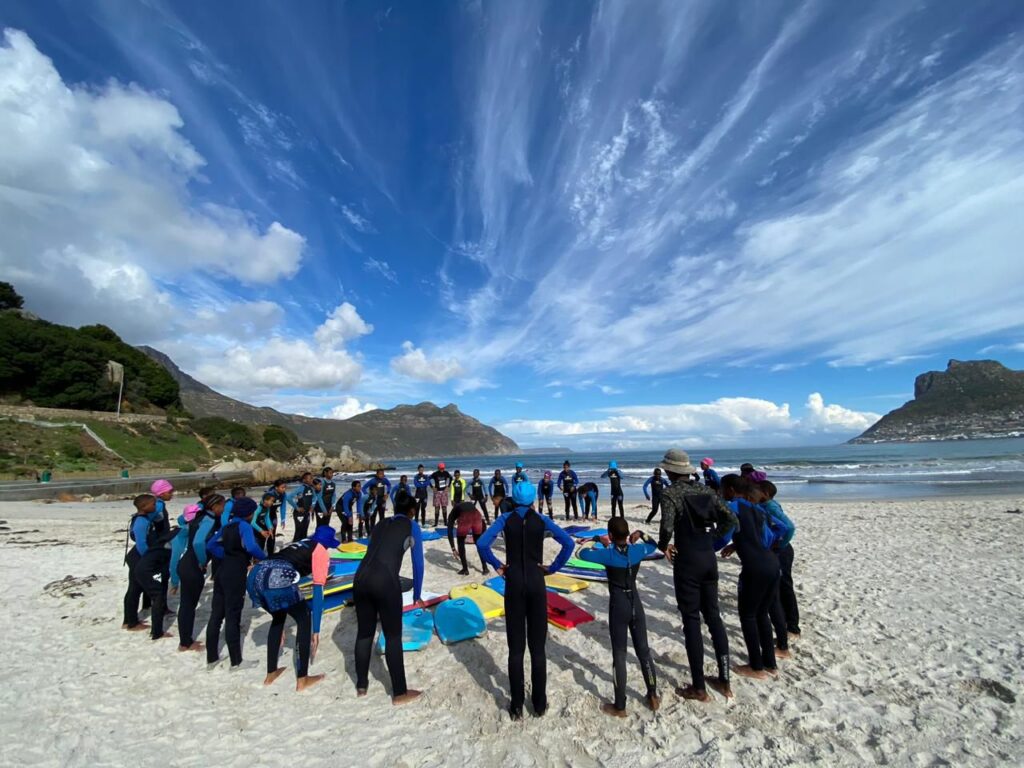
Catching a wave at Surf Therapy – Image Nelson Rosier Coulhan

How does Waves for Change use evidence-based Surf Therapy and capacity building as a solution to fill the gap in youth mental health care?

Approximately 90 percent of the world’s adolescents live in low- and middle-income countries (LMICs). In the most underserved communities, adolescents may experience repeated exposure to violence, unmet basic needs, and limited access to safe spaces or trusted caregivers. Typically, there are very few mental health services that are accessible to such youth.

The more Adverse Childhood Experiences (ACEs) a child or adolescent has whilst growing up, the more likely they are to develop toxic stress — an ongoing stress state without respite. This can often lead to mental health conditions such as anxiety, depression, substance misuse, and cognitive impairment. This can also result in the development of physical health conditions such as heart disease as they grow into adulthood.

The main problem we’ve identified is that there aren’t enough trained workforces (e.g., sports coaches, youth facilitators) that are able to deliver simple, fun, structured play-based sessions with consistency at scale. Our work provides a response to this issue within the adolescent mental health promotion and illness prevention arena. Additionally, our initiatives significantly increase the number of individuals — coaches, teachers, mentors or others — who are already in contact with young adolescents and can provide them with mental health support to foster their immediate and longer-term mental health.

How has Waves for Change adapted the organization’s Surf Therapy program to develop the Take 5 model?

Waves for Change’s Take 5 training model has been incubated, tested, and rigorously evaluated within W4C’s award-winning Surf Therapy program. Take 5 distils the key components of our Surf Therapy program, providing coaches with the essential skills they need to build and sustain caring relationships with children. And it uses a simple teaching routine that creates consistently engaging, fun, structured programs for children and adolescents that suit their language, culture, and context.

Take 5 is low intensity and cost-effective — tailored for high-stress environments and the unique mental wellness needs of adolescents living in multidimensional poverty, conflict, or crisis.

How has partnering with young people to research and co-develop programs made the work more impactful?

In research studies we’ve conducted, adolescent participants (ages 10-16) reported experiencing between 6-8 adverse events every year, including violence and abuse. When asked what sorts of spaces they wanted to see at Waves for Change, the adolescents identified core components such as access to a safe space where they could have fun, be heard, and learn skills to cope. These components now form the bedrock of our Surf Therapy program. We initially worked with 9-12-year-olds and have since developed the follow-on programme for adolescents up to age 16 who have graduated the Surf Therapy programme. This is called Surf Club and is available to all Surf Therapy graduates.

Waves for Change also conducts pre- and post-intervention surveys with participants to monitor the impact of our work. Our coaches (ages 18-25) are at the frontline of delivering our services. A key role they play is to listen with care and respect to the adolescents’ concerns, and to share them with our Child Protection team for review and follow-up when needed.

Surf Therapy at Hout Bay – Photo credit Waves for Change

What makes your partnership with the SNF Global Center at the Child Mind Institute unique?

Working with the Child Mind Institute allows Waves for Change to collaborate with and learn from colleagues doing similar work in the adolescent mental health space across South Africa, the United Kingdom, and Brazil. The partnership offers an opportunity to learn about approaches that have been successful in other health systems. It has also allowed Waves for Change to share detailed information about the training and supervision protocol used to develop key competencies in the coach workforce that leads Surf Therapy in South Africa. This has helped the Child Mind Institute to develop a comprehensive guide for other similar workforces.

Can you expand on the importance of partnerships in strengthening youth mental health care and community empowerment?

Partnerships allow for the consolidation of skills and resources so that a greater impact can be achieved. For example, at Waves for Change, we work with over 70 referral partners every year to identify young adolescents who can benefit from our Surf Therapy program. We are also partnering with the Department of Cultural Affairs and Sport to use our Take 5 model to train MOD and YearBeyond coaches and mentors, who are already reaching large numbers of children and young adolescents through their work. And we’re contributing to building the broader ecosystem of mental health support for adolescents and children by training large national NGOs, government agencies, and humanitarian organizations with our Take 5 model.

How can non-profits further help foster strong peer networks and inclusive safe spaces?

Some of the key lessons we have learnt are the following:

  • In the field of youth mental health, make youth the leaders on program implementation
  • Provide youth with skills, opportunities, supervision, and support so that they can grow and develop further
  • Maintain a strong culture of protection, respect, and communication so that all participants feel safe, welcome, accepted, and heard

Read more about W4C’s Surf Therapy from Youth Liaison Officer, Azola Sibanda and Training Manager Jamie-Lee Davids

The post Surf Therapy: A Powerful Low-Intensity Approach in Global Youth Mental Health Care appeared first on Child Mind Institute.

The Download: the hantavirus outbreak and Musk v. Altman week 2

This is today’s edition of The Download, our weekday newsletter that provides a daily dose of what’s going on in the world of technology.

Here’s what you need to know about the cruise ship hantavirus outbreak

Last week, eight passengers aboard a Dutch-flagged cruise ship contracted a type of hantavirus transmitted by rats. Three have since died. But health experts stress that this situation is nothing like the coronavirus outbreak in 2020.

The Andes virus is known to spread between people, and there are no specific antiviral treatments or vaccines. Yet transmission appears to require a specific form of contact that the cruise ship fostered.

Here’s what you need to know about the outbreak—and why experts believe it can be contained.

—Jessica Hamzelou

This story is part of MIT Technology Review Explains, our series untangling the complex, messy world of technology to help you understand what’s coming next. You can read more from the series here

Musk v. Altman week 2: OpenAI fires back, and Shivon Zilis reveals that Musk tried to poach Sam Altman

In the second week of the landmark trial between Elon Musk and OpenAI, Musk’s motivations for bringing the suit came under intense scrutiny.

OpenAI president Greg Brockman testified that Musk had pushed for the company to create a for-profit entity, while Shivon Zilis, a former board member, revealed that the Tesla tycoon had sought to lure Sam Altman to a new AI venture.

The courtroom also heard about Brockman’s private journals, Musk’s abandoned plans for a rival AI lab, and the moment he stormed out of a pivotal meeting carrying a painting of a Tesla.

Here’s what happened in the second week of the trial—and what’s coming next

—Michelle Kim

Michelle Kim, who’s also a lawyer, has been in court on each day of the Musk v. Altman trial. To keep up with her ongoing coverage of their legal showdown, follow @techreview or @michelletomkim on X. 

How LLMs could supercharge mass surveillance in the US: 10 Things That Matter in AI Right Now

There are pieces of your life scattered all over the internet, and some of them are for sale. Data brokers collect web searches, financial records, and location data from millions of people and sell them to various clients, including the US government.

While gathering that data has become easier in the smartphone era, making use of it at scale has remained difficult. But researchers are beginning to show that LLM agents can connect anonymized data to real people quickly, cheaply, and at a massive scale.

Find out why privacy experts fear AI could remove the friction that has long protected the public from mass surveillance.

—Grace Huckin

“How LLMs could supercharge mass surveillance in the US” is a feature accompanying MIT Technology Review’s 10 Things That Matter in AI Right Now, our guide to what’s really worth your attention in the busy, buzzy world of AI. Check out the full list of the big ideas, trends, and advances in the field here.

The must-reads

I’ve combed the internet to find you today’s most fun/important/scary/fascinating stories about technology.

1 Meta’s embrace of AI is making employees miserable
Workers feel pressured to use the tech while fearing AI-driven layoffs. (NYT $)
+ They’re also unhappy about Meta tracking them to train AI. (The Verge)
+ AI’s rise has been described as “the most joyless tech revolution ever.” (WSJ $)
+ Gen-Z is particularly fed up with it. (NYT $)
+ We’ve entered the era of AI malaise. (MIT Technology Review)
 
2 South Korea’s military wants robots to fill gaps in troop numbers
It’s in talks with Hyundai to bring robotics to the front lines. (Bloomberg $)
+ They could include Boston Dynamics’ Spot and a new exoskeleton. (SCMP)
+ South Korea’s military has shrunk by 20% over six years. (BBC)
 
3 OpenAI is being sued over ChatGPT’s alleged role in guiding a mass shooter
A lawsuit claims the bot said targeting children would bring more attention. (NBC)
+ Florida’s AG has opened a criminal investigation into the case. (NPR)
+ Does AI cause or amplify delusions? (MIT Technology Review)

4 The Canvas hack was the biggest-ever student data privacy disaster
It exposes the risks of centralizing the data of millions of students. (404 Media)
+ While the platform is back online, the hack disrupted university exams. (NPR)
+ The breach is part of a trend of edtech vulnerabilities. (WP $)
 
5 Alibaba has joined China’s “chat to buy” shopping craze
By integrating AI assistant Qwen into its e-commerce platforms. (Reuters $)
+ Companies are betting that chat is the future of online shopping. (SCMP)
+ OpenClaw is a driving force behind the trend. (MIT Technology Review)
 
6 Cybercrime increasingly comes with threats of physical violence
In the US, the physical threats rose more than twofold last year. (BBC)
 
7 AI’s next phase plays into TSMC’s hands
Taiwan’s chip-making giant stands to gain from the supply squeeze. (WSJ $)

8 Europe is confronting life without American tech
Dependence on Silicon Valley is a growing geopolitical concern. (FT $)
 
9 The US, UK, and China top new rankings for AI in life sciences
Switzerland and Germany follow in the AI Competitiveness Index. (SCMP)

10 The Pentagon has released a massive trove of declassified UFO files
Including newly declassified documents, images and footage. (New Scientist)
+ The files contain reports of “orbs,” “saucers,” and lunar “flashes.”  (Wired $)
+ Here’s how to spot an alien. (MIT Technology Review)

Quote of the day

“There’s a real sense where ‘safety’ isn’t a bad word anymore.”

—Nathan Calvin, general counsel at Encode, a nonprofit AI advocacy group, tells the Washington Post that Anthropic’s Mythos has forced a White House reset on AI safety.

One More Thing

detail from an image of Mars' surface
This computer-generated image of Mars was built with laser altimeter data from NASA’s Mars Global Surveyor, which operated for nine years in orbit around the planet.
NASA/JPL-CALTECH


Inside NASA’s bid to make spacecraft as small as possible

As NASA’s InSight lander descended to Mars in November 2018, two tiny spacecraft tracked its progress. InSight had touched down, they reported, and survived its treacherous journey.

The mission offered a pathway to cheaper space exploration, with small, low-cost probes launching far more often than multibillion-dollar flagship missions. But there’s a catch: miniaturization can only go so far before it collides with the hard limits of physics.

NASA still hopes small sats could transform planetary exploration. But first, scientists and engineers have to figure out what these tiny spacecraft can realistically do.

Discover how small spacecraft could pave the way for giant leaps into the cosmos.

—David W. Brown

We can still have nice things

A place for comfort, fun, and distraction to brighten up your day. (Got any ideas? Drop me a line.)
+ In a grand tribute to a four-legged hero, Cambodia has erected a statue to honor a rat.
+ A 1957 comedy accidentally made a seriously prescient prediction about office automation.
+ Explore the physics of the train that wouldn’t fall over—a monorail that promised to revolutionize travel.
+ Are you a true cinephile? Prove it with these daily movie quote challenges.

Musk v. Altman week 2: OpenAI fires back, and Shivon Zilis reveals that Musk tried to poach Sam Altman

In the second week of the landmark trial between Elon Musk and OpenAI, Musk’s motivations for bringing the suit were under scrutiny.

Last week, Musk took the stand, alleging that OpenAI CEO Sam Altman and president Greg Brockman had deceived him into donating $38 million to the company. He claimed that they’d promised to maintain it as a nonprofit dedicated to developing AI for the benefit of humanity, only to later accept billions of dollars of investment from Microsoft and restructure the company to operate a for-profit subsidiary.  

This week, Brockman fired back with his side of the story, arguing that Musk had actually pushed for OpenAI to create a for-profit arm and fought a bitter battle to have “absolute control” over it. OpenAI has argued that Musk is suing because he didn’t get his way and is now trying to undermine a competitor to his own AI company, xAI.

Shivon Zilis, a former OpenAI board member and the mother of four of Musk’s children, also testified, revealing that Musk tried to recruit OpenAI CEO Sam Altman to lead a new AI lab at his electric-car company, Tesla. 

Musk cofounded OpenAI in 2015 with Altman, Brockman, and others but left in 2018. Now, he’s asking the court to remove Altman and Brockman from their roles and to unwind the restructuring OpenAI undertook last year, which converted its for-profit subsidiary into a public benefit corporation. He is also seeking as much as $134 billion in damages from OpenAI and Microsoft, OpenAI’s investor. 

The outcome of the trial could upend OpenAI’s race toward an IPO at a valuation approaching $1 trillion. Meanwhile, xAI, which Musk founded in 2023, is now a division of his rocket company, SpaceX; the combined companies are also expected to go public as early as June, at a target valuation of $1.75 trillion.

On Monday, Brockman walked into the courtroom in a blue suit and tie, holding hands with his wife, Anna Brockman. On the stand, he was serene, even chipper, as he recalled OpenAI’s early days. But he grew agitated under impassioned questioning from Elon Musk’s lawyer, Steven Molo. Altman listened in silence, while Anna Brockman sat behind him, fidgeting. Outside the courthouse, protesters rallying against the AI race sang hymns over the voices of lawyers giving press conferences.

Two days before trial began, according to Brockman, Musk messaged him to ask if he would be interested in settling. When Brockman suggested that both sides drop their claims, Musk texted back: “By the end of this week, you and Sam will be the most hated men in America. If you insist, so it will be.”

Musk stormed out with a Tesla painting

Last week, Musk testified that he’s suing to save OpenAI’s nonprofit mission to develop AI safely, but he said he was open to seeing OpenAI become a capped-profit company with moderate investments from Microsoft

This week, Brockman told the jury that Musk was never truly committed to keeping OpenAI a nonprofit. In the summer of 2017, when an AI model that OpenAI built beat the world’s best players in a video game called Dota 2, Musk hosted a gathering at his “Haunted Mansion” near San Francisco. The house was splattered with confetti and cups, Brockman recalled, and the actress Amber Heard, who was Musk’s girlfriend at the time, served whiskey.

“Time to make the next step for OpenAI. This is the triggering event,” Musk wrote in an email—having said weeks earlier that if OpenAI made a major public achievement, it would be “time to create a for-profit,” Brockman told the jury.

Over the next six weeks, Brockman said, Musk and the other cofounders had intense discussions about creating a for-profit entity to raise enough capital to build artificial general intelligence—powerful AI that can compete with humans on most cognitive tasks. Musk wanted to have majority equity in the entity and the right to choose a majority of the board members. He also wanted to be its CEO, said Brockman. 

Brockman testified that in August 2017, he and other cofounders gathered to hash out the terms of the for-profit structure. Ilya Sutskever, OpenAI’s chief scientist at the time, arrived bearing a painting of a Tesla as a “token of goodwill” in return for the actual Teslas Musk had given them days earlier. “It felt a little bit like [Musk] was buttering us up, right,that he wanted us to feel indebted to him,” Brockman told the jury.

When Brockman and Sutskever proposed that they all have equal shares of equity, said Brockman, Musk fell silent and finally said, “I decline.” Musk then stood up and “stormed around the table,” he said. “I actually thought he was going to hit me.” Musk grabbed the painting and walked out. 

Brockman said that afterwards he struggled to decide whether to continue building OpenAI with Musk or break away. “There was a fork in the road,” he said. “Do we accept Elon’s terms? Or do we reject the terms, he quits to create his own, and then we create our own?”

“The one thing we could not accept was to hand him unilateral, absolute control, potentially, over the AGI,” Brockman told the jury.

What was Brockman thinking?

In his theatrical baritone, Molo argued that Brockman was motivated by greed rather than a commitment to OpenAI’s nonprofit mission to develop AI that benefits humanity. He noted that while Brockman never invested money in the company, he now owns a stake worth close to $30 billion. 

“Solving for the mission has always been my primary motivation,” Brockman said, pushing back on Molo’s characterization of him. “It remains so today.” 

Molo pulled up Brockman’s electronic journal on a screen in the courtroom, trying to show the jury what Brockman was really thinking behind the scenes. In 2017, while negotiating with Musk about the future of OpenAI, Brockman wrote about wanting to become a billionaire: “Financially what will take me to $1B?” 

“Why didn’t you take the $29 billion and donate it to the nonprofit that you had a fiduciary duty to, for the good of humanity?” Molo asked Brockman, raising his voice to dramatize moral indignation. 

Molo then pulled up a journal entry Brockman had written in November 2017, while he was torn over whether to turn OpenAI into a for-profit without Musk: “it’d be wrong to steal the nonprofit from him. to convert to a b-corp without him. that’d be pretty morally bankrupt.” Brockman and Musk had previously considered creating a b-corp, which is a for-profit company that pursues a social mission.

Brockman explained, “I meant it would actually serve the mission, but it’d be hard to look at yourself in the mirror.”

Molo also tried to undermine Brockman’s credibility by revealing that he holds a stake in multiple companies with business ties to OpenAI, including the AI company Cerebras, the cloud provider CoreWeave, and the nuclear fusion startup Helion Energy. Altman has tried to steer OpenAI into deals with companies that he invests in, including Helion and the rocket maker Stoke Space, drawing scrutiny over potential conflicts of interest.

Former OpenAI chief technology officer Mira Murati and former OpenAI board member Helen Toner both appeared in video depositions. They addressed the brief firing of Altman in 2023, saying that they could not trust him because of his alleged history of lying. Murati’s text messages with Altman from that time, which were introduced as evidence, revealed his desperate attempts to understand what was happening and regain control. 

Musk plotted a rival AI lab at Tesla

After Brockman’s two days of testimony, Shivon Zilis, who left OpenAI’s board in 2023, took the stand in a black jacket and black jeans, appearing composed but with a flicker of nerves. OpenAI’s lawyer Sarah Eddy asked her in a deceptively soothing voice whether she acted as a conduit for Musk as he tried to poach OpenAI’s cofounders to work at a new AI lab within Tesla. Eddy argued that Musk is suing OpenAI only to undermine a competitor in the AI race. 

Zilis said she met Musk while working at OpenAI as an informal advisor in 2016, and that they had a “one-off” romantic encounter. In 2017, she joined Tesla and Musk’s brain-implant company, Neuralink. In 2020, she joined OpenAI’s board of directors. She became pregnant with Musk’s children through IVF but did not disclose her ties with Musk to OpenAI until Business Insider reported them in 2022. 

By late 2017, Musk had concluded that OpenAI was unlikely to build AGI and pivoted to building an AI lab at Tesla, according to an email sent to Zilis. 

Eddy pulled up a draft of an FAQ document that Zilis emailed a colleague at Tesla in 2017 about an event the company was organizing at the NeurIPS AI conference: “The purpose of this event is to share that Tesla is building a world leading AI lab(?) which will rival the likes of Google/DeepMind and Facebook AI Research.” 

Zilis told the jury that when Musk was still on OpenAI’s board, he tried to recruit Altman to lead that prospective AI lab. Musk had asked Andrej Karpathy, an OpenAI research scientist he’d recruited to work at Tesla, “to send a list of top OpenAI people to poach,” according to a text message by Zilis. 

“There is little chance of OpenAI being a serious force if I focus on TeslaAI,” Musk texted Zilis in 2018, just before he left OpenAI. Tesla’s AI lab never came to fruition.

Eddy pressed Zilis about whom she was loyal to when she was working for OpenAI and Musk at the same time. “I had an allegiance to the best outcome for AI for humanity,” Zilis told the jury.

What’s going on next week?

Next week, Ilya Sutskever will testify, as will Microsoft CEO Satya Nadella. The lawyers for both Musk and OpenAI will deliver their closing arguments. The jury will begin deliberating the week after and deliver an advisory verdict guiding the judge to decide the case.

This story is part of MIT Technology Review’s ongoing coverage of the Musk v. Altman trial. Follow @techreview or @michelletomkim on X for up-to-the-minute reporting.


Amyloid-β clearance: an astrocytic perspective

Alzheimer’s disease (AD) represents a major global public health challenge in the 21st century, recognized as the neurodegenerative disorder with the highest mortality rate and socioeconomic burden. The core pathological feature of AD is an imbalance in Aβ production and clearance, leading to conformational changes and pathological aggregation of Aβ peptides. This imbalance triggers neurodegenerative cascades 20–30 years before clinical symptoms appear. Therapeutic approaches targeting Aβ production, including β-secretase and γ-secretase inhibitors, have thus far shown limited clinical benefit in late-stage trials and have been further constrained by safety and tolerability concerns. As a result, early interventions aimed at enhancing Aβ clearance have attracted increasing attention. While microglia-mediated phagocytosis of Aβ has been extensively studied, the multifaceted roles of astrocytes in this process remain underexplored. This review synthesizes recent findings to elucidate the molecular mechanisms of astrocyte-mediated Aβ clearance, focusing on endocytic uptake and intracellular degradation, maintenance of the blood–brain barrier, and aquaporin-4 (AQP4)-dependent glymphatic drainage. Additionally, this review dissects key regulatory nodes, including the dynamic modulation of Aβ clearance capacity through astrocyte phenotypic transitions and functional decline associated with pathology. These insights offer a theoretical foundation and translational perspective for the development of astrocyte-targeted interventions in early-stage AD.