The Food and Drug Administration on Tuesday approved a new medicine from the biotech company Vera Therapeutics for patients with a type of chronic autoimmune kidney disease.
The drug, called Trutakna, was cleared to treat IgA nephropathy, or IgAN, a disease caused by the buildup of immune antibodies in the kidneys. The condition leads to progressive loss of kidney function and potentially organ failure requiring dialysis.
“We’re extremely excited to bring Trutakna to patients,” Vera CEO Marshall Fordyce told STAT, in an interview conducted ahead of the FDA approval.
Background: Manual chart abstraction from electronic health records is a critical step in clinical outcomes research but is time-intensive and prone to human error. Advances in artificial intelligence (AI), particularly large language models, offer the potential to automate the extraction of structured data from unstructured clinical documentation with improved efficiency and consistency. Objective: This study aimed to evaluate the accuracy and efficiency of an AI-assisted approach for extracting patient-reported outcomes from clinical notes compared with traditional human abstraction. Methods: We conducted a retrospective study of 26 patients treated with low-dose radiation therapy for osteoarthritis. Human reviewers abstracted numeric rating scale (NRS; 0‐10) pain scores at baseline, the end of treatment, and the first follow-up, and von Pannewitz score (VPS; 0‐4) improvement scores at posttreatment time points. A HIPAA (Health Insurance Portability and Accountability Act)–compliant generative pretrained transformer–based AI system was prompted to extract the same end points from clinical notes. Concordance was assessed using exact match rates, the intraclass correlation coefficient for the NRS, and weighted Cohen κ for the VPS. The time required for AI vs manual abstraction was recorded. The AI system was not trained or fine-tuned on study data, and performance was evaluated directly against human abstraction to reflect real-world deployment. Results: The AI system demonstrated high concordance with human abstraction, achieving an exact match rate of 92% for the NRS (95% CI 84‐96; intraclass correlation coefficient=0.96) and 94% for the VPS (95% CI 84‐98; κ=0.91). All discrepancies were minor, and no spurious values were generated. The AI system identified 1 clinically relevant data point missed during manual review. Average abstraction time per patient decreased from approximately 30 minutes to 2 minutes, representing time savings of >90%. The system also captured trends in analgesic use, but these results were not statistically significant, including reductions without escalation. Conclusions: AI-assisted data abstraction demonstrated high concordance with human review in this single-institution cohort while substantially reducing the time requirements. These findings support the feasibility of AI-assisted abstraction workflows, although further validation across larger and more diverse datasets is needed.
The U.S. Food and Drug Administration has cleared CoRegen’s Investigational New Drug (IND) application for CRG-150, allowing the company to initiate a first-in-human Phase I/IIa clinical trial of its autologous CRISPR-engineered regulatory T (Treg) cell therapy in patients with advanced solid tumors. The study will evaluate safety and preliminary efficacy in metastatic triple-negative breast cancer (TNBC), metastatic HR-positive/HER2-negative breast cancer, and metastatic prostate cancer at leading academic cancer centers.
The clearance advances into the clinic an immunotherapy strategy that differs fundamentally from existing cell therapies. Rather than engineering cytotoxic lymphocytes to recognize tumor antigens, CRG-150 uses CRISPR gene editing to reprogram regulatory T cells (Tregs), with the goal of reversing the immunosuppressive tumor microenvironment and restoring endogenous antitumor immunity.
The approach emerged from more than three decades of research at Baylor College of Medicine on steroid receptor coactivator-3 (SRC-3), a transcriptional regulator that sits upstream of numerous immune signaling pathways. According to CoRegen, CRISPR-mediated disruption of SRC-3 fundamentally alters Treg biology, removing one of the mechanisms tumors use to evade immune surveillance.
Suneet Varma, Chairman of the Board at CoRegen [Baylor College of Medicine]
“What was fantastic about this discovery was that it allowed us to engineer a regulatory T cell to knock out SRC-3,” said Suneet Varma, chairman of the board of CoRegen. “By knocking out SRC-3, we have essentially removed the cloak of invisibility that cancer was hiding behind. Once you remove that cloak of invisibility, the tumor is recognized by the immune system, and CD4-positive T cells, CD8-positive T cells, and natural killer cells flood the tumor.”
The company reports that preclinical studies in multiple murine solid tumor models demonstrated durable tumor eradication following treatment with SRC-3-disrupted regulatory T cells. Investigators subsequently rechallenged animals with the original tumor and observed rapid elimination consistent with immunologic memory. In additional experiments, mice challenged with different tumor types, including pancreatic cancer after initial treatment of triple-negative breast cancer, also mounted antitumor responses, suggesting that the mechanism may not depend on a single tumor antigen or histology. Those findings now await validation in humans.
“This is a new, never-been-done-before approach to immuno-oncology,” Varma said. “We’ve cured many, many mice. But we need to now treat and cure humans. There’s a lot of work between here and there.”
Reversing the biology of immune suppression
Since the identification of FOXP3 as the master transcription factor governing regulatory T-cell development more than two decades ago, Tregs have become recognized as essential regulators of immune homeostasis. By suppressing excessive immune activation, they prevent autoimmunity and maintain peripheral tolerance. The same biology, however, is frequently co-opted by cancer. Many solid tumors recruit or expand Tregs within the tumor microenvironment, where they suppress cytotoxic T lymphocytes and natural killer (NK) cells, limiting endogenous antitumor immunity and contributing to resistance against immunotherapy.
That dual biology has made Tregs both attractive and challenging therapeutic targets. Most clinical development in the field has focused on harnessing their suppressive properties. Multiple companies are developing autologous, allogeneic, and CAR-engineered Treg therapies for autoimmune diseases, inflammatory disorders, and transplantation, where augmenting immune tolerance is desirable. By contrast, relatively few cell therapy programs have sought to manipulate Tregs in oncology because selectively disrupting their immunosuppressive function without broadly compromising immune regulation has proven difficult.
For example, last week, the FDA approved Orca Bio’s Tregzi, an unmodified donor-derived cell therapy designed as an alternative to traditional matched-donor stem cell transplantation for blood cancer patients. The therapy uses three purified donor cell populations—including regulatory T cells, conventional T cells, and hematopoietic stem and progenitor cells—selected to preserve immune control while supporting blood system recovery. By leveraging naturally occurring immune-regulating cells, Tregzi aims to reduce complications such as chronic graft-versus-host disease, marking a key milestone for the broader effort to harness Tregs as a next-generation approach in cancer treatment.
Sonal Gupta, MD, PhD, Chief Medical Officer at CoRegen [CoRegen]
CoRegen’s strategy is to alter Treg biology directly through CRISPR-mediated disruption of SRC-3, a steroid receptor coactivator that functions as a transcriptional regulator upstream of numerous immune signaling pathways. Sonal Gupta, MD, PhD, chief medical officer of CoRegen, explained that SRC-3 occupies a regulatory position upstream of numerous genes involved in immune signaling, including pathways associated with immune checkpoint regulation. “What we do is use CRISPR editing to knock out the SRC-3 gene,” Gupta told Inside Precision Medicine. “That changes the biology of regulatory T cells.”
She compares unmodified Tregs to “bouncers at a nightclub,” preventing immune cells from entering tumors. Following gene editing, the cells no longer maintain that suppressive phenotype, allowing endogenous immune cells to infiltrate the tumor microenvironment. Unlike checkpoint inhibitors, which interrupt individual inhibitory pathways such as PD-1/PD-L1 or CTLA-4, the company hypothesizes that reprogramming Tregs through SRC-3 disruption may produce broader remodeling of tumor immune suppression.
The therapy is also differentiated from CAR T cells. “CAR T cells directly kill the cancer cells by targeting something on the cancer cell, and, in our case, we genetically modify regulatory T cells,” said Gupta. “Regulatory T cells play a very important role in the tumor microenvironment. They basically do not allow the endogenous immune system to kill the cancer. When we gene-modify them the way we do, they allow the endogenous immune system to enter and kill the cancer cells.”
From laboratory discovery to first-in-human testing
The origins of CRG-150 trace back more than three decades to the laboratory of the late Bert W. O’Malley, MD, at Baylor College of Medicine. O’Malley, widely regarded as one of the founders of molecular endocrinology, spent much of his career studying steroid receptor coactivators (SRCs), proteins that regulate large transcriptional networks controlling cellular behavior.
According to Varma, bringing that body of work together with advances in regulatory T-cell biology transformed a long-running academic research program into a therapeutic platform. “Our goal was to take this tremendous body of evidence and receptor biology and move what was in an academic laboratory into a biotech environment where we could demonstrate the potential impact in patients,” he said.
CRG-150 begins with collection of autologous peripheral blood cells rather than bone marrow. Regulatory T cells are isolated, edited using CRISPR to disrupt SRC-3, expanded ex vivo, and then reinfused into the patient.
Gupta believes beginning with an autologous product provides the strongest opportunity to demonstrate proof of concept. “Autologous really is the gold standard,” she said. “Because the cells come from the patient, they’ve already been exposed to the tumor antigens.”
Another potentially important distinction is the absence of lymphodepleting chemotherapy prior to treatment. Current CAR T therapies typically require depletion of endogenous lymphocytes before infusion, adding toxicity and limiting outpatient administration. “Unlike CAR T cells, these patients do not have to undergo depletion and have their immune system knocked out before receiving therapy,” Gupta said. “There is potential for this therapy to actually be outpatient.”
Varma noted that because the therapy relies on a standard blood collection rather than more invasive procedures, the collection process should also be broadly accessible. “Not all autologous therapies are created equal,” he said. “We wanted the process to be as simple as possible and the vein-to-vein time as manageable as possible.”
The company has partnered with Lonza under a multi-year manufacturing agreement to support clinical production. Varma said manufacturing consistency formed an important component of the IND package reviewed by the FDA. “The FDA concurred that we had achieved what we needed to achieve to proceed,” he said.
Gupta added that recent advances in Treg manufacturing have substantially improved the feasibility of clinical development. “Being able to expand regulatory T cells to generate sufficient doses for patients has been a very important advance,” she said.
Testing a new therapeutic paradigm
Historically, novel oncology therapies enter clinical testing in heavily pretreated patients before moving into earlier treatment settings if efficacy is demonstrated. Varma believes CRG-150 may ultimately challenge that paradigm because its mechanism depends on mobilizing endogenous immunity. “We would really benefit from a healthier immune system, since that’s what we’re activating,” he said. “Scientifically, it suggests the therapy should ultimately be used earlier.”
The initial study, however, appropriately begins in advanced disease. The Phase I/IIa trial will use a dose-escalation and cohort-expansion design. Phase I will establish safety and identify the recommended Phase II dose, followed by expansion cohorts evaluating preliminary efficacy in metastatic TNBC, HR-positive/HER2-negative breast cancer, and metastatic prostate cancer. According to Gupta, the long-term objective is to generate sufficient data to support discussions with the FDA regarding a subsequent registration study.
The company reports strong interest from academic investigators participating in the study. “We’ve had more interest from clinical sites than we can currently support,” Varma said.
The FDA clearance positions CoRegen within a rapidly evolving landscape of engineered immune cell therapies. Most current Treg programs are directed toward restoring immune tolerance in autoimmune disease or transplantation, whereas oncology developers have largely focused on engineered effector cells such as CAR T cells, T-cell receptor-engineered T cells, and tumor-infiltrating lymphocytes. CRG-150 occupies a distinct niche by seeking to reprogram, rather than expand or eliminate, regulatory T cells within the tumor microenvironment.
The company is already exploring future iterations of the platform, including allogeneic products and in vivo approaches, as well as expansion into additional tumor types including pancreatic cancer, glioblastoma, melanoma, colorectal cancer, and non-small cell lung cancer. For now, however, the focus is on determining whether a strategy that has generated durable immune responses across multiple preclinical solid tumor models can safely translate into patients. The Phase I/IIa trial will provide the first opportunity to answer that question.
You’re reading the web edition of D.C. Diagnosis, STAT’s twice-weekly newsletter about the politics and policy of health and medicine. Sign up here to receive it in your inbox on Tuesdays and Thursdays.
Cody Rhodes, a WWE star and friend of the trans community; and Triple H, former pro wrestler and son-in-law of Education Department Secretary Linda McMahon, helped kick off the return of the presidential fitness test. Send news tips and your favorite wrestling moves to John.Wilkerson@statnews.com or John_Wilkerson.07 on Signal.
U.S. workers and businesses are getting soaked
Today, Bob Herman launched a series on the crumbling employer-based health insurance system. He wrote about it for his Health Care Inc. newsletter, so with his blessing, I’m going to cut-and-paste some of that here. Enjoy.
In biomanufacturing, scale has long been synonymous with success. Bigger bioreactors, larger facilities, and expanded footprints traditionally defined the path to higher output. But that paradigm is shifting with intensified bioprocessing. Today, the industry is embracing a more nuanced, efficient approach—one that prioritizes productivity over size, agility over rigidity, and integration over segmentation. Intensified bioprocessing is not just an incremental improvement; it is a fundamental rethinking of how biologics are made.
“Intensified bioprocessing aims to improve the productivity and efficiency of biomanufacturing,” explains Julie Kozaili, PhD, principal scientist at Asahi Kasei Bioprocess. “This is often achieved by designing new processes or modifying existing ones to increase output per unit time or equipment volume.”
That deceptively simple definition captures a sweeping transformation. Instead of relying on traditional batch processes, intensification often involves running at higher cell densities, integrating multiple process steps, and transitioning toward continuous or semi-continuous operations.
The implications are significant. Intensified processes can reduce facility size, minimize resource consumption, and shorten development timelines—all while maintaining or even improving product quality. For an industry under constant pressure to deliver therapies faster, these advantages are hard to ignore.
The urgency behind intensification is driven by both scientific and economic realities. Many modern therapeutics—particularly viral vectors and gene therapies—face inherent production challenges. Low yields, complex manufacturing requirements, and stringent quality standards make scaling difficult and expensive.
In viral-vector development, one of the central bottlenecks is simply producing enough material. Clinical applications often require a minimum effective dose volume, yet production systems struggle to generate sufficient yield, forcing manufacturers to concentrate limited output into small delivery formats. Legacy adherent cell culture technologies compound the problem by relying on scale-out strategies—adding more units rather than increasing efficiency—making cost reductions difficult as production expands.
Intensified bioprocessing offers a different path. It “is important because it allows manufacturers to increase capacity without new facilities, reduce equipment footprint, reduce media, buffer, and utility usage per gram of product, and shorten scale-up, tech transfer, and time-to-clinic timelines,” Kozaili says.
For companies working with unstable or complex molecules, speed can be just as important as scale. Faster processing reduces the risk of degradation and accelerates the path from development to commercialization.
Beyond cost: speed and flexibility
Although cost savings are often cited as a benefit of intensification, industry leaders emphasize that its true value lies beyond the cost of goods. “Intensified bioprocessing is less about driving down cost and more about enabling speed, flexibility, and fit,” says Mark Schofield, PhD, director of science at Cytiva. “For monoclonal antibodies in particular, the industry’s priorities are getting to launch faster, making better use of existing facilities, and being able to respond to uncertain or fluctuating demand.”
This shift in perspective reflects broader changes in the biopharmaceutical landscape. Pipelines are increasingly diverse, with smaller patient populations and more specialized therapies. Manufacturing systems must be adaptable, capable of switching between products or scaling production up and down as needed. “Intensification helps companies do all three by rethinking how processes are designed and scaled,” Schofield adds.
Companies such as Repligen are advancing upstream intensification through perfusion-based systems designed to sustain high cell densities and continuous productivity. Perfusion cell culture, a cornerstone of many intensified strategies, continuously feeds fresh media while removing waste and product, allowing cells to remain in an optimal growth state over extended periods. This approach not only improves yield but also creates a more stable and controlled production environment compared to traditional fed-batch methods. Repligen’s filtration and analytical technologies further support this shift by enabling continuous clarification and real-time monitoring, helping bridge the gap between process development and scalable manufacturing.
Beyond large platform providers, a growing number of specialized innovators are helping push intensified bioprocessing forward, particularly in high-demand areas like viral-vector manufacturing and upstream control.
Meanwhile, Batavia Biosciences is tackling one of the most persistent challenges in gene therapy: low viral-vector yields. Traditional adherent cell culture systems often require scaling out—adding more equipment rather than increasing efficiency—which drives up costs without significantly improving productivity. Batavia’s intensified approach centers on integrated solutions that combine optimized cell lines, streamlined purification processes, and novel bioreactor designs to dramatically increase output. By enabling higher yields within a smaller footprint, these strategies effectively miniaturize manufacturing, making it possible to produce clinical and commercial quantities without the need for large-scale facilities.
Together, these efforts underscore a key theme in intensified bioprocessing: innovation is not confined to a single step or technology. Instead, it is emerging across the entire workflow, from upstream cell culture to downstream purification and process analytics.
On the left, rigid legacy thinking and siloed bioprocessing models dominate a complex industrial environment. On the right, intensified bioprocessing enables agile, integrated systems where collaborative teams continuously test, optimize, and scale innovative manufacturing solutions. [Image generated with Google Gemini]
Real-world applications
The promise of intensified bioprocessing is being realized through a growing ecosystem of technologies. Asahi Kasei Bioprocess, for example, has developed solutions that support intensification at multiple stages. “We support intensified bioprocessing across upstream and downstream operations,” Kozaili explains, pointing to innovations such as hollow-fiber microfilters for high-intensity cell culture clarification and advanced virus filtration systems designed for continuous processing.
These technologies are engineered to handle the increased throughput associated with intensified upstream processes. High-density cultures generate larger volumes of product, which must be efficiently clarified, purified, and stabilized without compromising quality.
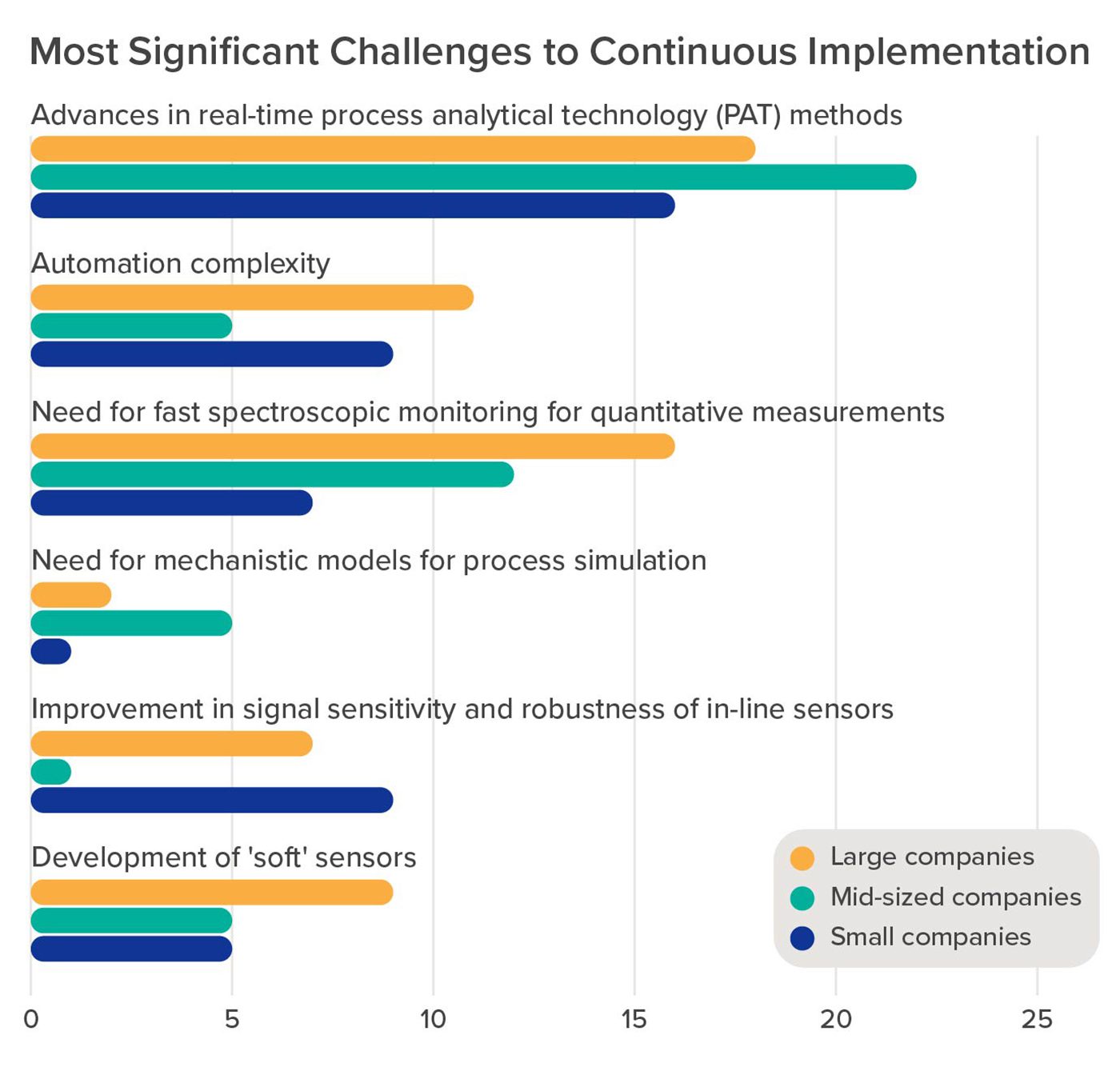
Continuous implementation is a key element of intensified bioprocessing, and a company’s size impacts its key challenges. [CRB Horizons: Life Sciences Report]
Downstream, continuous virus filtration systems can operate at low flux over extended periods while maintaining robust viral clearance. Inline buffer formulation systems further streamline workflows by eliminating the need for large storage tanks and ensuring consistent buffer quality in real time.
Automation and integration are also key components. New ultrafiltration and diafiltration systems are being designed for flexibility, allowing them to be deployed upstream or downstream and enabling seamless process integration.
Designing for intensification
Though technology is a crucial enabler, successful intensification requires more than just new equipment. It demands a holistic approach to process and facility design. “At CRB, our role is to help clients translate emerging process concepts into facilities that are safe, operable, and scalable,” says John Rubero, senior fellow in purification bioprocessing.
One of the defining characteristics of today’s intensification efforts is that they are often partial or hybrid implementations. Fully continuous, end-to-end processes remain relatively rare. Instead, manufacturers are adopting elements of intensification—such as integrating continuous perfusion with multi-column capture chromatography—within otherwise traditional workflows. This incremental approach allows companies to realize benefits without fully overhauling their operations. It also provides a pathway for future evolution as technologies mature.
Despite its advantages, intensified bioprocessing is not without challenges. One of the most significant is bridging the gap between process development and commercial-scale implementation. “While the practice of linking unit operations together is largely accepted, real-time control of an end-to-end continuous process remains challenging,” Rubero explains.
In traditional batch processes, control strategies are relatively straightforward because lot traceability is easy to maintain. But intensified systems—especially continuous ones—require real-time monitoring and advanced control strategies to ensure process stability and product quality.
“It is not realistic or necessary to find and assign a sensor to monitor each critical process parameter or critical quality attribute,” Rubero says. “Instead, a combination of direct measurements, soft sensors, multivariate models, and process understanding is required for effective process control.”
So, the industry is moving toward integrated approaches that combine process analytical technology (PAT) with mechanistic and data-driven models. These systems enable more sophisticated monitoring and control but are still evolving in terms of reliability and adoption.
Operational barriers
Technical challenges are only part of the equation. Intensification also requires a shift in mindset—one that can be difficult for organizations accustomed to established manufacturing paradigms. “In many cases, the technologies are either new or have novel applications, creating a learning curve,” Kozaili acknowledges.
Training gaps, operational changes, and resistance to new approaches can slow adoption. Teams must adjust not only their processes but also their thinking, moving away from long-standing practices toward more dynamic, integrated systems.
As Schofield notes, “adopting new approaches inevitably comes with skepticism.” Externally, there can be hesitation to move away from established technologies. Internally, organizations might question how intensified solutions might impact existing product lines. Those discussions, however, are part of the transition.
Despite these challenges, momentum is building. As intensified technologies demonstrate their value in real-world applications, resistance is gradually diminishing. “Over time, evidence and adoption speak for themselves,” Schofield says.
Kozaili emphasizes the importance of organizational alignment. “We had to change the company’s established mindset by securing support to develop these technologies and clearly show the value of these approaches,” she explains.
Collaboration also plays a key role. For technology providers, working closely with customers to test and refine solutions helps build confidence and accelerate adoption. “For our customers, it’s about finding the right partners to test the technologies, while providing appropriate feedback for improvement,” Kozaili adds.
Looking ahead, the trajectory of intensified bioprocessing is clear. Purpose-built facilities designed specifically for intensified operations will become more common, replacing retrofitted batch plants that struggle to accommodate new workflows, because intensified bioprocessing is no longer a niche concept reserved for early adopters. It is rapidly becoming a central pillar of modern biomanufacturing strategy.
The Clayco Foundation has gifted $10 million to researchers at the Perelman School of Medicine at the University of Pennsylvania to help them to development a potential treatment for the ultra-rare disease retinal vasculopathy with cerebral leukoencephalopathy (RVCL).
“This is a disease that affects so many organs across the body, so a typical targeted gene therapy doesn’t work,” said Jonathan Miner, MD, PhD, an associate professor of Rheumatology at Penn, who leads the work. “We have developed something that labels abnormal proteins—just like you would a package. The body’s cells can then read that label and ship the protein to a specific location in the cell for destruction.”
RVCL is an inherited, autosomal dominant disease caused by mutations in a gene called TREX1 that affects around 200 people across the world. The mutation causes DNA damage and premature death of the endothelial cells that line small blood vessels. Over time, the surrounding tissue receives less blood and oxygen and begins to malfunction or die.
People with the condition usually present in mid‑adulthood with slow vision loss from retinal vasculopathy and then develop stroke‑like episodes, cognitive decline, and psychiatric symptoms linked to white‑matter damage in the brain. There is no current disease-modifying treatment for the condition and people with the condition usually die in mid-late adulthood.
Miner directs the RVCL Research Center at Penn. He and his team are working on several potential therapies for this very rare disease including the one funded by this donation, a small molecule drug candidate that can degrade damaged TREX1 proteins in the body.
“In mice with the human mutation who get this disease, the degrader molecule saves their lives,” explained Miner in a press statement. “It stops organ damage and stabilizes them from further harms.”
The candidate therapy works by linking the faulty protein to an enzyme, an E3 ligase, that marks unwanted proteins so the cell can break them down. The damaged protein is then rapidly cleared by the cell’s disposal machinery, while normal proteins are spared.
The $10 million donation from the Clayco Foundation will help Miner and colleagues move this drug candidate closer to the clinic.
The Clayco Foundation is Chicago‑based and is closely linked to the design‑build firm Clayco, which was founded in the 1980’s by Bob Clark. Clark’s wife Ellen died of RVCL in 2010 and because of this the foundation has a strong focus on funding research that helps people with the condition.
Miner and colleagues are also working on a couple of genetic therapies for RVCL using CRISPR and prime-editing technology. They are also assessing if crizanlizumab, a P‑selectin–blocking monoclonal antibody currently approved to reduce sickle cell crises, could be repurposed to also treat RVCL.
This is the online version of STAT’s weekly email newsletter Health Care Inc. Sign up here.
Hello to all friends, new and old. We are officially launching a series called Out of Pocket, Out of Reach, which explores the different ways the employer-based health insurance system is crumbling. I want to hear from you: how your job-based coverage is affecting you or your business, whether you love it or hate it, and everything in between. Don’t be shy: bob.herman@statnews.com.
U.S. workers and businesses are getting soaked
There’s a very high likelihood that you, dear reader, get your health insurance from your job or the job of a loved one. There’s also a very high likelihood your earnings have suffered over time, quietly behind the scenes. It’s arguably never been worse than now, and it isn’t likely to get better.
According to the World Health Organization (WHO), tuberculosis, caused by the bacterium Mycobacterium tuberculosis (Mtb), is the world’s deadliest single-agent caused infection, responsible for 1.23 million deaths in 2024. The bacterium’s outer cell membrane is difficult hard to penetrate, making few drugs effective in treating the disease.
“Mtb is unique,” said Sloan Siegrist, PhD, associate professor of microbiology at UMass Amherst. “Not only does it have two membranes that protect the cell from antimicrobial chemical compounds that we might use to kill it, its outer membrane is unlike any other biological barrier out there.”
Siegrist’s lab specializes in finding vulnerabilities in the mycomembrane to develop drugs that can effectively treat tuberculosis. However, traditional drug discovery has relied on low throughput experimental screens. In 2023, Siegrist, in collaboration with Marcos Pires, PhD, professor of chemistry at the University of Virginia, published Peptidoglycan Accessibility Click-Mediated AssessmeNt (PAC-MAN), a method that can test many compounds in parallel.
“Marcos and I wanted to harness measurements of known chemicals to predict compound uptake for unknown chemicals, so we brought in computational biologists and chemists, including my colleague Anna Green, PhD, from UMass Amherst’s Manning College of Information and Computer Sciences,” said Siegrist.
Green uses computation to understand patterns in biological compounds. “Small molecules can be particularly difficult to analyze computationally,” she says. “Because they come in all different sizes with a wide range of molecular connections, you can’t describe them with a single measurement, by weight, say, or size.”
Green and colleagues designed a machine learning model, the Mycobacterial Permeability neural Network (MycoPermeNet), trained on the PAC-MAN screening data. The model can predict how readily a compound permeates the mycomembrane from its chemical structure alone and points to the physical properties that help a compound penetrate Mtb’s defenses.
“The mycomembrane lets some molecules through and keeps others out,” says Green. “There must be something about this membrane, and about the chemistry of each molecule, that decides which ones get in—and our combined tools help us figure out which ones can get through, and why.”
Knowing that the protein tissue kallikrein-1 (KLK1) is effective in treating ischemic diseases is one thing. Manufacturing it as a recombinant protein has been quite another. So, when DiaMedica Therapeutics cracked the manufacturing aspect, it was well on its way toward commercializing KLK1 therapeutics.
The manufacturing breakthrough came when researchers realized that protein activity (which is essential for therapeutic benefit) was linked to certain glycosylation patterns. DiaMedica engineered the molecule to reflect those glycosylations and also made two changes to the amino acid sequence to improve manufacturability. “Then we partnered with Catalent,” Rick Pauls, president and CEO, says. “We are using its GPEx® technology with CHO cells,” which produces more cells within the same timeframe and thus lowers manufacturing costs.
Tenacity in action
This happened neither easily nor quickly. To understand the measure of this achievement, we need to look at DiaMedica’s history.
KLK1 came to DiaMedica’s attention because of liver research. “A liver physiologist cut the vagus nerve [which regulates liver metabolism] and discovered that the rats, effectively, became diabetic,” Pauls recounts. “We hypothesized that when a healthy person consumed a meal, the liver releases something that acts as an insulin sensitizer. We did some basic work and identified KLK1 as that insulin sensitizer.”
The company was founded in 2004 to develop a KLK1 therapeutic for complications related to Type II diabetes. Those trials failed. “It’s a long story,” says Pauls, that left the company “pretty close to bankrupt.”
DiaMedica, though, was tenacious. “We knew there was a human urine form of this protein that had been used for a few decades in Asia to treat acute ischemic stroke, and a porcine form treating hypertension for decades as well,” Pauls recalls. DiaMedica had the protein and the manufacturing know-how to produce active, recombinant proteins, and—with KLK1 levels low in stroke patients—a reason to pivot.
Ischemic stroke and preeclampsia
Its lead compound, DM199 (rinvecalinase alfa), is enrolling patients in Phase II/III trials for acute ischemic stroke. Called the ReMEDy2 trial, the company anticipates an interim readout near year’s end. Additionally, Phase I and II studies for preeclampsia and Phase II studies for fetal growth restriction are underway.
“This is protein restoration,” Pauls says. It targets ischemic stroke patients who have missed the three-to-four-hour post-stroke treatment window for tissue plasminogen activator (tPA) therapeutics or mechanical thrombectomy. Those patients constitute approximately 80% of acute ischemic strokes today, so “there is a huge unmet medical need,” Pauls says.
DM199 works by restoring normal levels of the KLK1 protein. KLK1, in turn, is thought to enhance the production of nitric oxide, prostacyclin, and endothelium-derived hyperpolarizing factor. Pouring through their own preclinical and clinical results, the DiaMedica team noticed that DM199 consistently enhanced blood circulation and lowered blood pressure.
That realization drove the team to also target preeclampsia, a hypertensive disease of pregnancy that Pauls says may be the company’s most exciting application for investors.
Unlike approved blood pressure therapeutics, DM199 does not cross the placental barrier, a critical safety feature that protects the fetus. After examining early clinical data, DiaMedica scientists also realized that increasing blood flow to the placenta could target the root cause of the disease and perhaps gain another few weeks of crucial time in utero for the fetus.
“Today, there are no approved treatments. Mothers are given labetalol and nifedipine to control blood pressure and to extend the baby’s time in utero for only a few days.” Results are less than ideal, and the consequences can be severe.
Pauls says, “Some 40% of babies born before 28 weeks could have long-term disabilities, and 10 to 15% will have problems with eyesight for life. There’s been a real lack of drugs in development because developers are worried about harming the baby.”
An investigator-led Phase II clinical trial is enrolling. Later this year, the company plans to initiate its own Phase II study focused on early-onset preeclampsia after recently receiving regulatory clearance to start the study in Canada.
If the molecule eventually is approved for preeclampsia, DM199 seems poised to become, perhaps, the first approved treatment that offers the potential to extend gestational days and possibly address a root cause of preeclampsia.
Leveraging the pivot
Unlike many biopharmaceutical companies, DiaMedica has been able to bypass some of the usual first steps by leveraging existing studies on KLK1, as well as existing clinical data for stroke and preeclampsia.
That allows researchers to focus on humans without the translational issues inherent in animal studies. It also helps the company identify the human subgroups most likely to benefit from these treatments and the most appropriate dosing regimen early. “Having that clinical data helps de-risk our program and gives a better possibility of success,” Pauls says, because, as he points out, “Animals are not the same as people.”
Once the company pivoted to its current indications six or seven years ago, the challenge shifted from getting and manufacturing the active form of the protein to selecting the best indications and assembling the right team members.
“In the early days, maybe we didn’t have the right level of experience with limited capital,” he admits. Today, “we’ve been able to bring people on board who have brought drugs to market.”
Readouts due in 2027
Currently, the company is focused tightly on its clinical trials. The next step for DiaMedica is to get readouts from many of those, with five readouts on various aspects of the programs expected between now and the end of 2027. Each of those readouts will report on about 30 patients and will be factors in the design of a subsequent pivotal trial.
Additionally, an interim analysis of the first 200 patients in its acute ischemic stroke trial is expected by the end of the year, Pauls says. “If we see a drug effect that’s comparable to our Phase II trial or the data with the urine form (of KLK1) from China—which treats close to a million patients per year—we’ll be looking at completing enrollment the following quarter for stroke and then for preeclampsia. DiaMedica is dedicated to offering second chances to acute ischemic stroke patients and others who haven’t had them before, all while pivoting to new opportunities itself. Now, as trials advance, Pauls says, “I think this should be a straightforward path.”
DiaMedica Therapeutics
Location: 301 Carlson Parkway, Suite 210, Minneapolis, MN 55305
Phone: (763) 496-5192
Principal: Rick Pauls, president and CEO
Number of Employees: 35
Focus: DiaMedica is a clinical-stage company developing recombinant KLK1 protein restoration therapeutics for acute ischemic stroke, preeclampsia, fetal growth restriction, and other conditions with large unmet needs.