A cardiologist reviews an echocardiogram flagged by an algorithm she did not choose, trained on data she has never seen, deployed by a health system that did not ask for her input. The algorithm recommends a diagnosis. She disagrees. She overrides it. The patient does well.
No one will remember this moment. But if she had acquiesced and the patient suffered harm, she would be the one in the deposition, with her license on the line. Not the engineer who built the algorithm. Not the vendor who sold it. Not the health system that deployed it.
You get a CGM, you get a CGM, everybody gets a CGM? For the first time in the United States, children 2 and older can also get a continuous glucose monitor without a doctor’s prescription.
Is that a good thing? The Food and Drug Administration thinks so.
Thousands of federal civil servants who academic researchers see as partners in conducting their work were fired. An unprecedented number of scientific projects funded by previous administrations were terminated. Universities were pressured to abandon diversity programs and work to curb health disparities. On a Friday evening, the government tried to push through a dramatic change to how it reimburses universities for research overhead.
All of these actions in the first year of the Trump administration were rapidly challenged in federal court, in many cases resulting in the administration having to walk back policies because they ran afoul of the Administrative Procedures Act, which governs how new policies and regulations are rolled out.
Andrew Twinamatsiko, who is director of the Center for Health Policy and the Law at Georgetown University and runs a health care litigation tracker, describes what happened last year as “tempests that we could weather” until there’s a new administration, when “there can be ways of reverting back to the baseline that we used to have.”
(OTTAWA) July 8, 2026 — New polling shows approximately six million people in Canada used AI-enabled tools for mental health support in the past year and most find them effective. Today, the Mental Health Commission of Canada (the Commission), in partnership with Mental Health Research Canada (MHRC) and Pollara Strategic Insights, releases the first nationally representative data on how people in Canada engage with digitally supported mental health tools, including AI and virtual care, across every province and demographic.
Quick Facts:
1 in 7 people in Canada used AI mental health tools in the past year
Three out of four who used AI and virtual mental health services found them effective for their well-being
Only 14 % trust AI tools, just 2% trust them completely
40 % of AI users said they were more likely to seek professional care
Nearly half (45%) who accessed mental health care did so virtually, in whole or in part
WHY IT MATTERS
People in Canada are turning to AI as a convenient way to access mental health support. AI-enabled tools may offer greater convenience and accessibility. Among those surveyed, AI is being used because it is:
Free or low-cost; 46% of AI users cite this as the reason they use it during a time when financial stress is itself a cause for anxiety.
Always available; 44% of AI users cite 24/7 access.
Immediate and convenient; it can be used from anywhere without travelling or waiting for an appointment. For someone in rural Canada, it saves time and travel costs.
Seemingly private; 39 % of AI service users cite private, anonymous support as a reason for use, while privacy and data protection remain key public concerns.
AI is most used for general well-being (42%), companionship (36%), and mild-to-moderate stress (36%), and 40% of AI users said they were more likely to seek professional care.
WHO IS USING IT AND HOW MUCH DO THEY TRUST IT?
Use is higher among people in Canada under 35 (27%; 29% among men aged 25–34), newcomers to Canada (28%), racialized people in Canada (23%), and 2SLGBTQI+ communities (20%), populations that may experience greater barriers to traditional care.
Overall, trust remains low, particularly for AI-enabled tools, where only 2% of people in Canada trust them completely. People in Canada over 55 show the lowest adoption and trust.
VIRTUAL CARE: EFFECTIVE AND MORE TRUSTED BUT FALLS SHORT OF IN-PERSON SERVICES
45% of people in Canada who used mental health services in the past year did so virtually, with 75% reporting positive outcomes. However, nearly 1 in 3 prefer a hybrid model that combines virtual and in-person services. The data signals what people in Canada need: well-designed tools for safer digital mental health care that they can trust.
THE COMMISSION OFFERS GUIDANCE FOR THE DIGITAL MENTAL HEALTH ERA
The Commission is Canada’s trusted resource for safe digital mental health — assessing apps and tools, setting evidence-based standards, and leading the national conversation on guidance for AI in mental health and substance use health care.
As virtual services and AI-enabled tools continue to expand rapidly across the mental health landscape, there is a growing need for evidence-based insight into how people in Canada engage with, understand, and perceive them. The Commission partnered with MHRC to leverage their ongoing national polling initiative and provide timely insights into usage, attitudes, and concerns related to e-mental health and AI.
The polling is clear: people in Canada want to close the gap between availability and trust. The Commission is working with the Canadian Centre on Substance Use and Addiction and collaborators, provincial governments, technology developers, and health system partners to establish guidance for AI.
“Six million people in Canada have already used AI for mental health support and most found it convenient and effective for their well-being. It is critical that AI is safe and equitable to increase public trust and reduce harms.” – Lili-Anna Pereša, President and Chief Executive Officer, Mental Health Commission of Canada
“The people turning to digitally-supported mental health tools are often those facing some of the greatest barriers to care. Making sure these tools are safe, effective, evidence-based and human-centred is a matter of equity. Ongoing research is essential to understanding where they help and where safeguards are needed.”– Akela Peoples, Chief Executive Officer, Mental Health Research Canada
About Mental Health Commission of Canada As an independent, not-for-profit with charitable status, the Commission collaborates with leading experts and organizations nationally and internationally, including with people with lived and living experience, to develop national guidelines, standards and strategies, promote innovation and best practices, reduce stigma, increase mental health literacy, and support all levels of government to improve mental health outcomes for everyone living in Canada. The Commission is Canada’s trusted resource for digital mental health best practices with the e-Mental Health Strategy for Canada, app assessment, e-modules for e-mental health implementation, and AI guidance for mental health and substance use health.
About Mental Health Research Canada As an independent national charity, MHRC works hard to enable a future where mental health in Canada is transformed using evidence, data and stakeholder engagement. We unite researchers, communities, and people with lived experience to bridge gaps in care through national population polling, rapid data reporting, and partnerships that inform policy to improve outcomes. Learn more at www.mhrc.ca
About the Polling Conducted by Pollara Strategic Insights in partnership with Mental Health Research Canada and the Mental Health Commission of Canada, this national poll (n=3,519) is the first representative data on AI use for mental health in Canada. Full findings: https://mentalhealthcommission.ca/AI-polling-report
About the Funding The views in this report solely represent the views of the Mental Health Commission of Canada. Production of this report is made possible through financial contribution from Health Canada.
After Doug met Jane, he felt good. So too did Gabriella, his wife. Doug — a retired minister and writer — needed someone to talk to, and in conversation about his many accomplishments, Jane was indefatigable. For at least a few hours, Doug’s boredom vanished, and Gabriella no longer felt like an activities director on a cruise ship.
I wrote about Doug and Gabriella in my May Neurotransmissions column about ambiguous loss. Doug told me he was “bored, bored, bored,” and Gabriella said she struggled to find activities to relieve that boredom.
Jane was a solution. What she gave to Doug didn’t simply pass the time. It was a meaningful relationship. Except Jane wasn’t a person. She was an artificial intelligence chatbot.
A drug candidate developed at King’s College London boosts DNA repair and reduces neuronal damage, as well as lowering neuroinflammation and could become a new treatment option for people with early stage Alzheimer’s disease in the future.
Writing in the journal FEBS Open Bio, lead author Jonathan Corcoran, PhD, a professor at King’s College London, and colleagues report results of a study carried out in a mouse model of Alzheimer’s disease that tested KCL-286, a retinoic acid receptor-beta agonist, and showed it had beneficial effects in the animals.
As Alzheimer’s disease develops, amyloid-beta accumulates and suppresses the brain’s natural retinoic acid signaling. This, as well as other factors, leaves neurons increasingly unable to repair DNA damage. The unrepaired damage then triggers microglial and astrocyte overactivation, which contributes to further neuronal injury in a self-reinforcing loop.
Mice treated with KCL-286 had significantly fewer DNA double-strand breaks in neurons than untreated mice, something seen in Alzheimer’s patients. They also had increased neuronal expression of BRCA1 protein, a DNA repair and tumor suppressor protein, suggesting KCL-286 partly works by ramping up the brain’s own repair machinery. In certain cancers, a BRCA1 mutation results in reduced or absent functional protein, which increases cancer risk over time.
KCL-286 also seemed to reduce inflammation in the brain of treated mice. Microglia and astrocytes were both abnormally enlarged and activated in the animals before treatment. However, after treatment the size and shape of these cells went back towards normal, in other words, calming dangerous inflammation without getting rid of the cells.
“We think of the drug as repairing potholes in a road—once the damage is fixed, normal traffic can flow again and the system settles down. By repairing the underlying damage, we can allow the system to reset,” said Corcoran in a press statement.
This is an early stage study and still needs to be tested in humans, but KCL-286 has already completed a Phase I trial in healthy human volunteers with no drug-related adverse events and is known to cross the blood-brain barrier efficiently. This is because the drug candidate is also being tested for treatment of spinal cord injury, hence the earlier Phase I study.
Both acute spinal cord injury and chronic neurodegeneration in Alzheimer’s involve accumulation of DNA double-strand breaks in neurons. In the former this is caused by the mechanical trauma and subsequent inflammation, whereas in the latter it builds up gradually over years.
The lack of side effects seen in the Phase I study is also important for KCL-286’s development as a possible Alzheimer’s treatment, as two earlier, non-selective retinoid drugs tested for treatment of Alzheimer’s caused side effects because they hit multiple off target receptor subtypes. KCL-286’s selectivity for the retinoic acid receptor-beta is designed to avoid this.
“Together with its favorable human safety profile, the data support further investigation of selective retinoic acid receptor-beta agonism as a therapeutic strategy for modifying pathogenic processes associated with Alzheimer’s disease,” conclude the authors.
The researchers think that if KCL-286 reaches the clinic early treatment is likely to be key to success. They also note there is potential for this type of therapy to be used in combination with approved Alzheimer’s treatments like lecanemab, which act to reduce harmful amyloid beta in the brain.
Novartis has agreed to acquire Myricx Bio, a London-based developer of next-generation antibody-drug conjugates (ADCs), for up to $1.5 billion in a deal designed to bolster the buyer’s oncology pipeline with a next-generation ADC payload platform designed to fight cancer.
Privately-held Myricx specializes in developing ADCs that use N-myristoyltransferase inhibitor (NMTi) payloads, an approach designed to deliver a differentiated cancer-killing payload directly to tumor cells. Myricx says its ADC approach holds the potential to address limitations of TOPO-1 inhibitors, tubulin inhibitors, and other commonly used ADC payload classes—ranging from toxicity to healthy cells, to tumor resistance, to dose-limiting adverse events.
The acquisition deal is designed to combine Myricx’s two lead ADC assets and next-generation first-in-class NMTi payload platform with Novartis’ expertise in developing cancer therapies.
According to Myricx Bio, preclinical data suggests that its NMTi payload may have broad activity across multiple solid tumors, including TOPO-1-resistant models, and may enable more effective use of ADCs in settings where existing payload classes have limitations. NMT is an enzyme responsible for the addition of myristic acid, a 14-carbon fatty acid, to the N-terminus of multiple proteins that are crucial for cancer cell survival.
“ADCs have become an important part of cancer treatment, but there remains a clear need for new payload mechanisms to overcome resistance and expand their impact for patients,” Fiona Marshall, PhD, Novartis’ president of biomedical research, said in a statement. “Myricx Bio has developed a promising NMTi payload platform with a differentiated mechanism that could broaden the use of ADCs across multiple tumor settings.”
Marshall added that the Myricx Bio acquisition “reflects our strategy to scale innovative platforms, as we have with radioligand therapies, to deliver more durable, transformative treatments for patients.” In February, Novartis announced plans to build a 46,000-square-foot radioligand therapy (RLT) manufacturing site in the Dallas-Fort Worth suburb of Denton, TX.
Novartis investors reacted by sending its shares traded on the SIX Swiss exchange down 2% Monday, from CHF 127.92 ($157.69) to CHF 125.10 ($154.22). Novartis’ American Depositary Shares (ADSs) traded on the New York Stock Exchange dipped 3%, from $159.90 to $155.08 as of 10:13 a.m. ET
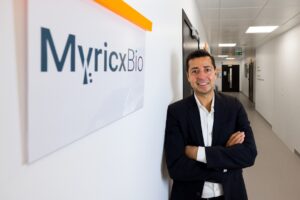
Mohit Rawat, Myricx Bio’s CEO
Until now, Myricx has said little about its two lead NMTi-ADC candidates, except to disclose on its website that it is prioritizing one that targets B7-H3 and the other, HER2, “based on compelling preclinical efficacy and safety data across multiple solid tumor-associated antigens and cancer cell types.”
Novartis agreed to shell out $1.1 billion cash upfront plus up to $400 million tied to achieving milestones. The transaction is expected to close in the second half of this year, subject to satisfaction or waiver of customary closing conditions, including regulatory approvals.
“Transformative promise”
“We are delighted that Novartis recognizes the transformative promise of our NMTi-ADC platform to deliver this next-generation of potential first-in-class, highly differentiated ADC therapeutics,” stated Mohit Rawat, Myricx Bio’s CEO.“Together with Novartis, we look forward to building upon our work to transform the landscape of cancer treatment.”
Rawat joined Myricx last year with the goal of steering the company through preclinical development and its next stage of growth.
Founded in 2019, Myricx Bio was spun out from Imperial College London and the Francis Crick Institute by Ed Tate, PhD; Roberto Solari, PhD; and Andrew Bell, PhD, with support from Cancer Research UK, as well as seed investment from Brandon Capital and Sofinnova Partners.
Myricx’s co-founders and their collaborative teams discovered that NMT played a vital role in maintaining multiple critical, diverse cellular processes in cancer cells, including vesicle trafficking, growth factor signaling, cancer cell survival, mitochondrial biogenesis, and cancer cell metabolism.
Under CTO Robin Carr, PhD, Myricx Bio raised £90 million ($114 million) in a Series A financing in mid-2024 led by Novo Holdings and Abingworth, joined by British Business Bank, Cancer Research Horizons, Eli Lilly, and existing investors. This enabled the company to scale its operations and expand the team to rapidly advance its pipeline.
The planned acquisition of Myrocx Bio is Novartis’ third major deal this year focused on boosting its cancer pipeline.
On June 24, Antares Therapeutics announced it would receive $105 million upfront from Novartis through a strategic collaboration to discover, develop, and commercialize small molecule therapies against promising but historically undruggable oncology targets. Novartis also committed to paying Antares upto $1.8 billion tied to achieving additional option exercise, development, regulatory, and commercial milestones, as well as tiered royalties on global net sales.
And in March, Novartis committed up to $2 billion upfront toward acquiring Pikavation Therapeutics, a subsidiary of Synnovation Therapeutics that specializes in developing PI3Kα inhibitor programs designed to treat forms of cancer. Novartis also agreed to pay up to $1 billion in payments tied to achieving development, regulatory, and commercial milestones.